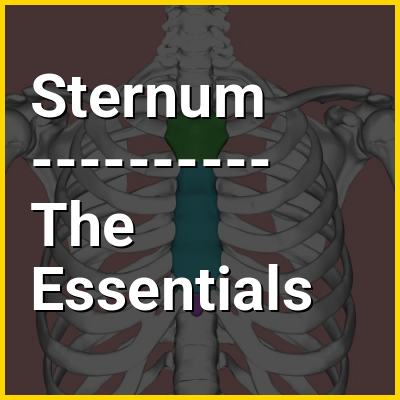
The sternum (pl.: sternums or sterna) or breastbone is a long flat bone located in the central part of the chest. It connects to the ribs via cartilage and forms the front of the rib cage, thus helping to protect the heart, lungs, and major blood vessels from injury. Shaped roughly like a necktie, it is one of the largest and longest flat bones of the body. Its three regions are the manubrium, the body, and the xiphoid process. The word sternum originates from Ancient Greek στέρνον (stérnon) 'chest'.
HINT:
In this Dossier
- ⭐ Core Definition: Sternum
- Sternum in the context of Ratite
- Sternum in the context of Clavicle
- Sternum in the context of Coracoid
- Sternum in the context of Axial skeleton
- Sternum in the context of Thoracic cage
- Sternum in the context of Bone marrow
- Sternum in the context of Thoracic cavity
- Sternum in the context of Rhea (bird)
- Sternum in the context of Cassowary
- Sternum in the context of Keel (bird anatomy)
- Sternum in the context of Thymus
Sternum in the context of Ratite
Ratites (/ˈrætaɪts/) are a polyphyletic group consisting of all birds within the infraclass Palaeognathae that lack keels and cannot fly. They are mostly large, long-necked, and long-legged, the exception being the kiwi, which is also the only nocturnal extant ratite.
The understanding of relationships within the paleognath clade has been in flux. Previously, all the flightless members had been assigned to the order Struthioniformes, which is more recently regarded as containing only the ostrich. The modern bird infraclass Palaeognathae consists of ratites and the flighted Neotropic tinamous (compare to Neognathae). Unlike other flightless birds, the ratites have no keel on their sternum—hence the name, from the Latin ratis ('raft', a vessel which has no keel—in contradistinction to extant flighted birds with a keel). Without this to anchor their wing muscles, they could not have flown even if they had developed suitable wings. Ratites are a polyphyletic group; tinamous fall within them, and are the sister group of the extinct moa. This implies that flightlessness is a trait that evolved independently multiple times in different ratite lineages.
View the full Wikipedia page for RatiteSternum in the context of Clavicle
The clavicle, collarbone, or keybone is a slender, S-shaped long bone approximately 6 inches (15 cm) long that serves as a strut between the shoulder blade and the sternum (breastbone). There are two clavicles, one on each side of the body. The clavicle is the only long bone in the body that lies horizontally. Together with the shoulder blade, it makes up the shoulder girdle. It is a palpable bone and, in people who have less fat in this region, the location of the bone is clearly visible. It receives its name from Latin clavicula 'little key' because the bone rotates along its axis like a key when the shoulder is abducted. The clavicle is the most commonly fractured bone. It can easily be fractured by impacts to the shoulder from the force of falling on outstretched arms or by a direct hit.
View the full Wikipedia page for ClavicleSternum in the context of Coracoid
A coracoid is a paired bone which is part of the shoulder assembly in all vertebrates except therian mammals (marsupials and placentals). In therian mammals (including humans), a coracoid process is present as part of the scapula, but this is not homologous with the coracoid bone of most other vertebrates.
In other tetrapods, it joins the scapula to the front end of the sternum and has a notch on the dorsal surface which, along with a similar notch on the ventral surface of the scapula, forms the socket in which the proximal end of the humerus (upper arm bone) is located. The acrocoracoid process is an expansion adjacent to this contact surface, to which the shoulderward end of the biceps brachii muscle attaches in these animals. In birds (and generally theropods and related animals), the entire unit is rigid and called scapulocoracoid. This plays a major role in bird flight. In other dinosaurs, the main bones of the pectoral girdle were the scapula (shoulder blade) and the coracoid, both of which directly articulated with the clavicle.
View the full Wikipedia page for CoracoidSternum in the context of Axial skeleton
The axial skeleton is the core part of the endoskeleton made of the bones of the head and trunk of vertebrates. In the human skeleton, it consists of 80 bones and is composed of the skull (28 bones, including the cranium, mandible and the middle ear ossicles), the vertebral column (26 bones, including vertebrae, sacrum and coccyx), the rib cage (25 bones, including ribs and sternum), and the hyoid bone. The axial skeleton is joined to the appendicular skeleton (which support the limbs) via the shoulder girdles and the pelvis.
View the full Wikipedia page for Axial skeletonSternum in the context of Thoracic cage
The rib cage or thoracic cage is an endoskeletal enclosure in the thorax of most vertebrates that comprises the ribs, vertebral column and sternum, which protect the vital organs of the thoracic cavity, such as the heart, lungs and great vessels and support the shoulder girdle to form the core part of the axial skeleton.
A typical human thoracic cage consists of 12 pairs of ribs and the adjoining costal cartilages, the sternum (along with the manubrium and xiphoid process), and the 12 thoracic vertebrae articulating with the ribs. The thoracic cage also provides attachments for extrinsic skeletal muscles of the neck, upper limbs, upper abdomen and back, and together with the overlying skin and associated fascia and muscles, makes up the thoracic wall.
View the full Wikipedia page for Thoracic cageSternum in the context of Bone marrow
Bone marrow is a semi-solid tissue found within the spongy (also known as cancellous) portions of bones. In birds and mammals, bone marrow is the primary site of new blood cell production (or haematopoiesis). It is composed of hematopoietic cells, marrow adipose tissue, and supportive stromal cells. In adult humans, bone marrow is primarily located in the ribs, vertebrae, sternum, and bones of the pelvis. Bone marrow comprises approximately 5% of total body mass in healthy adult humans, such that a person weighing 73 kg (161 lbs) will have around 3.7 kg (8 lbs) of bone marrow.
Human marrow produces approximately 500 billion blood cells per day, which join the systemic circulation via permeable vasculature sinusoids within the medullary cavity. All types of hematopoietic cells, including both myeloid and lymphoid lineages, are created in bone marrow; however, lymphoid cells must migrate to other lymphoid organs (e.g. thymus) in order to complete maturation.
View the full Wikipedia page for Bone marrowSternum in the context of Thoracic cavity
The thoracic cavity (or chest cavity) is the chamber of the body of vertebrates that is protected by the thoracic wall (rib cage and associated skin, muscle, and fascia). The central compartment of the thoracic cavity is the mediastinum. There are two openings of the thoracic cavity, a superior thoracic aperture known as the thoracic inlet and a lower inferior thoracic aperture known as the thoracic outlet.
The thoracic cavity includes the tendons as well as the cardiovascular system which could be damaged from injury to the back, spine or the neck.
View the full Wikipedia page for Thoracic cavitySternum in the context of Rhea (bird)
The rhea (/ˈriːə/ REE-ə), also known as the ñandú (/njænˈduː/ nyan-DOO) or South American ostrich, is a South American ratite (flightless bird without a keel on the sternum bone) of the order Rheiformes. Rheas are distantly related to the two African ostriches and Australia's emu (the largest, second-largest and third-largest living ratites, respectively), with rheas placing just behind the emu in height and overall size.
Most taxonomic authorities recognize two extant species: the greater or American rhea (Rhea americana), and the lesser or Darwin's rhea (Rhea pennata). The International Union for Conservation of Nature (IUCN) classifies the puna rhea as another species instead of a subspecies of the lesser rhea. The IUCN currently rates the greater and puna rheas as near-threatened in their native ranges, while Darwin's rhea is of least concern, having recovered from past threats to its survival. In addition, the feral population of the greater rhea in Germany appears to be growing. However, control efforts are underway and seem to succeed in controlling the birds' population growth. Similarly to ostriches and emus, rheas are fairly popular livestock and pets, regularly kept and bred on farms, ranches, private parks, and by aviculturists, mainly in North and South America and Europe.
View the full Wikipedia page for Rhea (bird)Sternum in the context of Cassowary
Cassowaries (Indonesian: kasuari; Biak: man suar 'bird strong'; Tok Pisin: muruk; Papuan: kasu weri 'horned head') are flightless birds of the genus Casuarius, in the order Casuariiformes. They are classified as ratites, flightless birds without a keel on their sternum bones. Cassowaries are native to the tropical forests of New Guinea (Western New Guinea and Papua New Guinea), the Moluccas (Seram and Aru Islands), and northeastern Australia.
Three cassowary species are extant. The most common, the southern cassowary, is the third-tallest and second-heaviest living bird, smaller only than the ostrich and emu. The other two species are the northern cassowary and the dwarf cassowary; the northern cassowary is the most recently discovered and the most threatened. A fourth, extinct, species is the pygmy cassowary.
View the full Wikipedia page for CassowarySternum in the context of Keel (bird anatomy)
In bird anatomy, the keel or carina (pl.: carinae) is an extension of the sternum (breastbone) which runs axially along the midline of the sternum and extends outward, perpendicular to the plane of the ribs. The keel provides an anchor to which a bird's wing muscles attach, thereby providing adequate leverage for flight. Not all birds have keels; in particular, some flightless birds lack a keel structure. Some flightless birds have a keel, such as the penguin; but in the penguin's case, its wings are too small for its body, so flight would require flapping its wings too fast to be practical.
Historically, the presence or absence of a pronounced keel structure was used as a broad classification of birds into two orders: Carinatae (from carina, "keel"), having a pronounced keel; and ratites (from ratis, "raft" – referring to the flatness of the sternum), having a subtle keel structure or lacking one entirely. However, this classification has become disused as evolutionary studies have shown that many flightless birds have evolved from flighted birds.
View the full Wikipedia page for Keel (bird anatomy)Sternum in the context of Thymus
The thymus (pl.: thymuses or thymi) is a specialized primary lymphoid organ of the immune system. Within the thymus, T cells mature. T cells are critical to the adaptive immune system, where the body adapts to specific foreign invaders. The thymus is located in the upper front part of the chest, in the anterior superior mediastinum, behind the sternum, and in front of the heart. It is made up of two lobes, each consisting of a central medulla and an outer cortex, surrounded by a capsule.
The thymus is made up of immature T cells called thymocytes, as well as lining cells called epithelial cells which help the thymocytes develop. T cells that successfully develop react appropriately with MHC immune receptors of the body (called positive selection) and not against proteins of the body (called negative selection). The thymus is the largest and most active during the neonatal and pre-adolescent periods. By the early teens, the thymus begins to decrease in size and activity and the tissue of the thymus is gradually replaced by fatty tissue. Nevertheless, some T cell development continues throughout adult life.
View the full Wikipedia page for Thymus