Staten Island Tunnel in the context of "Brooklyn–Manhattan Transit Corporation"

Play Trivia Questions online!

or

Skip to study material about Staten Island Tunnel in the context of "Brooklyn–Manhattan Transit Corporation"


⭐ Core Definition: Staten Island Tunnel

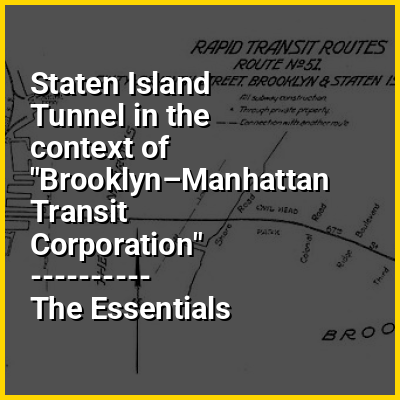
The Staten Island Tunnel is an abandoned, incomplete railway and subway tunnel in Staten Island, New York City. It was intended to connect railways on Staten Island (precursors to the modern-day Staten Island Railway) to the BMT Fourth Avenue Line of the New York City Subway, in Brooklyn, via a new crossing under the Narrows. Planned to extend 10,400 feet (3,200 m), the tunnel would have been among the world's longest at the time of its planning, in the late 19th and early 20th centuries.

Construction began in 1923, and the tunnel was excavated 150 feet (46 m) into the Narrows before New York City Mayor John Hylan, a former Brooklyn–Manhattan Transit Corporation (BMT) employee and initial proponent of the tunnel, canceled the project in 1925. The tunnel lies dormant under Owl's Head Park in Bay Ridge, Brooklyn. Later proposals to complete the tunnel, including the 1939 plans for the Independent Subway System's ambitious Second System, were never funded.
↓ Menu

In this Dossier

Staten Island Tunnel in the context of Verrazzano-Narrows Bridge

The Verrazzano-Narrows Bridge (/ˌvɛrəˈzɑːn/ VERR-ə-ZAH-noh; also referred to as the Narrows Bridge, the Verrazzano Bridge, and simply the Verrazzano) is a suspension bridge connecting the boroughs of Staten Island and Brooklyn in New York City, United States. It spans the Narrows, a body of water linking the relatively enclosed New York Harbor with Lower New York Bay and the Atlantic Ocean. It is the only fixed crossing of the Narrows. The double-deck bridge carries 13 lanes of Interstate 278: seven on the upper level and six on the lower level. The span is named for Giovanni da Verrazzano, who in 1524 was the first European explorer to enter New York Harbor and the Hudson River.

Engineer David B. Steinman proposed a bridge across the Narrows in the late 1920s, but plans were deferred over the next twenty years. A 1920s attempt to build a Staten Island Tunnel was aborted, as was a 1930s plan for vehicular tubes underneath the Narrows. Discussion of a tunnel resurfaced in the mid-1930s and early 1940s, but the plans were again denied. In the late 1940s, urban planner Robert Moses championed a bridge across the Narrows as a way to connect Staten Island with the rest of the city. Various problems delayed the start of construction until 1959. Designed by Othmar Ammann, Leopold Just, and other engineers at Ammann & Whitney, the bridge opened on November 21, 1964. The lower deck opened in 1969 to accommodate increasing traffic loads. The bridge was refurbished in the 1990s and again in the 2010s and 2020s.

↑ Return to Menu