Staten Island Railway in the context of "Staten Island Tunnel"

Play Trivia Questions online!

or

Skip to study material about Staten Island Railway in the context of "Staten Island Tunnel"

Ad spacer

⭐ Core Definition: Staten Island Railway

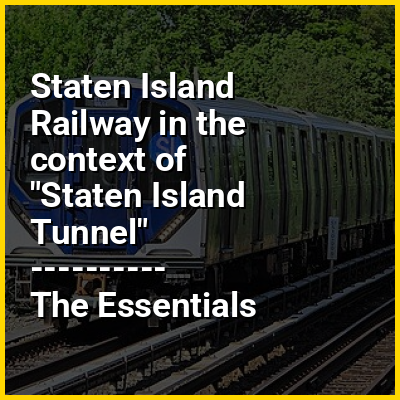
The Staten Island Railway (SIR) is a rapid transit line in the New York City borough of Staten Island. It is owned by the Staten Island Rapid Transit Operating Authority (SIRTOA), a subsidiary of the Metropolitan Transportation Authority, and operated by the New York City Transit Authority Department of Subways. SIR's only line operates 24 hours a day, seven days a week, providing local service between St. George and Tottenville, along the east side of Staten Island. There is no direct rail link between the SIR and the New York City Subway system, but SIR riders do receive a free transfer to New York City Transit bus and subway lines and the line is included on official New York City Subway maps. Commuters on the railway typically use the Staten Island Ferry to reach Manhattan. The line is accessible from within the Ferry Terminal, and most of its trains are timed to connect with the ferry. In 2024, the system had a ridership of 4,743,000, or about 18,100 per weekday as of the third quarter of 2025.

The railroad was incorporated in 1851 and was completed to Tottenville on June 2, 1860, as the Staten Island Rail Road. It was reorganized into the Staten Island Railway Company in 1873. During the late 19th and early 20th centuries, it was operated successively by the Baltimore and Ohio Railroad and then the Pennsylvania Railroad. Under these companies' control, the SIR formerly operated two other branches for passenger trains: the North Shore Branch from 1886 to 1953 and the South Beach Branch from 1888 to 1953. Operation of the Tottenville line was turned over to SIRTOA in 1971, and the line was purchased by the city of New York. The MTA rebranded the Staten Island Rapid Transit as the MTA Staten Island Railway in 1994.
↓ Menu

>>>PUT SHARE BUTTONS HERE<<<

👉 Staten Island Railway in the context of Staten Island Tunnel

The Staten Island Tunnel is an abandoned, incomplete railway and subway tunnel in Staten Island, New York City. It was intended to connect railways on Staten Island (precursors to the modern-day Staten Island Railway) to the BMT Fourth Avenue Line of the New York City Subway, in Brooklyn, via a new crossing under the Narrows. Planned to extend 10,400 feet (3,200 m), the tunnel would have been among the world's longest at the time of its planning, in the late 19th and early 20th centuries.

Construction began in 1923, and the tunnel was excavated 150 feet (46 m) into the Narrows before New York City Mayor John Hylan, a former Brooklyn–Manhattan Transit Corporation (BMT) employee and initial proponent of the tunnel, canceled the project in 1925. The tunnel lies dormant under Owl's Head Park in Bay Ridge, Brooklyn. Later proposals to complete the tunnel, including the 1939 plans for the Independent Subway System's ambitious Second System, were never funded.

↓ Explore More Topics
In this Dossier

Staten Island Railway in the context of New York City Subway stations

The New York City Subway is a rapid transit system that serves four of the five boroughs of New York City, New York: the Bronx, Brooklyn, Manhattan, and Queens. Its operator is the New York City Transit Authority, which is itself controlled by the Metropolitan Transportation Authority of New York. In 2015, an average of 5.65 million passengers used the system daily, making it the busiest rapid transit system in the United States and the 11th busiest in the world.

The present New York City Subway system is composed of three formerly separate systems that merged in 1940: the Interborough Rapid Transit Company (IRT), the Brooklyn–Manhattan Transit Corporation (BMT), and the Independent Subway System (IND). The privately held IRT, founded in 1902, constructed and operated the first underground railway line in New York City. The opening of the first line on October 27, 1904, is commonly cited as the opening of the modern New York City Subway, although some elevated lines of the IRT and BMT that were initially incorporated into the New York City Subway system but then demolished predate this. The oldest sections of elevated lines still in operation were built in 1885. The BMT, founded in 1923 and also privately held, was formed from the bankruptcy of the Brooklyn Rapid Transit Company. The IND was created by the City of New York in 1921 to be a municipally owned competitor of the two private companies. Unification in June 1940 by the New York City Board of Transportation brought the three systems under one operator. The New York City Transit Authority, created in 1953 to be a public benefit corporation that acquired the rapid transit and surface line (buses and streetcars) infrastructure of the Board of Transportation, remains the operator of the New York City Subway today.

↑ Return to Menu

Staten Island Railway in the context of Wolfe's Pond Park

Wolfe's Pond Park is a large public park located on Staten Island's South Shore. It is bounded on the south by Holton Avenue, on the east by Raritan Bay, on the west by the Staten Island Railway, and on the north by Chisholm Street, Luten Avenue, and Cornelia Avenue, which is also the main entry into the park's public areas. Hylan Boulevard bisects the park, and most visitors only visit the eastern half of the park, where Wolfes Pond (for which the park is named), two playgrounds, and basketball and tennis courts are located, as well as numerous walking and biking paths, open fields, and a small beach on Raritan Bay. The western, inland half consists mostly of ponds and woodlands, and the northwestern corner hugs Tottenville High School.

In 1991 and again in 2011 the dam between the beach and the pond broke, draining the pond of freshwater and flooding it with saltwater. In both cases, this killed the freshwater fish and many of the red-eared slider turtles. Repairs to the dam were completed in November, 2019.

↑ Return to Menu

Staten Island Railway in the context of Tottenville High School

Tottenville High School is located at 100 Luten Avenue, in Huguenot, Staten Island, New York. Tottenville H.S. is in Administrative District 31, and is operated by the New York City Department of Education. The school's principal is Gina Battista, who assumed the role in 2020.

Tottenville H.S. is within walking distance of the Huguenot station of the Staten Island Railway system.

↑ Return to Menu

Staten Island Railway in the context of Staten Island Ferry

The Staten Island Ferry is a fare-free passenger ferry route operated by the New York City Department of Transportation. The ferry's single route runs 5.2 miles (8.4 km) through New York Harbor between the New York City boroughs of Manhattan and Staten Island, with ferry boats completing the trip in about 25 minutes. The ferry operates 24 hours a day and 7 days a week, with boats leaving every 15 to 20 minutes during peak hours and every 30 minutes at other times. Apart from NYC Ferry's St. George route, it is the only direct mass-transit connection between the two boroughs. Historically, the Staten Island Ferry has charged a relatively low fare compared to other modes of transit in the area; and since 1997, the route has been fare-free. The Staten Island Ferry is one of several ferry systems in the New York City area and is operated separately from systems like NYC Ferry and NY Waterway.

The Staten Island Ferry route terminates at Whitehall Terminal, on Whitehall Street in Lower Manhattan, and at St. George Terminal, in St. George, Staten Island. At Whitehall, connections are available to the New York City Subway and several local New York City Bus routes. At St. George, there are transfers to the Staten Island Railway and to the St. George Bus Terminal's many bus routes. Using MetroCard fare cards, passengers from Manhattan can exit a subway or bus on Whitehall Street, take the ferry for free, and have a free second transfer to a train or bus at St. George. Conversely, passengers from Staten Island can freely transfer to a subway or bus in Manhattan after riding the ferry.

↑ Return to Menu