Stability theory in the context of Eigenvalue


Stability theory in the context of Eigenvalue

Stability theory Study page number 1 of 1

Play TriviaQuestions Online!

or

Skip to study material about Stability theory in the context of "Eigenvalue"


⭐ Core Definition: Stability theory

In mathematics, stability theory addresses the stability of solutions of differential equations and of trajectories of dynamical systems under small perturbations of initial conditions. The heat equation, for example, is a stable partial differential equation because small perturbations of initial data lead to small variations in temperature at a later time as a result of the maximum principle. In partial differential equations one may measure the distances between functions using L norms or the sup norm, while in differential geometry one may measure the distance between spaces using the Gromov–Hausdorff distance.

In dynamical systems, an orbit is called Lyapunov stable if the forward orbit of any point is in a small enough neighborhood or it stays in a small (but perhaps, larger) neighborhood. Various criteria have been developed to prove stability or instability of an orbit. Under favorable circumstances, the question may be reduced to a well-studied problem involving eigenvalues of matrices. A more general method involves Lyapunov functions. In practice, any one of a number of different stability criteria are applied.

↓ Menu
HINT:

In this Dossier

Stability theory in the context of Multidimensional system

In mathematical systems theory, a multidimensional system or m-D system is a system in which not only one independent variable exists (like time), but there are several independent variables.

Important problems such as factorization and stability of m-D systems (m > 1) have recently attracted the interest of many researchers and practitioners. The reason is that the factorization and stability is not a straightforward extension of the factorization and stability of 1-D systems because, for example, the fundamental theorem of algebra does not exist in the ring of m-D (m > 1) polynomials.

View the full Wikipedia page for Multidimensional system
↑ Return to Menu

Stability theory in the context of Mandelbrot set

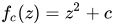
The Mandelbrot set (/ˈmændəlbrt, -brɒt/) is a two-dimensional set that is defined in the complex plane as the complex numbers for which the function does not diverge to infinity when iterated starting at , i.e., for which the sequence , , etc., remains bounded in absolute value.

This set was first defined and drawn by Robert W. Brooks and Peter Matelski in 1978, as part of a study of Kleinian groups. Afterwards, in 1980, Benoit Mandelbrot obtained high-quality visualizations of the set while working at IBM's Thomas J. Watson Research Center in Yorktown Heights, New York.

View the full Wikipedia page for Mandelbrot set
↑ Return to Menu

Stability theory in the context of Control theory

Control theory is a field of control engineering and applied mathematics that deals with the control of dynamical systems. The aim is to develop a model or algorithm governing the application of system inputs to drive the system to a desired state, while minimizing any delay, overshoot, or steady-state error and ensuring a level of control stability; often with the aim to achieve a degree of optimality.

To do this, a controller with the requisite corrective behavior is required. This controller monitors the controlled process variable (PV), and compares it with the reference or set point (SP). The difference between actual and desired value of the process variable, called the error signal, or SP-PV error, is applied as feedback to generate a control action to bring the controlled process variable to the same value as the set point. Other aspects which are also studied are controllability and observability. Control theory is used in control system engineering to design automation that have revolutionized manufacturing, aircraft, communications and other industries, and created new fields such as robotics.

View the full Wikipedia page for Control theory
↑ Return to Menu

Stability theory in the context of Equilibrium point

In mathematics, specifically in differential equations, an equilibrium point is a constant solution to a differential equation.

View the full Wikipedia page for Equilibrium point
↑ Return to Menu

Stability theory in the context of Unstable

In dynamical systems instability means that some of the outputs or internal states increase with time, without bounds. Not all systems that are not stable are unstable; systems can also be marginally stable or exhibit limit cycle behavior.

In structural engineering, a structural beam or column can become unstable when excessive compressive load is applied. Beyond a certain threshold, structural deflections magnify stresses, which in turn increases deflections. This can take the form of buckling or crippling. The general field of study is called structural stability.

View the full Wikipedia page for Unstable
↑ Return to Menu

Stability theory in the context of Bistability

In a dynamical system, bistability means the system has two stable equilibrium states. A bistable structure can be resting in either of two states. An example of a mechanical device which is bistable is a light switch. The switch lever is designed to rest in the "on" or "off" position, but not between the two. Bistable behavior can occur in mechanical linkages, electronic circuits, nonlinear optical systems, chemical reactions, and physiological and biological systems.

In a conservative force field, bistability stems from the fact that the potential energy has two local minima, which are the stable equilibrium points. These rest states need not have equal potential energy. By mathematical arguments, a local maximum, an unstable equilibrium point, must lie between the two minima. At rest, a particle will be in one of the minimum equilibrium positions, because that corresponds to the state of lowest energy. The maximum can be visualized as a barrier between them.

View the full Wikipedia page for Bistability
↑ Return to Menu

Stability theory in the context of Plasma instabilities

In plasma physics, plasma stability concerns the stability properties of a plasma in equilibrium and its behavior under small perturbations. The stability of the system determines if the perturbations will grow, oscillate, or be damped out. It is an important consideration in topics such as nuclear fusion and astrophysical plasma.

In many cases, a plasma can be treated as a fluid and analyzed with the theory of magnetohydrodynamics (MHD). MHD stability is necessary for stable operation of magnetic confinement fusion devices and places certain operational limits. The beta limit, for example, sets the maximum achievable plasma beta in tokamaks.

View the full Wikipedia page for Plasma instabilities
↑ Return to Menu

Stability theory in the context of Frequency response

In signal processing and electronics, the frequency response of a system is the quantitative measure of the magnitude and phase of the output as a function of input frequency. The frequency response is widely used in the design and analysis of systems, such as audio equipment and control systems, where they simplify mathematical analysis by converting governing differential equations into algebraic equations. In an audio system, it may be used to minimize audible distortion by designing components (such as microphones, amplifiers and loudspeakers) so that the overall response is as flat (uniform) as possible across the system's bandwidth. In control systems, such as a vehicle's cruise control, it may be used to assess system stability, often through the use of Bode plots. Systems with a specific frequency response can be designed using analog and digital filters.

The frequency response characterizes systems in the frequency domain, just as the impulse response characterizes systems in the time domain. In linear systems (or as an approximation to a real system neglecting second order non-linear properties), either response completely describes the system and thus there is a one-to-one correspondence: the frequency response is the Fourier transform of the impulse response. The frequency response allows simpler analysis of cascaded systems such as multistage amplifiers, as the response of the overall system can be found through multiplication of the individual stages' frequency responses (as opposed to convolution of the impulse response in the time domain). The frequency response is closely related to the transfer function in linear systems, which is the Laplace transform of the impulse response. They are equivalent when the real part of the transfer function's complex variable is zero.

View the full Wikipedia page for Frequency response
↑ Return to Menu

Stability theory in the context of Faraday wave

Faraday waves, also known as Faraday ripples, named after Michael Faraday (1791–1867), are nonlinear standing waves that appear on liquids enclosed by a vibrating receptacle. When the vibration frequency exceeds a critical value, the flat hydrostatic surface becomes unstable. This is known as the Faraday instability. Faraday first described them in an appendix to an article in the Philosophical Transactions of the Royal Society of London in 1831.

If a layer of liquid is placed on top of a vertically oscillating piston, a pattern of standing waves appears which oscillates at half the driving frequency, given certain criteria of instability. This relates to the problem of parametric resonance. The waves can take the form of stripes, close-packed hexagons, or even squares or quasiperiodic patterns. Faraday waves are commonly observed as fine stripes on the surface of wine in a wine glass that is ringing like a bell. Faraday waves also explain the 'fountain' phenomenon on a singing bowl.

View the full Wikipedia page for Faraday wave
↑ Return to Menu

Stability theory in the context of Autonomous system (mathematics)

In mathematics, an autonomous system or autonomous differential equation is a system of ordinary differential equations which does not explicitly depend on the independent variable. When the variable is time, they are also called time-invariant systems.

Many laws in physics, where the independent variable is usually assumed to be time, are expressed as autonomous systems because it is assumed the laws of nature which hold now are identical to those for any point in the past or future.

View the full Wikipedia page for Autonomous system (mathematics)
↑ Return to Menu

Stability theory in the context of Lyapunov stability

Various types of stability may be discussed for the solutions of differential equations or difference equations describing dynamical systems. The most important type is that concerning the stability of solutions near to a point of equilibrium. This may be discussed by the theory of Aleksandr Lyapunov. In simple terms, if the solutions that start out near an equilibrium point stay near forever, then is Lyapunov stable. More strongly, if is Lyapunov stable and all solutions that start out near converge to , then is said to be asymptotically stable (see asymptotic analysis). The notion of exponential stability guarantees a minimal rate of decay, i.e., an estimate of how quickly the solutions converge. The idea of Lyapunov stability can be extended to infinite-dimensional manifolds, where it is known as structural stability, which concerns the behavior of different but "nearby" solutions to differential equations. Input-to-state stability (ISS) applies Lyapunov notions to systems with inputs.

View the full Wikipedia page for Lyapunov stability
↑ Return to Menu

Stability theory in the context of Lyapunov function

In the theory of ordinary differential equations (ODEs), Lyapunov functions, named after Aleksandr Lyapunov, are scalar functions that may be used to prove the stability of an equilibrium of an ODE. Lyapunov functions (also called Lyapunov’s second method for stability) are important to stability theory of dynamical systems and control theory. A similar concept appears in the theory of general state-space Markov chains usually under the name Foster–Lyapunov functions.

For certain classes of ODEs, the existence of Lyapunov functions is a necessary and sufficient condition for stability. Whereas there is no general technique for constructing Lyapunov functions for ODEs, in many specific cases the construction of Lyapunov functions is known. For instance, quadratic functions suffice for systems with one state, the solution of a particular linear matrix inequality provides Lyapunov functions for linear systems, and conservation laws can often be used to construct Lyapunov functions for physical systems.

View the full Wikipedia page for Lyapunov function
↑ Return to Menu

Stability theory in the context of Stability criterion

↑ Return to Menu