Square root in the context of Radical sign


Square root in the context of Radical sign

Square root Study page number 1 of 2

Play TriviaQuestions Online!

or

Skip to study material about Square root in the context of "Radical sign"


⭐ Core Definition: Square root

In mathematics, a square root of a number x is a number y such that ; in other words, a number y whose square (the result of multiplying the number by itself, or ) is x. For example, 4 and −4 are square roots of 16 because .

Every nonnegative real number x has a unique nonnegative square root, called the principal square root or simply the square root (with a definite article, see below), which is denoted by where the symbol "" is called the radical sign or radix. For example, to express the fact that the principal square root of 9 is 3, we write . The term (or number) whose square root is being considered is known as the radicand. The radicand is the number or expression underneath the radical sign, in this case, 9. For non-negative x, the principal square root can also be written in exponent notation, as .

↓ Menu
HINT:

In this Dossier

Square root in the context of Algebraic operation

In mathematics, a basic algebraic operation is a mathematical operation similar to any one of the common operations of elementary algebra, which include addition, subtraction, multiplication, division, raising to a whole number power, and taking roots (fractional power). The operations of elementary algebra may be performed on numbers, in which case they are often called arithmetic operations. They may also be performed, in a similar way, on variables, algebraic expressions, and more generally, on elements of algebraic structures, such as groups and fields.

An algebraic operation on a set may be defined more formally as a function that maps to the tuples of a given length of elements of . The length of the tuples is called the arity of the operation, and each member of the tuple is called an operand. The most common case is the case of arity two, where the operation is called a binary operation and the operands form an ordered pair. A unary operation is an operation of arity one that has only one operand; for example, the square root. An example of a ternary operation (arity three) is the triple product.

View the full Wikipedia page for Algebraic operation
↑ Return to Menu

Square root in the context of Unary operation

In mathematics, a unary operation is an operation with only one operand, i.e. a single input. This is in contrast to binary operations, which use two operands. An example is any function , where A is a set; the function is a unary operation on A.

Common notations are prefix notation (e.g. ¬, ), postfix notation (e.g. factorial n!), functional notation (e.g. sinx or sin(x)), and superscripts (e.g. transpose A). Other notations exist as well, for example, in the case of the square root, a horizontal bar extending the square root sign over the argument can indicate the extent of the argument.

View the full Wikipedia page for Unary operation
↑ Return to Menu

Square root in the context of Sector (instrument)

The sector, also known as a sector rule, proportional compass, or military compass, is a major calculating instrument that was in use from the end of the sixteenth century until the nineteenth century. It is an instrument consisting of two rulers of equal length joined by a hinge. A number of scales are inscribed upon the instrument which facilitate various mathematical calculations. It is used for solving problems in proportion, multiplication and division, geometry, and trigonometry, and for computing various mathematical functions, such as square roots and cube roots. Its several scales permitted easy and direct solutions of problems in gunnery, surveying and navigation. The sector derives its name from the fourth proposition of the sixth book of Euclid, where it is demonstrated that similar triangles have their like sides proportional. Some sectors also incorporated a quadrant, and sometimes a clamp at the end of one leg which allowed the device to be used as a gunner's quadrant.

View the full Wikipedia page for Sector (instrument)
↑ Return to Menu

Square root in the context of Square root of 2

The square root of 2 (approximately 1.4142) is the positive real number that, when multiplied by itself or squared, equals the number 2. It may be written as or . It is an algebraic number, and therefore not a transcendental number. Technically, it should be called the principal square root of 2, to distinguish it from the negative number with the same property.

Geometrically, the square root of 2 is the length of a diagonal across a square with sides of one unit of length; this follows from the Pythagorean theorem. It was probably the first number known to be irrational. The fraction 99/70 (≈ 1.4142857) is sometimes used as a good rational approximation with a reasonably small denominator.

View the full Wikipedia page for Square root of 2
↑ Return to Menu

Square root in the context of Calculation

A calculation is a deliberate mathematical process that transforms a plurality of inputs into a singular or plurality of outputs, known also as a result or results. The term is used in a variety of senses, from the very definite arithmetical calculation of using an algorithm, to the vague heuristics of calculating a strategy in a competition, or calculating the chance of a successful relationship between two people.

For example, multiplying 7 by 6 is a simple algorithmic calculation. Extracting the square root or the cube root of a number using mathematical models is a more complex algorithmic calculation.

View the full Wikipedia page for Calculation
↑ Return to Menu

Square root in the context of Standard deviation

In statistics, the standard deviation is a measure of the amount of variation of the values of a variable about its mean. A low standard deviation indicates that the values tend to be close to the mean (also called the expected value) of the set, while a high standard deviation indicates that the values are spread out over a wider range. The standard deviation is commonly used in the determination of what constitutes an outlier and what does not. Standard deviation may be abbreviated SD or std dev, and is most commonly represented in mathematical texts and equations by the lowercase Greek letter σ (sigma), for the population standard deviation, or the Latin letter s, for the sample standard deviation.

The standard deviation of a random variable, sample, statistical population, data set, or probability distribution is the square root of its variance. (For a finite population, variance is the average of the squared deviations from the mean.) A useful property of the standard deviation is that, unlike the variance, it is expressed in the same unit as the data. Standard deviation can also be used to calculate standard error for a finite sample, and to determine statistical significance.

View the full Wikipedia page for Standard deviation
↑ Return to Menu

Square root in the context of Trial division

Trial division is the most laborious but easiest to understand of the integer factorization algorithms. The essential idea behind trial division tests to see if an integer n, the integer to be factored, can be divided by each number in turn that is less than or equal to the square root of n.

For example, to find the prime factors of n = 70, one can try to divide 70 by successive primes: first, 70 / 2 = 35; next, neither 2 nor 3 evenly divides 35; finally, 35 / 5 = 7, and 7 is itself prime. So 70 = 2 × 5 × 7.

View the full Wikipedia page for Trial division
↑ Return to Menu

Square root in the context of Dot product

In mathematics, the dot product is an algebraic operation that takes two equal-length sequences of numbers (usually coordinate vectors), and returns a single number. In Euclidean geometry, the scalar product of two vectors is the dot product of their Cartesian coordinates, and is independent from the choice of a particular Cartesian coordinate system. The terms "dot product" and "scalar product" are often used interchangeably when a Cartesian coordinate system has been fixed once for all. The scalar product being a particular inner product, the term "inner product" is also often used.

Algebraically, the dot product is the sum of the products of the corresponding entries of the two sequences of numbers. Geometrically, the scalar product of two vectors is the product of their lengths and the cosine of the angle between them. These definitions are equivalent when using Cartesian coordinates. In modern geometry, Euclidean spaces are often defined by using vector spaces. In this case, the scalar product is used for defining lengths (the length of a vector is the square root of the scalar product of the vector by itself) and angles (the cosine of the angle between two vectors is the quotient of their scalar product by the product of their lengths).

View the full Wikipedia page for Dot product
↑ Return to Menu

Square root in the context of Completing the square

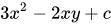
In elementary algebra, completing the square is a technique for converting a quadratic polynomial of the form to the form for some values of and . In terms of a new quantity , this expression is a quadratic polynomial with no linear term. By subsequently isolating and taking the square root, a quadratic problem can be reduced to a linear problem.

The name completing the square comes from a geometrical picture in which represents an unknown length. Then the quantity represents the area of a square of side and the quantity represents the area of a pair of congruent rectangles with sides and . To this square and pair of rectangles, one more square is added, of side length . This crucial step completes a larger square of side length .

View the full Wikipedia page for Completing the square
↑ Return to Menu

Square root in the context of Magnitude (vector)

In mathematics, a norm is a function from a real or complex vector space to the non-negative real numbers that behaves in certain ways like the distance from the origin: it commutes with scaling, obeys a form of the triangle inequality, and zero is only at the origin. In particular, the Euclidean distance in a Euclidean space is defined by a norm on the associated Euclidean vector space, called the Euclidean norm, the 2-norm, or, sometimes, the magnitude or length of the vector. This norm can be defined as the square root of the inner product of a vector with itself.

A seminorm satisfies the first two properties of a norm but may be zero for vectors other than the origin. A vector space with a specified norm is called a normed vector space. In a similar manner, a vector space with a seminorm is called a seminormed vector space.

View the full Wikipedia page for Magnitude (vector)
↑ Return to Menu

Square root in the context of Nth root

In mathematics, an nth root of a number x is a number r which, when raised to the power of n, yields x: The positive integer n is called the index or degree, and the number x of which the root is taken is the radicand. A root of degree 2 is called a square root and a root of degree 3, a cube root. Roots of higher degree are referred by using ordinal numbers, as in fourth root, twentieth root, etc. The computation of an nth root is a root extraction.

The nth root of x is written as using the radical symbol . The square root is usually written as , with the degree omitted. Taking the nth root of a number, for fixed , is the inverse of raising a number to the nth power, and can be written as a fractional exponent:

View the full Wikipedia page for Nth root
↑ Return to Menu

Square root in the context of Algebraic expression

In mathematics, an algebraic expression is an expression built up from constants (usually, algebraic numbers), variables, and the basic algebraic operations: addition (+), subtraction (−), multiplication (×), division (÷), whole number powers, and roots (fractional powers).. For example, is an algebraic expression. Since taking the square root is the same as raising to the power 1/2, the following is also an algebraic expression:

View the full Wikipedia page for Algebraic expression
↑ Return to Menu

Square root in the context of Integer factorization

In mathematics, integer factorization is the decomposition of a positive integer into a product of integers. Every positive integer greater than 1 is either the product of two or more integer factors greater than 1, in which case it is a composite number, or it is not, in which case it is a prime number. For example, 15 is a composite number because 15 = 3 · 5, but 7 is a prime number because it cannot be decomposed in this way. If one of the factors is composite, it can in turn be written as a product of smaller factors, for example 60 = 3 · 20 = 3 · (5 · 4). Continuing this process until every factor is prime is called prime factorization; the result is always unique up to the order of the factors by the prime factorization theorem.

To factorize a small integer n using mental or pen-and-paper arithmetic, the simplest method is trial division: checking if the number is divisible by prime numbers 2, 3, 5, and so on, up to the square root of n. For larger numbers, especially when using a computer, various more sophisticated factorization algorithms are more efficient. A prime factorization algorithm typically involves testing whether each factor is prime each time a factor is found.

View the full Wikipedia page for Integer factorization
↑ Return to Menu

Square root in the context of Mechanical computer

A mechanical computer is a computer built from mechanical components such as levers and gears rather than electronic components. The most common examples are adding machines and mechanical counters, which use the turning of gears to increment output displays. More complex examples could carry out multiplication and division—Friden used a moving head which paused at each column—and even differential analysis. One model, the Ascota 170 accounting machine sold in the 1960s, calculated square roots.

Mechanical computers can be either analog, using continuous or smooth mechanisms such as curved plates or slide rules for computations; or discrete, which use mechanisms like pinwheels and gears.

View the full Wikipedia page for Mechanical computer
↑ Return to Menu