Spiral galaxy in the context of "Galaxy morphological classification"

Play Trivia Questions online!

or

Skip to study material about Spiral galaxy in the context of "Galaxy morphological classification"

Ad spacer

⭐ Core Definition: Spiral galaxy

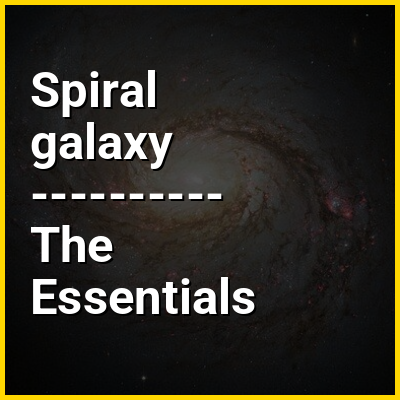
Spiral galaxies form a class of galaxy originally described by Edwin Hubble in his 1936 work The Realm of the Nebulae and, as such, form part of the Hubble sequence. Most spiral galaxies consist of a flat, rotating disk containing stars, gas and dust, and a central concentration of stars known as the bulge. These are often surrounded by a much fainter halo of stars, many of which reside in globular clusters.

Spiral galaxies are named by their spiral structures that extend from the center into the galactic disk. The spiral arms are sites of ongoing star formation and are brighter than the surrounding disc because of the young, hot OB stars that inhabit them.

↓ Menu

>>>PUT SHARE BUTTONS HERE<<<
In this Dossier

Spiral galaxy in the context of Galaxy

A galaxy is a system of stars, stellar remnants, interstellar gas, dust, and dark matter bound together by gravity. The word is derived from the Greek galaxias (γαλαξίας), literally 'milky', a reference to the Milky Way galaxy that contains the Solar System. Galaxies, averaging an estimated 100 million stars, range in size from dwarfs with less than a thousand stars, to the largest galaxies knownsupergiants with one hundred trillion stars, each orbiting its galaxy's centre of mass. Most of the mass in a typical galaxy is in the form of dark matter, with only a few per cent of that mass visible in the form of stars and nebulae. Supermassive black holes are a common feature at the centres of galaxies.

Galaxies are categorised according to their visual morphology as elliptical, spiral, or irregular. The Milky Way is an example of a spiral galaxy. It is estimated that there are between 200 billion (2×10) to 2 trillion galaxies in the observable universe. Most galaxies are 1,000 to 100,000 parsecs in diameter (approximately 3,000 to 300,000 light years) and are separated by distances in the order of millions of parsecs (or megaparsecs). For comparison, the Milky Way has a diameter of at least 26,800 parsecs (87,400 ly) and is separated from the Andromeda Galaxy, its nearest large neighbour, by just over 750,000 parsecs (2.5 million ly).
↑ Return to Menu

Spiral galaxy in the context of Elliptical galaxy

An elliptical galaxy is a type of galaxy with an approximately ellipsoidal shape and a smooth, nearly featureless image. They are one of the three main classes of galaxy described by Edwin Hubble in his Hubble sequence and 1936 work The Realm of the Nebulae, along with spiral and lenticular galaxies. Elliptical (E) galaxies are, together with lenticular galaxies (S0) with their large-scale disks, and ES galaxies with their intermediate scale disks, a subset of the "early-type" galaxy population.

Most elliptical galaxies are composed of older, low-mass stars, with a sparse interstellar medium, and they tend to be surrounded by large numbers of globular clusters. Star formation activity in elliptical galaxies is typically minimal; they may, however, undergo brief periods of star formation when merging with other galaxies. Elliptical galaxies are believed to make up approximately 10–15% of galaxies in the Virgo Supercluster, and they are not the dominant type of galaxy in the universe overall. They are preferentially found close to the centers of galaxy clusters.

↑ Return to Menu

Spiral galaxy in the context of Irregular galaxy

An irregular galaxy is a galaxy that does not have a distinct regular shape, unlike a spiral or an elliptical galaxy. Irregular galaxies do not fall into any of the regular classes of the Hubble sequence, and they are often chaotic in appearance, with neither a nuclear bulge nor any trace of spiral arm structure. This absence of structure in an irregular galaxy leads to little density waves in these galaxies. This makes irregular galaxies prime areas to study star formation without the effects of density waves.

Collectively they are thought to make up about a quarter of all galaxies. Some irregular galaxies were once spiral or elliptical galaxies but were deformed by an uneven external gravitational force. Irregular galaxies may contain abundant amounts of gas and dust. This is not necessarily true for dwarf irregulars. Irregular galaxies may also be formed in galaxy collisions.

↑ Return to Menu

Spiral galaxy in the context of Galactic bulge

In astronomy, a galactic bulge (or simply bulge) is a tightly packed group of stars within a larger star formation. The term almost exclusively refers to the group of stars found near the center of most spiral galaxies. Bulges were historically thought to be elliptical galaxies that happened to have a disk of stars around them, but high-resolution images using the Hubble Space Telescope have revealed that many bulges lie at the heart of a spiral galaxy. It is now thought that there are at least two types of bulges: bulges that are like ellipticals and bulges that are like spiral galaxies.

↑ Return to Menu

Spiral galaxy in the context of Elliptical galaxy M87

Messier 87 (also known as Virgo A or NGC 4486, generally abbreviated to M87) is a supergiant elliptical galaxy in the constellation Virgo that contains several trillion stars. One of the largest and most massive galaxies in the local universe, it has a large population of globular clusters—about 15,000 compared with the 150–200 orbiting the Milky Way—and a jet of energetic plasma that originates at the core and extends at least 1,500 parsecs (4,900 light-years), traveling at a relativistic speed. It is one of the brightest radio sources in the sky and a popular target for both amateur and professional astronomers.

The French astronomer Charles Messier discovered M87 in 1781, and cataloged it as a nebula. M87 is about 16.4 million parsecs (53 million light-years) from Earth and is the second-brightest galaxy within the northern Virgo Cluster, having many satellite galaxies. Unlike a disk-shaped spiral galaxy, M87 has no distinctive dust lanes. Instead, it has an almost featureless, ellipsoidal shape typical of most giant elliptical galaxies, diminishing in luminosity with distance from the center. Forming around one-sixth of its mass, M87's stars have a nearly spherically symmetric distribution. Their population density decreases with increasing distance from the core. It has an active supermassive black hole at its core, which forms the primary component of an active galactic nucleus. The black hole was imaged using data collected in 2017 by the Event Horizon Telescope (EHT), with a final, processed image released on 10 April 2019. In March 2021, the EHT Collaboration presented, for the first time, a polarized-based image of the black hole which may help better reveal the forces giving rise to quasars.

↑ Return to Menu

Spiral galaxy in the context of Tidal force

The tidal force or tide-generating force is the difference in gravitational attraction between different points in a gravitational field, causing bodies to be pulled unevenly and as a result are being stretched towards the attraction. It is the differential force of gravity, the net between gravitational forces, the derivative of gravitational potential, the gradient of gravitational fields. Therefore tidal forces are a residual force, a secondary effect of gravity, highlighting its spatial elements, making the closer near-side more attracted than the more distant far-side.

This produces a range of tidal phenomena, such as ocean tides. Earth's tides are mainly produced by the relative close gravitational field of the Moon and to a lesser extent by the stronger, but further away gravitational field of the Sun. The ocean on the side of Earth facing the Moon is being pulled by the gravity of the Moon away from Earth's crust, while on the other side of Earth there the crust is being pulled away from the ocean, resulting in Earth being stretched, bulging on both sides, and having opposite high-tides. Tidal forces viewed from Earth, that is from a rotating reference frame, appear as centripetal and centrifugal forces, but are not caused by the rotation.

↑ Return to Menu

Spiral galaxy in the context of Ultraviolet astronomy

Ultraviolet astronomy is the observation of electromagnetic radiation at ultraviolet wavelengths between approximately 10 and 320 nanometres; shorter wavelengths—higher energy photons—are studied by X-ray astronomy and gamma-ray astronomy. Ultraviolet light is not visible to the human eye. Most of the light at these wavelengths is absorbed by the Earth's atmosphere, so observations at these wavelengths must be performed from the upper atmosphere or from space.

↑ Return to Menu

Spiral galaxy in the context of Barred spiral galaxy

A barred spiral galaxy is a spiral galaxy with a central bar-shaped structure composed of stars. Bars are found in about two thirds of all spiral galaxies in the local universe, and generally affect both the motions of stars and interstellar gas within spiral galaxies and can affect spiral arms as well. The Milky Way Galaxy, where the Solar System is located, is classified as a barred spiral galaxy.

Edwin Hubble classified spiral galaxies of this type as "SB" (spiral, barred) in his Hubble sequence and arranged them into sub-categories based on how open the arms of the spiral are. SBa types feature tightly bound arms, while SBc types are at the other extreme and have loosely bound arms. SBb-type galaxies lie in between the two. SB0 is a barred lenticular galaxy. A new type, SBm, was subsequently created to describe somewhat irregular barred spirals, such as the Magellanic Clouds, which were once classified as irregular galaxies, but have since been found to contain barred spiral structures. Among other types in Hubble's classifications for the galaxies are the spiral galaxy, elliptical galaxy and irregular galaxy.

↑ Return to Menu