Spectral flux density in the context of Surface brightness


Spectral flux density in the context of Surface brightness

Spectral flux density Study page number 1 of 1

Play TriviaQuestions Online!

or

Skip to study material about Spectral flux density in the context of "Surface brightness"


⭐ Core Definition: Spectral flux density

In spectroscopy, spectral flux density is the quantity that describes the rate at which energy is transferred by electromagnetic radiation through a real or virtual surface, per unit surface area and per unit wavelength (or, equivalently, per unit frequency). It is a radiometric rather than a photometric measure. In SI units it is measured in W m, although it can be more practical to use W m nm (1 W m nm = 1 GW m = 1 W mm) or W m μm (1 W m μm = 1 MW m), and respectively by W·m·Hz, Jansky or solar flux units. The terms irradiance, radiant exitance, radiant emittance, and radiosity are closely related to spectral flux density.

The terms used to describe spectral flux density vary between fields, sometimes including adjectives such as "electromagnetic" or "radiative", and sometimes dropping the word "density". Applications include:

↓ Menu
HINT:

👉 Spectral flux density in the context of Surface brightness

In astronomy, surface brightness (SB) quantifies the apparent brightness or flux density per unit angular area of a spatially extended object such as a galaxy or nebula, or of the night sky background. An object's surface brightness depends on its surface luminosity density, i.e., its luminosity emitted per unit surface area. In visible and infrared astronomy, surface brightness is often quoted on a magnitude scale, in magnitudes per square arcsecond (MPSAS) in a particular filter band or photometric system.

Measurement of the surface brightnesses of celestial objects is called surface photometry.

↓ Explore More Topics
In this Dossier

Spectral flux density in the context of List of deep fields

In astronomy, a deep field is an image of a portion of the sky taken with a very long exposure time, in order to detect and study faint objects. The depth of the field refers to the apparent magnitude or the flux of the faintest objects that can be detected in the image. Deep field observations usually cover a small angular area on the sky, because of the large amounts of telescope time required to reach faint flux limits. Deep fields are used primarily to study galaxy evolution and the cosmic evolution of active galactic nuclei, and to detect faint objects at high redshift. Numerous ground-based and space-based observatories have taken deep-field observations at wavelengths spanning radio to X-rays.

The first deep-field image to receive a great deal of public attention was the Hubble Deep Field, observed in 1995 with the WFPC2 camera on the Hubble Space Telescope. Other space telescopes that have obtained deep-field observations include the Chandra X-ray Observatory, the XMM-Newton Observatory, the Spitzer Space Telescope, and the James Webb Space Telescope.

View the full Wikipedia page for List of deep fields
↑ Return to Menu

Spectral flux density in the context of Spread spectrum

In telecommunications, especially radio communication, spread spectrum are techniques by which a signal (e.g., an electrical, electromagnetic, or acoustic) generated with a particular bandwidth is deliberately spread in the frequency domain over a wider frequency band. Spread-spectrum techniques are used for the establishment of secure communications, increasing resistance to natural interference, noise, and jamming, to prevent detection, to limit power flux density (e.g., in satellite downlinks), and to enable multiple-access communications.

View the full Wikipedia page for Spread spectrum
↑ Return to Menu

Spectral flux density in the context of Jansky

The jansky (symbol Jy, plural janskys) is a non-SI unit of spectral flux density, or spectral irradiance, used especially in radio astronomy. It is equivalent to 10 watts per square metre per hertz.

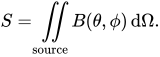
The spectral flux density or monochromatic flux, S, of a source is the integral of the spectral radiance, B, over the source solid angle:

View the full Wikipedia page for Jansky
↑ Return to Menu

Spectral flux density in the context of Solar flux units

The solar flux unit (sfu) is a non-SI unit of spectral flux density often used in solar radio observations, such as the F10.7 solar activity index. It is equivalent to 10 watts per square metre per hertz (SI), 10 ergs per second per square centimetre per hertz (CGS), and 10 Jansky.

View the full Wikipedia page for Solar flux units
↑ Return to Menu