Southern Tagalog in the context of "Calabarzon"

Play Trivia Questions online!

or

Skip to study material about Southern Tagalog in the context of "Calabarzon"

Ad spacer

⭐ Core Definition: Southern Tagalog

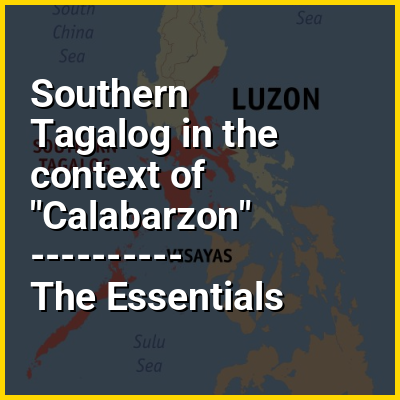
Southern Tagalog (Filipino: Timog Katagalugan), designated as Region IV, was an administrative region in the Philippines that comprised the current regions of Calabarzon and Mimaropa, the province of Aurora in Central Luzon, and most of the National Capital Region. It was the largest region in the Philippines in terms of both land area and population. After its partition on May 17, 2002, Southern Tagalog continues to exist as a cultural-geographical region.

The region was and is still bordered by Manila Bay and the South China Sea to the west, Lamon Bay and the Bicol Region to the east, the Tayabas Bay, Sibuyan Sea, and Balabac Strait, where it shared a maritime border with Sabah, Malaysia, to the south, and Central Luzon to the north; it was bordered by Cagayan Valley to the north geographically.

↓ Menu

>>>PUT SHARE BUTTONS HERE<<<

👉 Southern Tagalog in the context of Calabarzon

Calabarzon (officially stylized in all caps; English: /ˌkɑːləbɑːrˈzɒn/; Tagalog: [kalɐbaɾˈsɔn]), sometimes referred to as Southern Tagalog (Tagalog: Timog Katagalugan) and designated as Region IV‑A, is an administrative region in the Philippines. It is situated southeast of Metro Manila and is bordered by Manila Bay and the South China Sea to the west, Lamon Bay and the Bicol Region to the east, Tayabas Bay and the Sibuyan Sea to the south, and Central Luzon to the north. Comprising five provincesCavite, Laguna, Batangas, Rizal, and Quezon (hence the acronym)—and one highly urbanized city, Lucena, it is the most populous region in the Philippines, according to the 2020 census, with over 16.1 million inhabitants. It is also the country's second most densely populated region, after the National Capital Region. Calamba in Laguna serves as the regional center, while Antipolo in Rizal is the most populous city in the region.

Before its creation as a separate region, Calabarzon, along with the Mimaropa region, the province of Aurora, and parts of Metro Manila, comprised the historical region known as Southern Tagalog until they were separated in 2002 through Executive Order No. 103.

↓ Explore More Topics
In this Dossier

Southern Tagalog in the context of Quezon City

Quezon City (UK: /ˈkzɒn/, US: /ˈksɒn/; Filipino: Lungsod Quezon [luŋˈsod ˈkɛson] ), also known as the City of Quezon and Q.C. (read and pronounced in Filipino as Kyusi), is the most populous city in the Philippines. According to the 2024 census, it has a population of 3,084,270 people. It was founded on October 12, 1939, and was named after Manuel L. Quezon, the second president of the Philippines. Quezon City served as the capital of the Philippines from 1948 until 1976, when the designation was returned to Manila.

The city was intended to be the national capital of the Philippines that would replace Manila, as the latter was suffering from overcrowding, lack of housing, poor sanitation, and traffic congestion. To create Quezon City, several barrios were carved out from the towns of Caloocan, Marikina, San Juan and Pasig, in addition to the eight vast estates the Philippine government purchased for this purpose. It was officially proclaimed the national capital on October 12, 1949, and several government departments and institutions moved out of Manila and settled into the new capital city. This necessitated the expansion of the city northward, carving out Novaliches from Caloocan which divided it into two non-contiguous parts. Several barrios were also taken from San Mateo and parts of Montalban. However, on June 24, 1976, Presidential Decree No. 940 was enacted, which reverted national capital status to Manila while the whole of Metro Manila was designated as the seat of government. The city was also chosen as the regional center of Southern Tagalog, which was created in 1965, along with the provinces of Quezon and Aurora, the birthplace of Manuel L. Quezon; however, its status of regional center became ineffective when the region was divided into Calabarzon and Mimaropa, through the effect of Executive Order No. 103 in May 2002 under the presidency of Gloria Macapagal Arroyo, and Aurora was transferred to the authority of Central Luzon, with Southern Tagalog limited to being a cultural-geographic region.
↑ Return to Menu

Southern Tagalog in the context of Mimaropa

Mimaropa (officially stylized in all caps), officially the Southwestern Tagalog Region (Filipino: Rehiyong Timog-Kanlurang Tagalog), is an administrative region in the Philippines. The name is an acronym combination of its constituent provinces: Mindoro (divided into Occidental Mindoro and Oriental Mindoro), Marinduque, Romblon, and Palawan. It is the only region in the country outside the Visayas that has no land border with another region.

The region was part of the now-defunct Southern Tagalog region until May 17, 2002. On May 23, 2005, Palawan and the highly urbanized city of Puerto Princesa were moved to the region of Western Visayas by Executive Order No. 429. However, on August 19, 2005, President Arroyo issued Administrative Order No. 129 to put in abeyance Executive Order No. 429 pending a review. On July 17, 2016, Republic Act No. 10879 formally established the Southwestern Tagalog Region to be known as Mimaropa, discontinuing the Region IV-B designation; however, no boundary changes were involved.

↑ Return to Menu