Songwriter in the context of Hit record


Songwriter in the context of Hit record

Songwriter Study page number 1 of 2

Play TriviaQuestions Online!

or

Skip to study material about Songwriter in the context of "Hit record"


⭐ Core Definition: Songwriter

A songwriter is a person who creates musical compositions or writes lyrics for songs, or both. The writer of the music for a song can be called a composer, although this term tends to be used mainly in the classical music genre and film scoring. A songwriter who mainly writes the lyrics for a song is referred to as a lyricist. Pressure from the music industry to produce popular hits means that songwriting is often a collaborative process with tasks shared among multiple people. For example, a songwriter who excels at writing lyrics might be paired with a songwriter with the task of creating original melodies. Pop songs may be composed by group members from the band or by staff writers – songwriters directly employed by music publishers. Some songwriters serve as their own music publishers, while others have external publishers.

The old-style apprenticeship approach to learning how to write songs is being supplemented by university degrees, college diplomas and "rock schools". Knowledge of modern music technology (sequencers, synthesizers, computer sound editing), songwriting elements and business skills are significant for modern songwriters. Several music colleges offer songwriting diplomas and degrees with music business modules. Since songwriting and publishing royalties can be substantial sources of income, particularly if a song becomes a hit record; legally, in the US, songs written after 1934 may be copied only by the authors. The legal power to grant these permissions may be bought, sold or transferred. This is governed by international copyright law.

↓ Menu
HINT:

In this Dossier

Songwriter in the context of Musical composition

Musical composition can refer to an original piece or work of music, either vocal or instrumental, the structure of a musical piece or to the process of creating or writing a new piece of music. People who create new compositions are called composers. Composers of primarily songs are usually called songwriters; with songs, the person who writes lyrics for a song is the lyricist. In many cultures, including Western classical music, the act of composing typically includes the creation of music notation, such as a sheet music "score", which is then performed by the composer or by other musicians. In popular music and traditional music, songwriting may involve the creation of a basic outline of the song, called the lead sheet, which sets out the melody, lyrics and chord progression. In classical music, orchestration (choosing the instruments of a large music ensemble such as an orchestra which will play the different parts of music, such as the melody, accompaniment, countermelody, bassline and so on) is typically done by the composer, but in musical theatre and in pop music, songwriters may hire an arranger to do the orchestration. In some cases, a pop or traditional songwriter may not use written notation at all and instead compose the song in their mind and then play, sing or record it from memory. In jazz and popular music, notable sound recordings by influential performers are given the weight that written or printed scores play in classical music.

Although a musical composition often uses musical notation and has a single author, this is not always the case. A work of music can have multiple composers, which often occurs in popular music when all members of a band collaborate to write a song or in musical theatre, when one person writes the melodies, a second person writes the lyrics and a third person orchestrates the songs.

View the full Wikipedia page for Musical composition
↑ Return to Menu

Songwriter in the context of Poet

A poet is a person who studies and creates poetry. Poets may describe themselves as such or be described as such by others. A poet might simply be the creator (thinker, songwriter, writer, or author) who creates (composes) poems (oral or written), or someone who also performs their art to an audience.

The work of a poet is essentially one of communication, expressing ideas either in a literal sense (such as describing a specific event or place) or metaphorically. Poets have existed since prehistory, in nearly all languages, and have produced works that vary greatly in different cultures and periods. Throughout each civilization and language, poets have used various styles that have changed over time, resulting in countless poets as diverse as the literature that (since the advent of writing systems) they have produced.

View the full Wikipedia page for Poet
↑ Return to Menu

Songwriter in the context of Musician

A musician is someone who composes, conducts, or performs music. According to the United States Employment Service, "musician" is a general term used to designate a person who follows music as a profession. Musicians include songwriters, who write both music and lyrics for songs; conductors, who direct a musical performance; and performers, who perform for an audience. A music performer is generally either a singer (also known as a vocalist), who provides vocals, or an instrumentalist, who plays a musical instrument. Musicians may perform on their own or as part of a group, band or orchestra.

Musicians may specialize in a musical genre, although many perform across a variety of styles and often blend or cross genres. Their musical output is influenced by a range of factors, including culture, skill set, life experience, education, and creative preferences. A musician who records and releases music is often referred to as a recording artist; while a musician who primarily writes and records art music, media soundtracks , and scores—including for films, theatrical stage productions, and video games—or classical music is usually called a composer. A music producer, while not a musician outright, may themselves be a musician. A conductor, by way of gestures, leads and provides live direction for, or conducts, an ensemble, typically an orchestra or choral group.

View the full Wikipedia page for Musician
↑ Return to Menu

Songwriter in the context of Tin Pan Alley

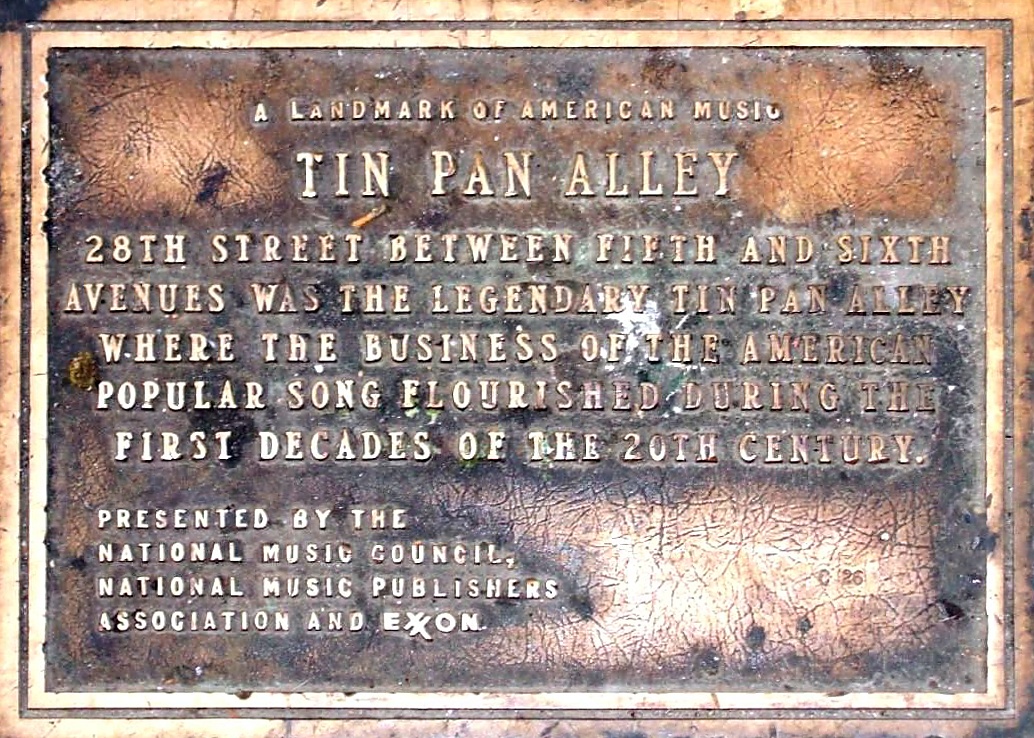
Tin Pan Alley was a collection of music publishers and songwriters in New York City that dominated the popular music of the United States in the late 19th and early 20th centuries. Originally, it referred to a specific location on West 28th Street, between Fifth and Sixth Avenues in the Flower District of Manhattan, as commemorated by a plaque on 28th Street between Broadway and Sixth. Several buildings on Tin Pan Alley are protected as New York City designated landmarks, and the section of 28th Street from Fifth to Sixth Avenue is also officially co-named Tin Pan Alley.

The start of Tin Pan Alley is usually dated to about 1885, when a number of music publishers set up shop in the same district of Manhattan. The end of Tin Pan Alley is less clear cut. Some date it to the start of the Great Depression in the 1930s when the phonograph, radio, and motion pictures supplanted sheet music as the driving force of American popular music, while others consider Tin Pan Alley to have continued into the 1950s when earlier styles of music were upstaged by the rise of rock and roll, which was centered on the Brill Building. Brill Building songwriter Neil Sedaka described his employer as being a natural outgrowth of Tin Pan Alley, in that the older songwriters were still employed in Tin Pan Alley firms while younger songwriters such as Sedaka found work at the Brill Building.

View the full Wikipedia page for Tin Pan Alley
↑ Return to Menu

Songwriter in the context of Music industry

The music industry are individuals and organizations that earn money by writing songs and musical compositions, creating and selling recorded music and sheet music, presenting concerts, as well as the organizations that aid, train, represent and supply music creators. Among the many individuals and organizations that operate in the industry are: the songwriters and composers who write songs and musical compositions; the singers, musicians, conductors, and bandleaders who perform the music; the record labels, music publishers, recording studios, music producers, audio engineers, retail and digital music stores, and performance rights organizations who create and sell recorded music and sheet music; and the booking agents, promoters, music venues, road crew, and audio engineers who help organize and sell concerts.

The industry also includes a range of professionals who assist singers and musicians with their music careers. These include talent managers, artists and repertoire managers, business managers, entertainment lawyers; those who broadcast audio or video music content (satellite, Internet radio stations, broadcast radio and TV stations); music journalists and music critics; DJs; music educators and teachers; manufacturers of musical instruments and music equipment; as well as many others. In addition to the businesses and artists there are organizations that also play an important role, including musician's unions (e.g. American Federation of Musicians), not-for-profit performance-rights organizations (e.g. American Society of Composers, Authors and Publishers) and other associations (e.g. International Alliance for Women in Music, a non-profit organization that advocates for women composers and musicians).

View the full Wikipedia page for Music industry
↑ Return to Menu

Songwriter in the context of Herbert Rehbein

Herbert "Herb" Rehbein (15 April 1922 – 28 July 1979) was a German songwriter, composer and arranger of light orchestral music. Together with his friend and collaborator Bert Kaempfert, he was posthumously inducted into the Songwriters Hall of Fame in 1993.

View the full Wikipedia page for Herbert Rehbein
↑ Return to Menu

Songwriter in the context of Nonsensical

Nonsense is a form of communication, via speech, writing, or any other formal logic system, that lacks any coherent meaning. In ordinary usage, nonsense is sometimes synonymous with absurdity or the ridiculous. Many poets, novelists and songwriters have used nonsense in their works, often creating entire works using it for reasons ranging from pure comic amusement or satire, to illustrating a point about language or reasoning. In the philosophy of language and philosophy of science, nonsense is distinguished from sense or meaningfulness, and attempts have been made to come up with a coherent and consistent method of distinguishing sense from nonsense. It is also an important field of study in cryptography regarding separating a signal from noise.

View the full Wikipedia page for Nonsensical
↑ Return to Menu

Songwriter in the context of Rodgers and Hart

Rodgers and Hart were an American songwriting partnership between composer Richard Rodgers (1902–1979) and the lyricist Lorenz Hart (1895–1943). They worked together on 28 stage musicals and more than 500 songs from 1919 until Hart's death in 1943. Many of their songs are classics of the Great American Songbook.

View the full Wikipedia page for Rodgers and Hart
↑ Return to Menu

Songwriter in the context of Music publisher (popular music)

A music publisher is a type of publisher that specializes in distributing music. Music publishers originally published sheet music. When copyright became legally protected, music publishers began to play a role in the management of the intellectual property of composers. Today, music publishers license compositions, collect royalties, and make sure songwriters and composers are paid when their work is used.

View the full Wikipedia page for Music publisher (popular music)
↑ Return to Menu

Songwriter in the context of Bobby McFerrin

Robert Keith McFerrin Jr. (born March 11, 1950) is an American singer, songwriter, and conductor. His vocal techniques include singing fluidly but with quick and considerable jumps in pitch—for example, sustaining a melody while also rapidly alternating with arpeggios and harmonies—as well as scat singing, polyphonic overtone singing, and improvisational vocal percussion. He performs and records regularly as an unaccompanied solo vocal artist. He has frequently collaborated with other artists from both the jazz and classical scenes.

McFerrin's song "Don't Worry, Be Happy" is the only acapella track to ever reach No. 1 in the US, which it reached in 1988 and additionally won Song of the Year and Record of the Year honors at the 1989 Grammy Awards. McFerrin has also worked in collaboration with jazz fusion instrumentalists including pianists Chick Corea (of Return to Forever), Herbie Hancock (of The Headhunters), and Joe Zawinul (of Weather Report), drummer Tony Williams, and cellist Yo-Yo Ma.

View the full Wikipedia page for Bobby McFerrin
↑ Return to Menu

Songwriter in the context of Billy Steinberg

William Endfield Steinberg (born February 26, 1950) is an American songwriter. He achieved his greatest success in the 1980s with songwriting partner Tom Kelly; together they wrote or co-wrote the No. 1 hits "Like a Virgin" by Madonna (1984), "True Colors" by Cyndi Lauper (1986), "Eternal Flame" by the Bangles (1989), "So Emotional" by Whitney Houston (1987), and "Alone" (covered by Heart in 1987). Steinberg and Kelly also wrote or co-wrote the hit songs "I Drove All Night" (recorded by various artists, initially recorded by Roy Orbison in 1987 but first released by Lauper in 1989), "I Touch Myself" by Divinyls (1990), and "I'll Stand by You" by The Pretenders (1994).

After Kelly retired from music in the 1990s, Steinberg collaborated with other songwriters. With Rick Nowels and Marie-Claire D'Ubaldo he wrote the hit songs "Falling Into You" (covered by Celine Dion) and "One & One". He has written hit songs with Josh Alexander including "All About Us" by t.A.T.u. (2005), "Too Little Too Late" by JoJo (2006), "Over It" by Katharine McPhee (2007), and "Give Your Heart a Break" by Demi Lovato (2012).

View the full Wikipedia page for Billy Steinberg
↑ Return to Menu

Songwriter in the context of History of music publishing

Music publishing is the business of creating, producing and distributing printed musical scores, parts, and books in various types of music notation, while ensuring that the composer, songwriter and other creators receive credit and royalties or other payment (where applicable). This article outlines the early history of the industry.

View the full Wikipedia page for History of music publishing
↑ Return to Menu