Silbury Hill in the context of "British Bronze Age"

Play Trivia Questions online!

or

Skip to study material about Silbury Hill in the context of "British Bronze Age"


⭐ Core Definition: Silbury Hill

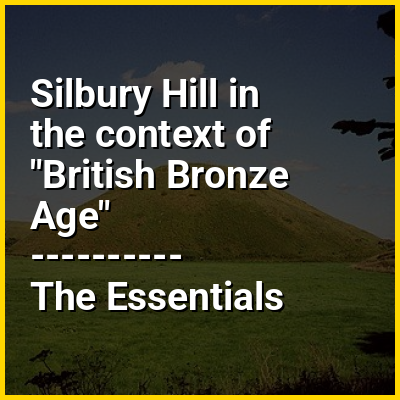
Silbury Hill is a prehistoric artificial chalk mound near Avebury in the English county of Wiltshire. It is part of the Stonehenge, Avebury and Associated Sites UNESCO World Heritage Site. At 39.3 metres (129 ft) high, the hill is the second tallest prehistoric man-made mound in Europe (after The Castle Hill in Udine, Italy) and one of the largest in the world; it is similar in volume to contemporary Egyptian pyramids. The site is in the care of English Heritage.

Silbury Hill is part of the complex of Neolithic monuments around Avebury, which includes the Avebury Ring and West Kennet Long Barrow. Its original purpose is still debated. Several other important Neolithic monuments in Wiltshire, including the large henges at Marden and Salisbury Plain (Stonehenge), may be culturally or functionally related to Avebury and Silbury.
↓ Menu

In this Dossier

Silbury Hill in the context of Bronze Age Britain

Bronze Age Britain is an era of British history that spanned from c. 2500–2000 BC until c. 800 BC. Lasting for approximately 1,700 years, it was preceded by the era of Neolithic Britain and was in turn followed by the period of Iron Age Britain. Being categorised as the Bronze Age, it was marked by the use of copper and then bronze by the prehistoric Britons, who used such metals to fashion tools. Great Britain in the Bronze Age also saw the widespread adoption of agriculture.

During the British Bronze Age, large megalithic monuments similar to those from the Late Neolithic continued to be constructed or modified, including such sites as Avebury, Stonehenge, Silbury Hill and Must Farm. That has been described as a time "when elaborate ceremonial practices emerged among some communities of subsistence agriculturalists of western Europe".

↑ Return to Menu

Silbury Hill in the context of Avebury

Avebury (/ˈvbəri/) is a Neolithic henge monument containing three stone circles, around the village of Avebury in Wiltshire, in south-west England. One of the best-known prehistoric sites in Britain, it contains the largest megalithic stone circle in the world. It is both a tourist attraction and a place of religious importance to contemporary pagans.

Constructed over several hundred years in the third millennium BC, during the Neolithic, or New Stone Age, the monument comprises a large henge (a bank and a ditch) with a large outer stone circle and two separate smaller stone circles situated inside the centre of the monument. Its original purpose is unknown, although archaeologists believe that it was most likely used for some form of ritual or ceremony. The Avebury monument is a part of a larger prehistoric landscape containing several older monuments nearby, including West Kennet Long Barrow, Windmill Hill and Silbury Hill.

↑ Return to Menu