Sicilian cuisine in the context of "Jewish cuisine"

Play Trivia Questions online!

or

Skip to study material about Sicilian cuisine in the context of "Jewish cuisine"


⭐ Core Definition: Sicilian cuisine

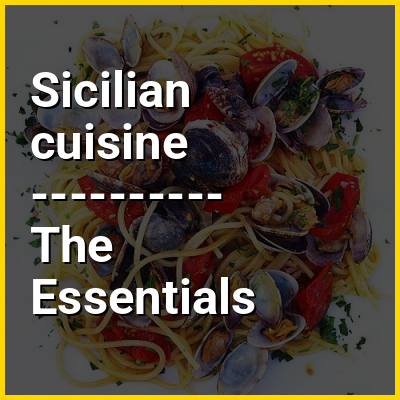
Sicilian cuisine is the style of cooking on the island of Sicily. It shows traces of all cultures that have existed on the island of Sicily over the last two millennia. Although its cuisine has much in common with Italian cuisine, Sicilian food also has Greek, Spanish, Jewish, Maghrebi, and Arab influences.

The Sicilian cook Mithaecus, born during 5th century BC, is credited with having brought knowledge of Sicilian gastronomy to Greece: his cookbook was the first in Greek, therefore he was the earliest cookbook author in any language whose name is known.
↓ Menu

In this Dossier

Sicilian cuisine in the context of Sicily

Sicily (Italian and Sicilian: Sicilia), officially the Sicilian Region (Italian: Regione Siciliana; Sicilian: Riggiuni Siciliana), is an island in the central Mediterranean Sea and one of the twenty regions of Italy, situated south of the Italian Peninsula in continental Europe. With 4.7 million inhabitants, including 1.2 million in and around the capital city of Palermo, it is both the largest and most populous island in the Mediterranean Sea.

Sicily is named after the Sicels, who inhabited the eastern part of the island during the Iron Age. Sicily has a rich and unique culture in arts, music, literature, cuisine, and architecture. Its most prominent landmark is Mount Etna, the tallest active volcano in Europe, and one of the most active in the world, currently 3,403 m (11,165 ft) high. The island has a typical Mediterranean climate. It is separated from Calabria by the Strait of Messina. It is one of the five Italian autonomous regions and is considered part of Southern Italy.

↑ Return to Menu

Sicilian cuisine in the context of Pasta alla Norma

Pasta alla Norma (Italian: [ˈpasta alla ˈnɔrma]), also called pasta con le melanzane (lit.'pasta with eggplant'), is a pasta dish made from eggplant. It is typical of Sicilian cuisine, from Catania in particular.

It is made of penne or other pasta with tomato sauce, covered with slices of fried eggplant and served with grated ricotta salata cheese and often basil.

↑ Return to Menu

Sicilian cuisine in the context of Mithaecus

Mithaecus (Ancient Greek: Μίθαικος) was a cook and cookbook author of the late 5th century BC. A Greek-speaking native of Sicily, Magna Graecia, at a time when the island was rich and highly civilized, Mithaecus is credited with having brought knowledge of Sicilian gastronomy to Greece. Specifically, according to sources of varying reliability, he worked in Sparta, from which he was expelled as a bad influence, and in Athens. He earned an unfavourable mention in Plato's dialogue Gorgias.

Mithaecus is the first known author of any cookbook, and his is the first known (if not extant) Greek cookbook. One very brief recipe survives from it, thanks to a quotation in the Deipnosophistae of Athenaeus. It is in the Doric dialect of Greek (appropriate both to Greek Sicily and to Sparta) and describes, in one line, how to deal with the fish Cepola macrophthalma, a ribbon-like fish here called tainia (known in Italian as cepola and in modern Greek as kordella):

↑ Return to Menu