Shamash in the context of "Anu"

Play Trivia Questions online!

or

Skip to study material about Shamash in the context of "Anu"

Ad spacer

⭐ Core Definition: Shamash

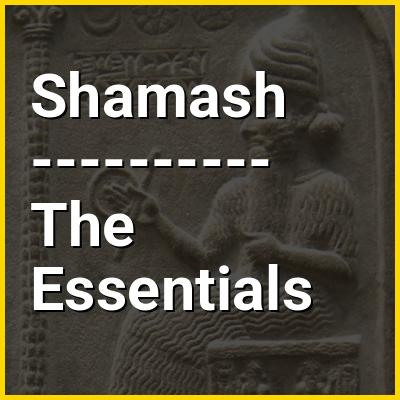
Shamash (Akkadian: šamaš), also known as Utu (Sumerian: utu 𒀭𒌓 "Sun"), was the ancient Mesopotamian sun god. He was believed to see everything that happened in the world every day, and was therefore responsible for justice and protection of travelers. As a divine judge, he could be associated with the underworld. Additionally, he could serve as the god of divination, typically alongside the weather god Adad. While he was universally regarded as one of the primary gods, he was particularly venerated in Sippar and Larsa. The moon god Nanna (Sin) and his wife Ningal were regarded as his parents, while his twin sister was Inanna (Ishtar). Occasionally other goddesses, such as Manzat and Pinikir, could be regarded as his sisters too. The dawn goddess Aya (Sherida) was his wife, and multiple texts describe their daily reunions taking place on a mountain where the sun was believed to set. Among their children were Kittum, the personification of truth, dream deities such as Mamu, as well as the god Ishum. Utu's name could be used to write the names of many foreign solar deities logographically. The connection between him and the Hurrian solar god Shimige is particularly well attested, and the latter could be associated with Aya as well.

While no myths focusing on Utu are known, he often appears as an ally of other figures in both Sumerian and Akkadian compositions. According to narratives about Dumuzi's death, he helped protect him when the galla demons tried to drag him to the underworld. In various versions of the Epic of Gilgamesh and in earlier Gilgamesh myths, he helps this hero defeat the monstrous Humbaba. In the myth Inanna and An, he helps his sister acquire the temple Eanna. In How Grain Came to Sumer, he is invoked to advise Ninazu and Ninmada.
↓ Menu

>>>PUT SHARE BUTTONS HERE<<<
In this Dossier

Shamash in the context of Hammurabi

Hammurabi (/ˌhæmʊˈrɑːbi/; Old Babylonian Akkadian: 𒄩𒄠𒈬𒊏𒁉, romanized: Ḫammu-rāpi; Akkadian: [xammuˈraːpʰi]; c. 1810 – c. 1750 BC), also spelled Hammurapi, was the sixth Amorite king of the Old Babylonian Empire, reigning from c. 1792 to c. 1750 BC. He was preceded by his father, Sin-Muballit, who abdicated due to failing health. During his reign, he conquered the city-states of Larsa, Eshnunna, and Mari. He ousted Ishme-Dagan I, the king of Assyria, and forced his son Mut-Ashkur to pay tribute, bringing almost all of Mesopotamia under Babylonian rule.

Hammurabi is best known for having issued his eponymous code, which he claimed to have received from Shamash, the Babylonian god of justice. Unlike earlier Sumerian law codes, such as the Code of Ur-Nammu, which had focused on compensating the victim of the crime, the Law of Hammurabi was one of the first law codes to place greater emphasis on the physical punishment of the perpetrator. It prescribed specific penalties for each crime and is among the first codes to establish the presumption of innocence. They were intended to limit what a wronged person was permitted to do in retribution. The Code of Hammurabi and the Law of Moses in the Torah contain numerous similarities.

↑ Return to Menu

Shamash in the context of Yahwism

Yahwism, also known as the Israelite religion, was the ancient Semitic religion of ancient Israel and Judah and the ethnic religion of the Israelites. The Israelite religion was a derivative of the Canaanite religion and a polytheistic religion that had a pantheon with various gods and goddesses. The primary deity of the religion and the head of the pantheon was Yahweh, the national god of the kingdoms of Judah and Israel. The majority of scholars hold that the goddess Asherah was the consort of Yahweh, though some scholars disagree. Following this divine duo were second-tier gods and goddesses, such as Baal, Shamash, Yarikh, Mot, and Astarte, with each having priests and prophets, and numbering royalty among their devotees.

The practices of Yahwism included festivals, ritual sacrifices, vow-making, private rituals, and the religious adjudication of legal disputes. For most of its history, the Temple in Jerusalem was not the sole or central place of worship dedicated to Yahweh, with many locations throughout Israel, Judah, and Samaria. However, it was still significant to the Israelite king, who effectively led the national religion as the worldly viceroy of the national god.

↑ Return to Menu

Shamash in the context of Shamash-shum-ukin

Šamaš-šuma-ukin (Neo-Assyrian Akkadian: 𒌋𒌋𒈬𒁺, romanized: Šamaš-šuma-ukin or Šamaš-šumu-ukīn, meaning "Shamash has established the name"), was king of Babylon as a vassal of the Neo-Assyrian Empire from 668 BC to his death in 648. Born into the Assyrian royal family, Šamaš-šuma-ukin was the son of the Neo-Assyrian king Esarhaddon and the elder brother of Esarhaddon's successor Ashurbanipal.

Despite being the elder son, Šamaš-šuma-ukin was for unknown reasons bypassed as heir to Assyria. His designation as heir to Babylonia was likely devised by Esarhaddon as a means to counteract future rivalry and jealousy between the brothers. Although Esarhaddon specified that Šamaš-šuma-ukin was to swear an oath of allegiance to Ashurbanipal, the clear primary heir, Šamaš-šuma-ukin was also referred to as Ashurbanipal's "equal brother" and Ashurbanipal was to stay out of his affairs. This part of the succession plans were not upheld by Ashurbanipal after Esarhaddon's death; Šamaš-šuma-ukin only acceded to the Babylonian throne months after Ashurbanipal had become king and was throughout his reign a closely monitored vassal, not entrusted with all of Babylonia or substantial military forces and only allowed to make decisions if they were approved and verified by Ashurbanipal.

↑ Return to Menu

Shamash in the context of Samsu-iluna

Samsu-iluna (Amorite: Samsu-iluna or Samsu-ilūna, "The Sun (is) our god") (c. 1749–1712 BC) was the seventh king of the founding Amorite dynasty of Babylon. His reign is estimated from 1749 BC to 1712 BC (middle chronology), or from 1686 to 1648 BC (short chronology). He was the son and successor of Hammurabi (r. 1792-1750 BC) by an unknown mother. His reign was marked by the violent uprisings of areas conquered by his father and the abandonment of several important cities primarily in Sumer.A number of letters sent by Samsu-iluna have been found of which 20 have been published. One is addressed toAbban the king of Aleppo. No received letters have been found due to the modern high water table at Babylon.

↑ Return to Menu

Shamash in the context of Ninsuna

Ninsun (also called Ninsumun, cuneiform: 𒀭𒊩𒌆𒄢 NIN.SUMUN2; Sumerian: Nin-sumun(ak) "lady of the wild cows") was a Mesopotamian goddess. She is best known as the mother of the hero Gilgamesh and wife of deified legendary king Lugalbanda, and appears in this role in most versions of the Epic of Gilgamesh. She was associated with Uruk, where she lives in this composition, but she was also worshiped in other cities of ancient Mesopotamia, such as Nippur and Ur, and her main cult center was the settlement KI.KAL.

The degree of Ninsun's involvement in Gilgamesh's life varies between various versions of the Epic. She only plays an active role in the so-called "Standard Babylonian" version, in which she advises her son and interprets his dreams, petitions the sun god Shamash to protect him, and accepts Enkidu as a member of her family. In the Old Babylonian version her role is passive, with her actions being merely briefly discussed by Shamhat, while a Hittite translation of the text omits her altogether. She is additionally present in older Sumerian compositions, including Gilgamesh and the Bull of Heaven, as well as a poorly preserved and very early myth describing her first meeting with Lugalbanda and their marriage.

↑ Return to Menu

Shamash in the context of Ninlil

Ninlil (𒀭𒎏𒆤 NIN.LÍL; meaning uncertain) was a Mesopotamian goddess regarded as the wife of Enlil. She shared many of his functions, especially the responsibility for declaring destinies, and like him was regarded as a senior deity and head of the pantheon. She is also well attested as the mother of his children, such as the underworld god Nergal, the moon god Nanna or the warrior god Ninurta. She was chiefly worshiped in Nippur and nearby Tummal alongside Enlil, and multiple temples and shrines dedicated to her are attested in textual sources from these cities. In the first millennium BCE she was also introduced to Ḫursaĝkalamma near Kish, where she was worshiped alongside the goddess Bizilla, who was likely her sukkal (attendant deity).

At an early date Ninlil was identified with the goddess Sud from Shuruppak, like her associated with Enlil, and eventually fully absorbed her. In the myth Enlil and Sud, Ninlil is the name Sud received after marrying Enlil. Nisaba, the goddess of writing, and her husband Haya are described as her parents. While Ninlil's mother bears a different name, Nunbaršegunu, in the myth Enlil and Ninlil, the god list An = Anum states that it was an alternate name of Nisaba. Syncretism with Sud also resulted in Ninlil acquiring some of her unique characteristics, such as an association with healing goddesses and with Sudaĝ, a name of the wife of the sun god Shamash. References to these connections can be found in various Mesopotamian texts, such as a hymn referring to Ninlil as a healing goddess or a myth apparently confusing her with Sudaĝ in the role of mother of Ishum.

↑ Return to Menu

Shamash in the context of Shapash

Shapshu (Ugaritic: 𐎌𐎔𐎌 špš, "sun") or Shapsh, and also Shamshu, was a Canaanite sun goddess. She also served as the royal messenger of the high god El, her probable father. Her most common epithets in the Ugaritic corpus are nrt ỉlm špš ("Shapshu, lamp of the gods", also translated as "torch" or "luminary" of the gods by various authors), rbt špš ("great lady Shapshu"), and špš ʿlm ("eternal Shapshu"). In the pantheon lists KTU 1.118 and 1.148, Shapshu is equated with the Akkadian šamaš.

↑ Return to Menu