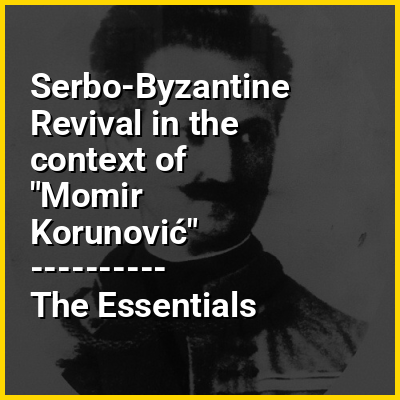
Serbo-Byzantine Revival in the context of "Momir Korunović"

Play Trivia Questions online!

or

Skip to study material about Serbo-Byzantine Revival in the context of "Momir Korunović"


⭐ Core Definition: Serbo-Byzantine Revival

The Modern Serbo-Byzantine architectural style, Neo-Byzantine architectural style or Serbian national architectural style is the style in Serbian architecture which lasted from the second half of the 19th century to the first half of the 20th century. This style originated in the tradition of medieval Serbian-Byzantine school and was part of international Neo-Byzantine style.

↓ Menu

👉 Serbo-Byzantine Revival in the context of Momir Korunović

Momir Korunović (Serbian Cyrillic: Момир Коруновић), was a Serbian architect associated with Serbo-Byzantine Revival. He was sometimes called the 'Serbian Gaudi'. Although he designed many buildings in Belgrade and Yugoslavia between the two World Wars, he is largely forgotten today. Many of his works were destroyed or substantially altered during World War II and the communist period.

↓ Explore More Topics
In this Dossier

Serbo-Byzantine Revival in the context of Sts. Cyril and Methodius Church (Ljubljana)

Sts. Cyril and Methodius Church (Serbian: Храм светих Кирила и Методија/Hram svetih Kirila i Metodija, Slovene: Cerkev sv. Cirila in Metoda), commonly known as the Orthodox Church (Slovene: Pravoslavna cerkev, Serbian: Pravoslavna crkva), is an Eastern Orthodox church building located in Trubar Park (Slovene: Trubarjev park), between Bleiweis Street (Bleiweisova cesta) and Prešeren Street (Prešernova cesta), north of the Museum of Modern Art and west of the National Gallery of Slovenia. It belongs to the Metropolitanate of Zagreb and Ljubljana of the Serbian Orthodox Church and is named after Saints Cyril and Methodius, brothers known as the "Apostles to the Slavs."

Built in Serbo-Byzantine Revival, the church has five domes with golden crosses at their top. It was built from 1932 to 1936 by Ivan Bricelj based on plans by the architect Momir Korunović. The frescoes in the interior were painted by the Serbian painters Dragomir Jašović, Miša Mladenović, and Danica Mladenovič from 1986 until 1997. The iconostasis is work of a prominent woodcarver workshop from Debar (Macedonia) and has been decorated with icons by the Slovene painter Mirko Šubic [sl], who created them in 1940.

↑ Return to Menu