Semi-rigid airship in the context of "Rigid airship"

Play Trivia Questions online!

or

Skip to study material about Semi-rigid airship in the context of "Rigid airship"

Ad spacer

⭐ Core Definition: Semi-rigid airship

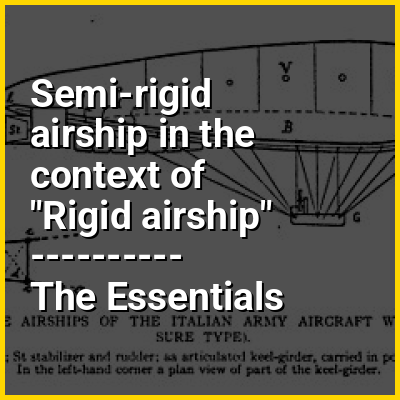
A semi-rigid airship is an airship which has a stiff keel or truss supporting the main envelope along its length. The keel may be partially flexible or articulated and may be located inside or outside the main envelope. The outer shape of the airship is maintained by gas pressure, as with the non-rigid "blimp". Semi-rigid dirigibles were built in significant quantity from the late 19th century but in the late 1930s they fell out of favour along with rigid airships. No more were constructed until the semi-rigid design was revived by the Zeppelin NT in 1997.

Semi-rigid construction is lighter-weight than the outer framework of a rigid airship, while it allows greater loading than a non-rigid type.

↓ Menu

>>>PUT SHARE BUTTONS HERE<<<

👉 Semi-rigid airship in the context of Rigid airship

A rigid airship is a type of airship (or dirigible) in which the envelope is supported by an internal framework rather than by being kept in shape by the pressure of the lifting gas within the envelope, as in blimps (also called pressure airships) and semi-rigid airships. Rigid airships are often commonly called Zeppelins, though this technically refers only to airships built by the Luftschiffbau Zeppelin company.

In 1900, Count Ferdinand von Zeppelin successfully performed the maiden flight of his first airship; further models quickly followed. Prior to the First World War, Germany was a world leader in the field, largely attributable to the work of von Zeppelin and his Luftschiffbau Zeppelin company. During the conflict, rigid airships were tasked with various military duties, which included their participation in Germany's strategic bombing campaign. Numerous rigid airships were produced and employed with relative commercial success between the 1900s and the late 1930s. The heyday of the rigid airship was abruptly ended by the destruction of the Hindenburg by fire on 6 May 1937. The disaster not only destroyed the biggest zeppelin in the world, but the film caused considerable reputation damage to rigid airships in general. Several nations had ended military rigid airship programs after serious accidents earlier in the decade, but widespread public safety concerns in the wake of the Hindenburg disaster led several nations to permanently ground their existing rigid airships and scrap them in subsequent years.
↓ Explore More Topics
In this Dossier

Semi-rigid airship in the context of Blimp

A non-rigid airship, commonly called a blimp (/blɪmp/), is an airship (dirigible) without an internal structural framework or a keel. Unlike semi-rigid and rigid airships (e.g. Zeppelins), blimps rely on the pressure of their lifting gas (usually helium, rather than flammable hydrogen) and the strength of the envelope to maintain their shape. Blimps are known for their use in advertising, surveillance, and observation due to their maneuverability, slow speeds and steady flight capabilities.

↑ Return to Menu

Semi-rigid airship in the context of Ballonet

A ballonet is an inflatable bag inside the outer envelope of an airship which, when inflated, reduces the volume available for the lifting gas, making it more dense. Because air is also denser than the lifting gas, inflating the ballonet reduces the overall lift, while deflating it increases lift. In this way, the ballonet can be used to adjust the lift as required.

Ballonets may typically be used in non-rigid or semi-rigid airships, commonly with multiple ballonets located both fore and aft to maintain balance and to control the pitch of the airship.

↑ Return to Menu

Semi-rigid airship in the context of Zeppelin NT

The Zeppelin NT ("Neue Technologie", German for new technology) is a class of helium-filled airships being manufactured since the 1990s by the German company Zeppelin Luftschifftechnik GmbH (ZLT) in Friedrichshafen. The initial model is the N07. The company considers itself the successor of the companies founded by Ferdinand von Zeppelin which constructed and operated the very successful Zeppelin airships in the first third of the 20th century. There are, however, a number of notable differences between the Zeppelin NT and original Zeppelins as well as between the Zeppelin NT and usual non-rigid airships known as blimps. The Zeppelin NT is classified as a semi-rigid airship.

There are various roles for the Zeppelin NT; traditional roles have been aerial tourism purposes and for conducting passenger services. The Zeppelin NT have also been used for observation platforms, such as for aerial photographers and by television commentators covering major events. Due to their capability for low-vibration flight for up to 24 hours at a time, ZLT considers the airships suitable for research missions for environmental observation, troposphere research and natural resource prospecting. The envelope of the airship has also been used for advertising purposes.

↑ Return to Menu

Semi-rigid airship in the context of Goodyear GZ-20

The Goodyear GZ-20/20A was a class of non-rigid airship or blimp introduced in 1969 by The Goodyear Tire and Rubber Company in the United States as its signature promotional aircraft, the Goodyear Blimp. The design is based on the previous Goodyear GZ-19 class. The GZ-20 featured a larger envelope to carry the "Super-Skytacular" advertising night sign and more powerful engines. The GZ-20s were the mainstay of Goodyear's airship operations until 2017, when they were replaced with the new Zeppelin NT semi-rigid airship.

↑ Return to Menu

Semi-rigid airship in the context of Roma (airship)

Roma was an Italian-built semi-rigid airship, designated by its designer as the Model T-34. Purchased by the United States from the Italian government in 1921, Roma was operated for three months by the United States Army Air Service from November 15, 1921 to February 21, 1922, when it crashed and exploded in Norfolk, Virginia, killing 34 crewmen and passengers aboard, with 9 survivors. As a result of this accident, Roma was the last hydrogen inflated airship flown by the US military; all subsequent US Army and Navy airships were inflated with non-flammable helium.

↑ Return to Menu