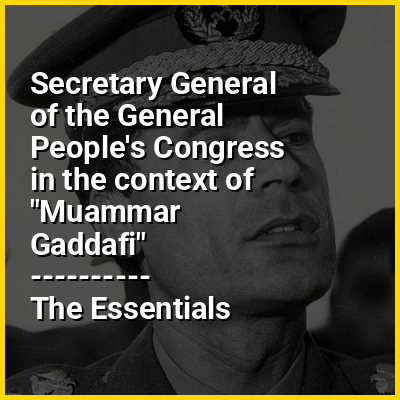
Muammar Muhammad Abu Minyar al-Gaddafi (c. 1942 – 20 October 2011) was a Libyan military officer, revolutionary, politician, and political theorist who ruled Libya from 1969 until his overthrow by Libyan rebel forces in 2011 during the first Libyan civil war. He came to power through a military coup, first becoming Revolutionary Chairman of the Libyan Arab Republic from 1969 to 1977, Secretary General of the General People's Congress from 1977 to 1979, and then the Brotherly Leader of the Great Socialist People's Libyan Arab Jamahiriya from 1979 to 2011. Initially ideologically committed to Arab nationalism and Arab socialism, Gaddafi later ruled according to his own Third International Theory.
Born near Sirte, Italian Libya, to a poor Bedouin Arab family, Gaddafi became an Arab nationalist while at school in Sabha, later enrolling in the Royal Military Academy, Benghazi. He founded a revolutionary group known as the Free Officers movement which deposed the Western-backed Senussi monarchy of Idris in a 1969 coup. Gaddafi converted Libya into a republic governed by his Revolutionary Command Council. Ruling by decree, he deported Libya's Italian population and ejected its Western military bases. He strengthened ties to Arab nationalist governments and unsuccessfully advocated pan-Arab political union. An Islamic modernist, he introduced sharia as the basis for the legal system and promoted Islamic socialism. He nationalized the oil industry and used the increasing state revenues to bolster the military, fund foreign revolutionaries, and implement social programs emphasizing housebuilding, healthcare and education projects. In 1973, he initiated a "Popular Revolution" with the formation of Basic People's Congresses, presented as a system of direct democracy, but retained personal control over major decisions. He outlined his Third International Theory that year in The Green Book.