Secondary treatment in the context of "Constructed wetland"

Play Trivia Questions online!

or

Skip to study material about Secondary treatment in the context of "Constructed wetland"

Ad spacer

⭐ Core Definition: Secondary treatment

Secondary treatment (mostly biological wastewater treatment) is the removal of biodegradable organic matter (in solution or suspension) from sewage or similar kinds of wastewater. The aim is to achieve a certain degree of effluent quality in a sewage treatment plant suitable for the intended disposal or reuse option. A "primary treatment" step often precedes secondary treatment, whereby physical phase separation is used to remove settleable solids. During secondary treatment, biological processes are used to remove dissolved and suspended organic matter measured as biochemical oxygen demand (BOD). These processes are performed by microorganisms in a managed aerobic or anaerobic process depending on the treatment technology. Bacteria and protozoa consume biodegradable soluble organic contaminants (e.g. sugars, fats, and organic short-chain carbon molecules from human waste, food waste, soaps and detergent) while reproducing to form cells of biological solids. Secondary treatment is widely used in sewage treatment and is also applicable to many agricultural and industrial wastewaters.

Secondary treatment systems are classified as fixed-film or suspended-growth systems, and as aerobic versus anaerobic. Fixed-film or attached growth systems include trickling filters, constructed wetlands, bio-towers, and rotating biological contactors, where the biomass grows on media and the sewage passes over its surface. The fixed-film principle has further developed into moving bed biofilm reactors (MBBR) and Integrated Fixed-Film Activated Sludge (IFAS) processes. Suspended-growth systems include activated sludge, which is an aerobic treatment system, based on the maintenance and recirculation of a complex biomass composed of micro-organisms (bacteria and protozoa) able to absorb and adsorb the organic matter carried in the wastewater. Constructed wetlands are also being used. An example for an anaerobic secondary treatment system is the upflow anaerobic sludge blanket reactor.
↓ Menu

>>>PUT SHARE BUTTONS HERE<<<

👉 Secondary treatment in the context of Constructed wetland

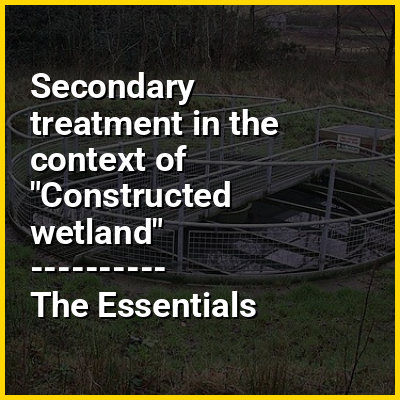
A constructed wetland is an artificial wetland to treat sewage, greywater, stormwater runoff or industrial wastewater. It may also be designed for land reclamation after mining, or as a mitigation step for natural areas lost to land development. Constructed wetlands are engineered systems that use the natural functions of vegetation, soil, and organisms to provide secondary treatment to wastewater. The design of the constructed wetland has to be adjusted according to the type of wastewater to be treated. Constructed wetlands have been used in both centralized and decentralized wastewater systems. Primary treatment is recommended when there is a large amount of suspended solids or soluble organic matter (measured as biochemical oxygen demand and chemical oxygen demand).

Similar to natural wetlands, constructed wetlands also act as a biofilter and/or can remove a range of pollutants (such as organic matter, nutrients, pathogens, heavy metals) from the water. Constructed wetlands are designed to remove water pollutants such as suspended solids, organic matter and nutrients (nitrogen and phosphorus). All types of pathogens (i.e., bacteria, viruses, protozoans and helminths) are expected to be removed to some extent in a constructed wetland. Subsurface wetlands provide greater pathogen removal than surface wetlands.

↓ Explore More Topics
In this Dossier

Secondary treatment in the context of Sewage treatment

Sewage treatment is a type of wastewater treatment which aims to remove contaminants from sewage to produce an effluent that is suitable to discharge to the surrounding environment or an intended reuse application, thereby preventing water pollution from raw sewage discharges. Sewage contains wastewater from households and businesses and possibly pre-treated industrial wastewater. There are a large number of sewage treatment processes to choose from. These can range from decentralized systems (including on-site treatment systems) to large centralized systems involving a network of pipes and pump stations (called sewerage) which convey the sewage to a treatment plant. For cities that have a combined sewer, the sewers will also carry urban runoff (stormwater) to the sewage treatment plant. Sewage treatment often involves two main stages, called primary and secondary treatment, while advanced treatment also incorporates a tertiary treatment stage with polishing processes and nutrient removal. Secondary treatment can reduce organic matter (measured as biological oxygen demand) from sewage,  using aerobic or anaerobic biological processes. A quaternary treatment step (sometimes referred to as advanced treatment) can also be added for the removal of organic micropollutants, such as pharmaceuticals. This has been implemented in full-scale in Sweden.

A large number of sewage treatment technologies have been developed, mostly using biological treatment processes. Design engineers and decision makers need to take into account technical and economical criteria of each alternative when choosing a suitable technology. Often, the main criteria for selection are desired effluent quality, expected construction and operating costs, availability of land, energy requirements and sustainability aspects. In developing countries and in rural areas with low population densities, sewage is often treated by various on-site sanitation systems and not conveyed in sewers. These systems include septic tanks connected to drain fields, on-site sewage systems (OSS), and vermifilter systems. On the other hand, advanced and relatively expensive sewage treatment plants may include tertiary treatment with disinfection and possibly even a fourth treatment stage to remove micropollutants.

↑ Return to Menu

Secondary treatment in the context of Sewage sludge treatment

Sewage sludge treatment describes the processes used to manage and dispose of sewage sludge produced during sewage treatment. Sludge treatment is focused on reducing sludge weight and volume to reduce transportation and disposal costs, and on reducing potential health risks of disposal options. Water removal is the primary means of weight and volume reduction, while pathogen destruction is frequently accomplished through heating during thermophilic digestion, composting, or incineration. The choice of a sludge treatment method depends on the volume of sludge generated, and comparison of treatment costs required for available disposal options. Air-drying and composting may be attractive to rural communities, while limited land availability may make aerobic digestion and mechanical dewatering preferable for cities, and economies of scale may encourage energy recovery alternatives in metropolitan areas.

Sludge is mostly water with some amounts of solid material removed from liquid sewage. Primary sludge includes settleable solids removed during primary treatment in primary clarifiers. Secondary sludge is sludge separated in secondary clarifiers that are used in secondary treatment bioreactors or processes using inorganic oxidizing agents. In intensive sewage treatment processes, the sludge produced needs to be removed from the liquid line on a continuous basis because the volumes of the tanks in the liquid line have insufficient volume to store sludge. This is done in order to keep the treatment processes compact and in balance (production of sludge approximately equal to the removal of sludge). The sludge removed from the liquid line goes to the sludge treatment line. Aerobic processes (such as the activated sludge process) tend to produce more sludge compared with anaerobic processes. On the other hand, in extensive (natural) treatment processes, such as ponds and constructed wetlands, the produced sludge remains accumulated in the treatment units (liquid line) and is only removed after several years of operation.

↑ Return to Menu

Secondary treatment in the context of Vermifilter

A vermifilter (also vermi-digester or lumbrifilter) is an aerobic treatment system, consisting of a biological reactor containing media that filters organic material from wastewater. The media also provides a habitat for aerobic bacteria and composting earthworms that purify the wastewater by removing pathogens and oxygen demand. The "trickling action" of the wastewater through the media dissolves oxygen into the wastewater, ensuring the treatment environment is aerobic for rapid decomposition of organic substances.

Vermifilters are most commonly used for sewage treatment and for agro-industrial wastewater treatment. Vermifilters can be used for primary, secondary and tertiary treatment of sewage, including blackwater and greywater in on-site systems and municipal wastewater in large centralised systems.

↑ Return to Menu

Secondary treatment in the context of Activated sludge

The activated sludge process is a type of biological wastewater treatment process for treating sewage or industrial wastewaters using aeration and a biological floc composed of bacteria and protozoa. It is one of several biological wastewater treatment alternatives in secondary treatment, which deals with the removal of biodegradable organic matter and suspended solids. It uses air (or oxygen) and microorganisms to biologically oxidize organic pollutants, producing a waste sludge (or floc) containing the oxidized material.

The activated sludge process for removing carbonaceous pollution begins with an aeration tank where air (or oxygen) is injected into the waste water. This is followed by a settling tank to allow the biological flocs (the sludge blanket) to settle, thus separating the biological sludge from the clear treated water. Part of the waste sludge is recycled to the aeration tank and the remaining waste sludge is removed for further treatment and ultimate disposal.

↑ Return to Menu