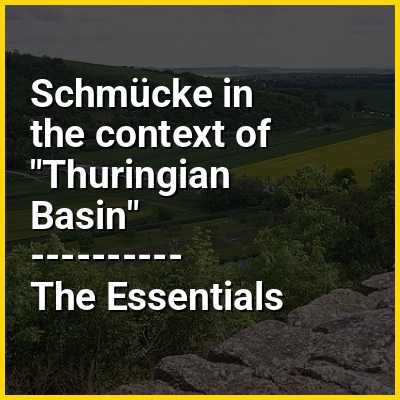
The Schmücke (German pronunciation: [ˈʃmʏkə] ), also called the Kahle Schmücke, is a hill ridge up to 380.1 m above sea level (NHN) and only about 7 km² in area. It lies within the districts of Kyffhäuserkreis and Sömmerda in the German state of Thuringia.
>>>PUT SHARE BUTTONS HERE<<<
👉 Schmücke in the context of Thuringian Basin
The Thuringian Basin (German: Thüringer Becken, pronounced [ˈtyːʁɪŋɐ ˈbɛkn̩]) is a depression in the central and northwest part of Thuringia in Germany which is crossed by several rivers, the longest of which is the Unstrut. It stretches about 60 kilometres (37 mi) from north to south and around 120 kilometres (75 mi) from east to west. Its height varies from about 150 to 250 m above sea level (NN).
The Basin is surrounded by a wide outer girdle of limestone (Muschelkalk) ridges (including Hainich, Dün, Hainleite, Hohe Schrecke, Schmücke, Finne), and to the southwest by the Thuringian Forest and to the southeast by sharply divided terraces (the Ilm-Saale and Ohrdruf Muschelkalk plateaus, and the Saale-Elster Bunter sandstone plateau). The Thuringian Basin belongs to the triassic period, during which horizontal beds of Bunter sandstone, Muschelkalk and Keuper were laid down. Below those lie the salt and gypsum layers of Magnesian Limestone (Zechstein). In the Cenozoic era the surrounding ridges were uplifted, whilst the Thuringian Basin sank to form a saucer-shaped depression.