Satellites in the context of "Satellite navigation device"

Play Trivia Questions online!

or

Skip to study material about Satellites in the context of "Satellite navigation device"

Ad spacer

⭐ Core Definition: Satellites

A satellite or an artificial satellite is an object, typically a spacecraft, placed into orbit around a celestial body. They have a variety of uses, including communication relay, weather forecasting, navigation (GPS), broadcasting, scientific research, and Earth observation. Additional military uses are reconnaissance, early warning, signals intelligence and, potentially, weapon delivery. Other satellites include the final rocket stages that place satellites in orbit and formerly useful satellites that later become defunct.

Except for passive satellites, most satellites have an electricity generation system for equipment on board, such as solar panels or radioisotope thermoelectric generators (RTGs). Most satellites also have a method of communication to ground stations, called transponders. Many satellites use a standardized bus to save cost and work, the most popular of which are small CubeSats. Similar satellites can work together as groups, forming constellations. Because of the high launch cost to space, most satellites are designed to be as lightweight and robust as possible. Most communication satellites are radio relay stations in orbit and carry dozens of transponders, each with a bandwidth of tens of megahertz.
↓ Menu

>>>PUT SHARE BUTTONS HERE<<<

👉 Satellites in the context of Satellite navigation device

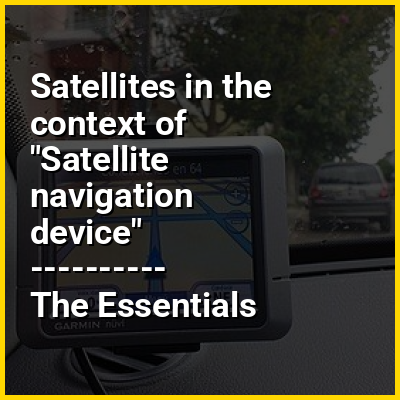
A satellite navigation device, also called a satnav device or GPS device, uses satellites of the Global Positioning System (GPS) or similar global navigation satellite systems (GNSS) to determine the user's geographic coordinates. It may also display the user's position on a map and offer routing directions (as in turn-by-turn navigation).

As of 2023, four GNSS systems are operational: the original United States' GPS, the European Union's Galileo, Russia's GLONASS, and China's BeiDou Navigation Satellite System. The Indian Regional Navigation Satellite System (IRNSS) will follow and Japan's Quasi-Zenith Satellite System (QZSS) scheduled for 2023 will augment the accuracy of a number of GNSS.

↓ Explore More Topics
In this Dossier

Satellites in the context of Fuel cell

A fuel cell is an electrochemical cell that converts the chemical energy of a fuel (often hydrogen) and an oxidizing agent (often oxygen) into electricity through a pair of redox reactions. Fuel cells are different from most batteries in requiring a continuous source of fuel and oxygen (usually from air) to sustain the chemical reaction, whereas in a battery the chemical energy usually comes from substances that are already present in the battery. Fuel cells can produce electricity continuously for as long as fuel and oxygen are supplied.

The first fuel cells were invented by Sir William Grove in 1838. The first commercial use of fuel cells came almost a century later following the invention of the hydrogen–oxygen fuel cell by Francis Thomas Bacon in 1932. The alkaline fuel cell, also known as the Bacon fuel cell after its inventor, has been used in NASA space programs since the mid-1960s to generate power for satellites and space capsules. Since then, fuel cells have been used in many other applications. Fuel cells are used for primary and backup power for commercial, industrial and residential buildings and in remote or inaccessible areas. They are also used to power fuel cell vehicles, including forklifts, automobiles, buses, trains, boats, motorcycles, and submarines.

↑ Return to Menu

Satellites in the context of Reconnaissance

In military operations, military reconnaissance (/rɪˈkɒnɪsəns/) or scouting is the exploration of an area by military forces to obtain information about enemy forces, the terrain, and civil activities in the area of operations. In military jargon, reconnaissance is abbreviated to recce (in British, Canadian, Australian English) and to recon (in American English), both derived from the root word reconnoitre / reconnoitering.

The types of reconnaissance include patrolling the local area of operations and long-range reconnaissance patrols, which are tasks usually realized in the United States of America by U.S. Army Rangers, cavalry scouts, and military intelligence specialists, using navy ships and submarines, reconnaissance aircraft, satellites to collect raw intelligence; and establishing observation posts. Moreover, espionage is different from reconnaissance, because spies work as civilians in enemy territory.

↑ Return to Menu

Satellites in the context of Lockheed Martin Space Systems

Lockheed Martin Space is one of the four major business divisions of Lockheed Martin. It has its headquarters in Littleton, Colorado, with additional sites in Valley Forge, Pennsylvania; Sunnyvale, California; Santa Cruz, California; Huntsville, Alabama; and elsewhere in the United States and United Kingdom. The division employs about 20,000 people, and its products include commercial and military satellites, space probes, missile defense systems, NASA's Orion spacecraft, and the Space Shuttle external tank.

↑ Return to Menu

Satellites in the context of Beryllium

Beryllium is a chemical element; it has symbol Be and atomic number 4. It is a steel-gray, hard, strong, lightweight and brittle alkaline earth metal. It is a divalent element that occurs naturally only in combination with other elements to form minerals. Gemstones high in beryllium include beryl (aquamarine, emerald, red beryl) and chrysoberyl. It is a relatively rare element in the universe, usually occurring as a product of the spallation of larger atomic nuclei that have collided with cosmic rays. Within the cores of stars, beryllium is depleted as it is fused into heavier elements. Beryllium constitutes about 0.0004 percent by mass of Earth's crust. The world's annual beryllium production of 220 tons is usually manufactured by extraction from the mineral beryl, a difficult process because beryllium bonds strongly to oxygen.

In structural applications, the combination of high flexural rigidity, thermal stability, thermal conductivity and low density (1.85 times that of water) make beryllium a desirable aerospace material for aircraft components, missiles, spacecraft, and satellites. Because of its low density and atomic mass, beryllium is relatively transparent to X-rays and other forms of ionizing radiation; therefore, it is the most common window material for X-ray equipment and components of particle detectors. When added as an alloying element to aluminium, copper (notably the alloy beryllium copper), iron, or nickel, beryllium improves many physical properties. For example, tools and components made of beryllium copper alloys are strong and hard and do not create sparks when they strike a steel surface. In air, the surface of beryllium oxidizes readily at room temperature to form a passivation layer 1–10 nm thick that protects it from further oxidation and corrosion. The metal oxidizes in bulk (beyond the passivation layer) when heated above 500 °C (932 °F), and burns brilliantly when heated to about 2,500 °C (4,530 °F).

↑ Return to Menu

Satellites in the context of Russian Aerospace Defence Forces

The Russian Aerospace Defence Forces (VVKO) (Russian: Войска воздушно-космической обороны (ВВКО), romanizedVoyska vozdushno-kosmicheskoy oborony (VVKO)) was a branch of the Russian Armed Forces responsible for aerospace defence, operation of Russian military satellites and the Plesetsk Cosmodrome. It was established on 1 December 2011 and dissolved on 1 August 2015. Russian Space Forces was reestablished on 1 August 2015 to replace it.

The Aerospace Defence Forces was first commanded by former Space Forces commander Colonel General Oleg Ostapenko, who was promoted to Deputy Minister of Defence in November 2012. In December 2012, Aleksandr Golovko was appointed the new commander. Although it is officially translated as aerospace in English, some Russian writers translate it as "air and space" instead.

↑ Return to Menu

Satellites in the context of James Van Allen

James Alfred Van Allen (September 7, 1914 – August 9, 2006) was an American space physicist at the University of Iowa. He was instrumental in establishing the field of magnetospheric research in space.

The Van Allen radiation belts were named after him, following his discovery using Geiger–Müller tube instruments on the 1958 satellites (Explorer 1, Explorer 3, and Pioneer 3) during the International Geophysical Year. Van Allen led the scientific community in putting scientific research instruments on space satellites.

↑ Return to Menu