Saskatchewan River in the context of "North Saskatchewan River"

Play Trivia Questions online!

or

Skip to study material about Saskatchewan River in the context of "North Saskatchewan River"

Ad spacer

>>>PUT SHARE BUTTONS HERE<<<

👉 Saskatchewan River in the context of North Saskatchewan River

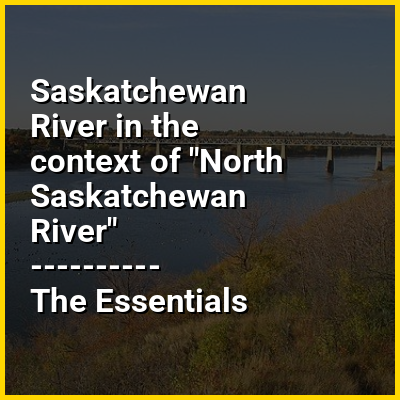
The North Saskatchewan River is a glacier-fed river that flows from the Canadian Rockies continental divide east to central Saskatchewan, where it joins with the South Saskatchewan River to make up the Saskatchewan River. Its water flows into the Hudson Bay.

The Saskatchewan River system is the largest shared between the Canadian provinces of Alberta and Saskatchewan. Its watershed includes most of southern and central Alberta and Saskatchewan.

↓ Explore More Topics
In this Dossier

Saskatchewan River in the context of Nelson River

The Nelson River is a river of north-central North America, in the Canadian province of Manitoba. The river drains Lake Winnipeg and runs 644 kilometres (400 mi) before it ends in Hudson Bay near Port Nelson. Its full length (including the Saskatchewan River and Bow River) is 2,575 kilometres (1,600 mi), it has mean discharge of 2,370 cubic metres per second (84,000 cu ft/s), and has a drainage basin of 1,072,300 square kilometres (414,000 sq mi), of which 180,000 square kilometres (69,000 sq mi) is in the United States.

↑ Return to Menu

Saskatchewan River in the context of Swampy Cree

The Swampy Cree people, also known by their autonyms Néhinaw, Maskiki Wi Iniwak, Mushkekowuk, Maškékowak, Maskegon or Maskekon (and therefore also Muskegon and Muskegoes) or by exonyms including West Main Cree, Lowland Cree, and Homeguard Cree, are a division of the Cree Nation occupying lands located in northern Manitoba, along the Saskatchewan River in northeastern Saskatchewan, along the shores of Hudson Bay and adjoining interior lands south and west as well as territories along the shores of Hudson and James Bay in Ontario. They are geographically and to some extent culturally split into two main groupings, and therefore speak two dialects of the Swampy Cree language, which is an "n-dialect":

  • Western Swampy Cree called themselves: Mushkego, Mushkegowuk (or Maškēkowak), also called Lowland (Half-Homeguard) Cree, speak the western dialect of the Swampy Cree language, while the s/š distinction is kept in the eastern dialect, the western dialect have merged both into s
  • Eastern Swampy Cree / Western James Bay Cree called themselves: Omaškêkowak, Omushkego, Omushkegowak, together with the Moose Cree also called Lowland Cree, Lowland (Homeguard) Cree, West Main Cree, James Bay Mushkego, because they were living along the western shores of the Hudson and James Bay they were oft also known as Western James Bay Cree, reflecting their position in contrast to the (Eastern) James Bay Cree, speak the eastern dialect of the Swampy Cree language, which kept the s/š distinction
↑ Return to Menu

Saskatchewan River in the context of The Pas, Manitoba

The Pas (/pɑː/ PAH; French: Le Pas) is a town in Manitoba, Canada, at the confluence of the Pasquia River and the Saskatchewan River and surrounded by the unorganized Northern Region of the province. It is approximately 520 kilometres (320 mi) northwest of the provincial capital, Winnipeg, and 35 kilometres (22 mi) from the border of Saskatchewan. It is sometimes still called Paskoyac by locals after the first trading post, called Fort Paskoya, constructed in the 1740s by French and Canadian traders. The Pasquia River begins in the Pasquia Hills in east central Saskatchewan. The French in 1795 knew the river as Basquiau.

Known as "The Gateway to the North", The Pas is a multi-industry northern Manitoba town serving the surrounding region. The main components of the region's economy are agriculture, forestry, commercial fishing, tourism, transportation, and services (especially health and education). The main employer is a paper mill operated by Canadian Kraft Paper Industries Ltd. The Pas contains one of the two main campuses of the University College of the North. Across the river on the neighbouring Opaskwayak Cree Nation, the Otineka Mall serves as the area's principal enclosed shopping centre.
↑ Return to Menu