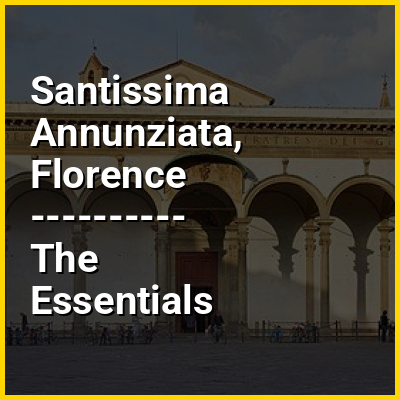
The Basilica della Santissima Annunziata (Basilica of the Most Holy Annunciation) is a Renaissance-style, Catholic minor basilica in Florence, region of Tuscany, Italy. This is considered the mother church of the Servite Order. It is located at the northeastern side of the Piazza Santissima Annunziata near the city center.
HINT:
👉 Santissima Annunziata, Florence in the context of Piazza Santissima Annunziata
The Piazza della Santissima Annunziata is a square in the city of Florence, the capital city of Tuscany in central Italy. The piazza is named after the Basilica della Santissima Annunziata at the head of the square facing via dei Servi, which leads to the Cathedral.
The model for the arcades framing the square on three sides was provided by the Ospedale degli Innocenti, a 15th-century foundling hospital sponsored by a civic donation. The complex was initially designed by Filippo Brunelleschi, the father of Renaissance architecture and builder of the cathedral's dome. The hospital is one of the first of its kind, in function and in style. Still in use today it also houses the Museo degli Innocenti. Adjacent on its other end, is the entrance to the National Archeological Museum.
In this Dossier
- ⭐ Core Definition: Santissima Annunziata, Florence
- 👉 Santissima Annunziata, Florence in the context of Piazza Santissima Annunziata
- Santissima Annunziata, Florence in the context of The Virgin and Child with Saint Anne (Leonardo)
- Santissima Annunziata, Florence in the context of Cosimo Rosselli
Santissima Annunziata, Florence in the context of The Virgin and Child with Saint Anne (Leonardo)
The Virgin and Child with Saint Anne (Italian: Sant'Anna, la Vergine e il Bambino con l'agnellino) is an unfinished oil painting by High Renaissance artist Leonardo da Vinci, dated to c. 1501–1519. It depicts Saint Anne, her daughter the Virgin Mary and the infant Jesus. Christ is shown grasping a sacrificial lamb symbolizing his Passion. The painting was commissioned as the high altarpiece for the Church of Santissima Annunziata in Florence and its theme had long preoccupied Leonardo.
View the full Wikipedia page for The Virgin and Child with Saint Anne (Leonardo)Santissima Annunziata, Florence in the context of Cosimo Rosselli
Cosimo Rosselli (Italian: [ˈkɔːzimo rosˈsɛlli]; 1439–1507) was an Italian painter of the Quattrocento, active mainly in his birthplace of Florence, but also in Pisa earlier in his career and in 1481–82 in the Sistine Chapel in Rome, where he painted some of the large frescoes on the side walls.
Though generally regarded as a lesser talent in comparison to Sandro Botticelli, Pietro Perugino, and Domenico Ghirlandaio, who were all also active at the Sistine Chapel, Rosselli was still able to win large and important commission throughout his career, a testament to his high level of activity in his native Florence. Important local commissions include a fresco in the cloister of Santissima Annunziata, Florence and those in the Chapel of the Holy Blood in Sant'Ambrogio, Florence.
View the full Wikipedia page for Cosimo Rosselli