San Bartolomeo all'Isola in the context of "Tiber Island"

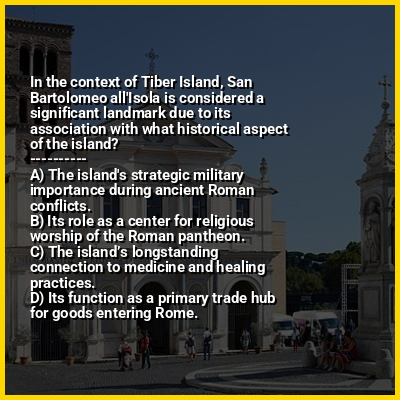
⭐ In the context of Tiber Island, San Bartolomeo all'Isola is considered a significant landmark due to its association with what historical aspect of the island?

Ad spacer

⭐ Core Definition: San Bartolomeo all'Isola

The Basilica of St. Bartholomew on the Island (Italian: Basilica di San Bartolomeo all'Isola, Latin: Basilica S. Bartholomaei in Insula) is a titular minor basilica, located in Rome, Italy. It was founded in 998 by Otto III, Holy Roman Emperor and contains the putative relics of St. Bartholomew the Apostle. It is located on Tiber Island, on the site of the former temple of Aesculapius, which had cleansed the island of its former ill-repute among the Romans and established its reputation as a hospital, continued under Christian auspices today.

Its cardinal priest has been Cardinal Blase Cupich since 19 November 2016.

↓ Menu

>>>PUT SHARE BUTTONS HERE<<<

👉 San Bartolomeo all'Isola in the context of Tiber Island

The Tiber Island (Italian: Isola Tiberina, Latin: Insula Tiberina) is the only river island in the part of the Tiber which runs through Rome. Tiber Island is located in the southern bend of the Tiber.

The island is boat-shaped, approximately 270 metres (890 feet) long and 67 metres (220 feet) wide, and has been connected with bridges to both sides of the river since antiquity. Being a seat of the ancient temple of Asclepius and later a hospital, the island is associated with medicine and healing. The Fatebenefratelli Hospital founded in the 16th century, and the basilica church of San Bartolomeo all'Isola dating from the 10th century, are located on the island.

↓ Explore More Topics
In this Dossier

San Bartolomeo all'Isola in the context of 1000s (decade)

The 1000s was a decade of the Julian Calendar which began on January 1, 1000, and ended on December 31, 1009.

  • Palace Scandal: Princess Consort Yasuko has an affair. Michinaga (her half-brother) investigates it secretly and finds out the truth about her pregnancy. Yasuko cries and repents. Yasuko leaves the palace under the patronage of Empress Dowager Senshi and Michinaga (moved to his residence).
  • Murasaki Shikibu starts to write The Tale of Genji.
  • Ichimonjiya Wasuke, the oldest surviving wagashi store, is established as a teahouse adjacent to Imamiya Shrine.
  • January 10: Death of Empress Dowager Masako (empress consort of the late Emperor Reizei)
  • April 8: Fujiwara no Shoshi is promoted to Empress (Chugu), while there is another empress, Fujiwara no Teishi (kogo) - this is the first time that there are two empresses

The Muslim world was in its Golden Age; still organised in caliphates, it continued to be dominated by the Abbasid Caliphate, with the Caliphate of Córdoba to the west, the Fatimid Caliphate in North Africa, and experienced ongoing campaigns in Africa and in India. At the time, Persia was in a period of instability, with various polities seceding from Abbasid rule, among whom the Ghaznavids would emerge as the most powerful.
↑ Return to Menu