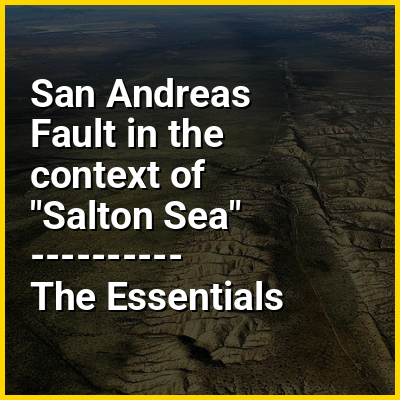
The San Andreas Fault is a continental right-lateral strike-slip transform fault that extends roughly 750 mi (1,210 km) through the U.S. state of California. It forms part of the tectonic boundary between the Pacific plate and the North American plate. Traditionally, for scientific purposes, the fault has been classified into three main segments (northern, central, and southern), each with different characteristics and a different degree of earthquake risk. The average slip rate along the entire fault ranges from 0.79 to 1.38 inches (20 to 35 mm) per year.
In the north, the fault terminates offshore near Eureka, California, at the Mendocino triple junction, where three tectonic plates meet. The Cascadia subduction zone intersects the San Andreas fault at the Mendocino triple junction. It has been hypothesized that a major earthquake along the Cascadia subduction zone could trigger a rupture along the San Andreas Fault.