S-Bahn in the context of "Crossrail"

Play Trivia Questions online!

or

Skip to study material about S-Bahn in the context of "Crossrail"


⭐ Core Definition: S-Bahn

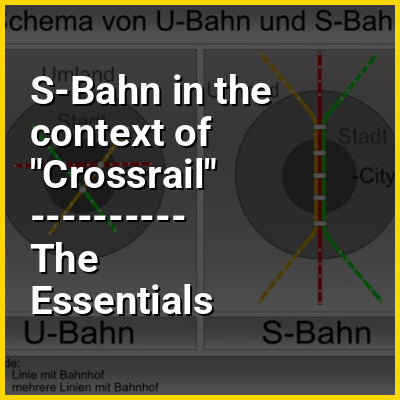
S-Bahn (/ˈɛsbɑːn/ ESS-bahn, German: [ˈɛsˌbaːn] ; lit.'S-train') is a type of hybrid commuter rail and rapid transit service, originating in German-speaking countries. In general, S-Bahn systems link suburbs with the city centre at moderate speeds, while continuing across the urban core over a central high-frequency corridor where multiple lines converge, where they provide a rapid means of travel across the city. The name S-Bahn derives from the German terms Schnellbahn (lit.'rapid train'), Stadtschnellbahn (lit.'rapid city train'), and Stadtbahn (lit.'city train'; not to be confused with the modern Stadtbahn).

The first such network, the Berlin S-Bahn, began operation in December 1930 and inspired similar systems across Europe. The term "S-Bahn" has since become a generic term for hybrid suburban–urban rail networks, with counterparts such as the Stog in Denmark, S‑Trein/Train S in Belgium, Esko/S‑lines in the Czech Republic, Linee S in Italy, and SKM in Poland. The S-Bahn is also recognized as a train category in several European countries. The concept also influenced systems outside the German-speaking world, including the Réseau Express Régional (RER) in Paris and its counterparts in other cities.
↓ Menu

👉 S-Bahn in the context of Crossrail

Crossrail is a completed railway project centred on London. It provides a high-frequency hybrid commuter rail and rapid transit system, akin to the RER in Paris and the S-Bahn systems of German-speaking countries, known as the Elizabeth line, that crosses the capital from suburbs on the west to east and connects two major railway lines terminating in London: the Great Western Main Line and the Great Eastern Main Line. The project was approved in 2007, and construction began in 2009 on the central section and connections to existing lines that became part of the route, which has been named the Elizabeth line in honour of Queen Elizabeth II who opened the line on 17 May 2022 during her Platinum Jubilee. The central section of the line between Paddington and Abbey Wood opened on 24 May 2022, with 12 trains per hour running in each direction through the core section in Central London.

The main feature of the project was the construction of a new railway line that runs underground from Paddington Station to a junction near Whitechapel. There it splits into a branch to Stratford, where it joins the Great Eastern Main Line; and a branch to Abbey Wood in southeast London.

↓ Explore More Topics
In this Dossier

S-Bahn in the context of Réseau Express Régional

The Réseau Express Régional (French pronunciation: [ʁezo ɛkspʁɛs ʁeʒjɔnal]; English: Regional Express Network), commonly abbreviated RER (pronounced [ɛʁəɛʁ]), is a hybrid commuter rail and rapid transit system serving the city centre of Paris and its suburbs. It acts as a combined city centre underground rail system and suburbs-to-city-centre commuter rail, similar to the S-Bahn in Germany, Austria and Switzerland, S-train in Copenhagen, the Pendeltåg in Sweden, the Overground and Elizabeth Line in London, S Lines in Milan, plus many other commuter rail networks around the world.

Conceived of as a métropolitain express ('express metro') during the mid-1930s, the scheme was revived in the 1950s and construction began in the early 1960s. The RER was not fully conceptualised until the completion of the Schéma directeur d'aménagement et d'urbanisme (rough translation: 'master plan for urban development') in 1965. The RER network, which initially comprised two lines, was formally inaugurated on 8 December 1977 in a ceremony that was attended by President Valéry Giscard d'Estaing. A second phase of construction commenced at the end of the 1970s which saw additional lines constructed along with extensions to the original two. The RER is operated partly by RATP, the authority that operates most of the public transport in Paris, and partly by the SNCF, France's national rail operator.

↑ Return to Menu

S-Bahn in the context of Elizabeth line

The Elizabeth line is a railway line that runs across Greater London and nearby towns, operating similarly to the RER in Paris and the S-Bahn systems of German-speaking countries. It runs services on dedicated infrastructure in central London from the Great Western Main Line west of Paddington station to Abbey Wood and via Whitechapel to the Great Eastern Main Line near Stratford; along the Great Western Main Line to Reading and Heathrow Airport in the west; and along the Great Eastern Main Line to Shenfield in the east.

Under the project name of Crossrail, the system was approved in 2007, and construction began in 2009. Originally planned to open in 2018, the project was repeatedly delayed, including for several months as a result of the COVID-19 pandemic. The service is now named after Queen Elizabeth II, who officially opened the line on 17 May 2022 during her Platinum Jubilee year; passenger services started on 24 May 2022.

↑ Return to Menu

S-Bahn in the context of Zurich S-Bahn

The Zurich S-Bahn (German: S-Bahn Zürich) system is a network of rail lines that has been incrementally expanded to cover the ZVV area, which comprises the entire canton of Zurich and portions of neighbouring cantons (Aargau, Glarus, Schaffhausen, Schwyz, St. Gallen, Thurgau and Zug), with a few lines extending into or crossing the territory of southern Germany. The network is one of many commuter rail operations in German speaking countries to be described as an S-Bahn. The lines connect with services of Aargau S-Bahn to the West, Basel S-Bahn (only in Waldshut) and Schaffhausen S-Bahn to the North, St. Gallen S-Bahn to the East, and Lucerne S-Bahn/Zug Stadtbahn to the South, as well as with InterCity, InterRegio and RegioExpress services at major junction stations.

The entire ZVV S-Bahn network went into operation in May 1990, although many of the lines were already in operation.

↑ Return to Menu

S-Bahn in the context of Rhine-Main S-Bahn

The Rhine-Main S-Bahn system is an integrated rapid transit and commuter train system for the Frankfurt/Rhine-Main region, which includes the cities Frankfurt am Main, Wiesbaden, Mainz, Offenbach am Main, Hanau and Darmstadt. The network comprises nine S-Bahn lines, eight of which currently travel through the cornerstone of the system, a tunnel (the "City Tunnel") through central Frankfurt. The first section of this tunnel was opened on May 28, 1978. Further tunnel sections were opened in 1983 and 1990, before its completion in 1992. The system belongs to the Rhein-Main-Verkehrsverbund (RMV) and is operated by DB Regio, a subsidiary of Deutsche Bahn.

End-to-end journey times on the nine lines in the system range from 36 minutes (on line S7) up to 87 minutes (on line S1). The longest journey time into central Frankfurt (Hauptwache), from any point on the network, is 54 minutes. Services on some lines start shortly after 4 a.m., while all lines have services from about 5 a.m. onwards. A full service is maintained from 6 a.m. until about 8 p.m., and a somewhat reduced service is run until the late evening. The last services leave Frankfurt at 2:12 a.m. The S8/S9 runs 24/7.

↑ Return to Menu

S-Bahn in the context of S-train (Copenhagen)

The Copenhagen S-train (Danish: S-tog), the S-train of Copenhagen, Denmark, is a key part of public transport in the city. It is a hybrid urban-suburban rail serving most of the Copenhagen urban area, and is analogous to the S-Bahn systems of Berlin, Vienna and Hamburg. The trains connect the Copenhagen inner city with Hillerød, Klampenborg, Frederikssund, Farum, Høje-Taastrup and Køge. There are 170 km (110 mi) of double track with 87 S-train stations, of which eight are in neighbouring towns outside greater Copenhagen.

The S-train is run by DSB S-tog A/S while Banedanmark owns the tracks and signals. Rail services are operated by "Fourth Generation" S-trains divided into 104 8-car train sets (Class SA) and 31 4-car train sets (Class SE).

↑ Return to Menu

S-Bahn in the context of Milan S Lines

The Milan S Lines are a commuter rail system serving the metropolitan area of Milan, Italy.The system comprises 13 lines serving 124 stations, for a total length of 403 km.There are 415 trains per day with a daily ridership of about 230,000.

The core of the system is the Passante, an underground railway running through the city approximately from the north-west to the south-east.Several lines share this track, making the service in the city centre comparable to a metro line or S-Bahn system.

↑ Return to Menu

S-Bahn in the context of Sihltal Zürich Uetliberg Bahn

The Sihltal Zürich Uetliberg Bahn AG (lit.'Sihl Valley Zurich Uetliberg Railway') – commonly abbreviated to SZU – is a public transport company and network in the Swiss canton of Zurich. The network comprises the Uetliberg and Sihltal railway lines, operated by S-Bahn services S4 and S10, a cable car and several bus services of Zimmerbergbus.

The SZU is jointly owned by the city of Zurich (32.6%), the municipalities of Adliswil, Langnau am Albis, Horgen, Thalwil and Uitikon (6.8%), the Canton of Zürich (23.8%), the federal government (27.8%), and other parties (9%). It is constituted as an Aktiengesellschaft (AG) or public company.

↑ Return to Menu

S-Bahn in the context of Dresden S-Bahn

The Dresden S-Bahn is a network of S-Bahn-type commuter train services in Dresden and the surrounding area. It is commissioned by Verkehrsverbund Oberelbe (VVO) from DB Regio Verkehrsbetrieb Südostsachsen and currently consists of three services operating over a 127.7 km-long (79.3 mi) network.

The S-Bahn fare structure was introduced on a series of suburban railway lines on 29 September 1974. The term "S-Bahn" has only officially been used for the system since 31 May 1992. Since 24 May 1998, VVO fares have been valid for the S-Bahn Dresden. Outside of Dresden, it runs to the centres of Freital, Meissen, Pirna, Radebeul and since 9 December 2007 also to Freiberg. All lines stop at Dresden Hauptbahnhof.

↑ Return to Menu