Russian America in the context of "Fort Ross, California"

Play Trivia Questions online!

or

Skip to study material about Russian America in the context of "Fort Ross, California"

Ad spacer

⭐ Core Definition: Russian America

From 1732 to 1867, the Russian Empire laid claim to northern Pacific Coast territories in the Americas. Russian colonial possessions in the Americas were collectively known as Russian America from 1799 to 1867. It consisted mostly of present-day Alaska in the United States, but also included the outpost of Fort Ross in California. Russian Creole settlements were concentrated in Alaska, including the capital, New Archangel (Novo-Arkhangelsk), which is now Sitka.

Russian expansion eastward began in 1552, and Russian explorers reached the Pacific Ocean in 1639. In 1725, Emperor Peter the Great ordered navigator Vitus Bering to explore the North Pacific for potential colonization. The Russians were primarily interested in the abundance of fur-bearing mammals on Alaska's coast, as stocks had been depleted by overhunting in Siberia. Bering's first voyage was foiled by thick fog and ice, but in 1741 a second voyage by Bering and Aleksei Chirikov discovered part of the North American mainland. Bering claimed the Alaskan country for the Russian Empire. Russia later confirmed its rule over the territory with the Ukase of 1799 which established the southern border of Russian America along the 55th parallel north. The decree also provided monopolistic privileges to the state-sponsored Russian-American Company (RAC) and established the Russian Orthodox Church in Alaska.
↓ Menu

>>>PUT SHARE BUTTONS HERE<<<

👉 Russian America in the context of Fort Ross, California

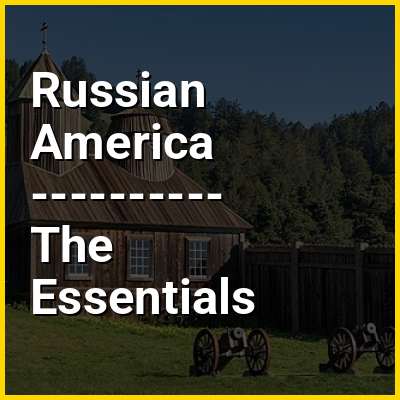
Fort Ross is a former Russian establishment on the west coast of North America in what is now Sonoma County, California. It was notable as the first multi-ethnic community north of the Spanish missions in what is now the U.S. state of California. Owned and operated by the Russian-American Company, it was the hub of the southernmost Russian settlements in North America from 1812 to 1841. Notably cosmopolitan, different ethnic groups settled in and around the fort: Native Californians, Native Alaskans, Russians, Finns, Swedes. It has been the subject of archaeological investigation and is a California Historical Landmark, a National Historic Landmark, and on the National Register of Historic Places. It is part of California's Fort Ross State Historic Park.

↓ Explore More Topics
In this Dossier

Russian America in the context of List of Russian explorers

The history of exploration by citizens or subjects of the Russian Federation, the Soviet Union, the Russian Empire, the Tsardom of Russia and other Russian predecessor states forms a significant part of the history of Russia as well as the history of the world. At 17,075,400 square kilometres (6,592,850 sq mi), Russia is the largest country in the world, covering more than a ninth of Earth's landmass. In the times of the Soviet Union and the Russian Empire, the country's share in the world's landmass reached 1/6. Most of these territories were first discovered by Russian explorers (if indigenous peoples of inhabited territories are not counted). Contiguous exploration in Eurasia and the building of overseas colonies in Russian America were some of the primary factors in Russian territorial expansion.

Apart from their discoveries in Alaska, Central Asia, Siberia, and the northern areas surrounding the North Pole, Russian explorers have made significant contributions to the exploration of the Antarctic, Arctic, and the Pacific islands, as well as deep-sea and space explorations.

↑ Return to Menu

Russian America in the context of Catherine the Great

Catherine II (born Princess Sophia Augusta Frederica, Russian: Екатерина Алексеевна Романова; 2 May 1729 – 17 November [O.S. 6 November] 1796), commonly known as Catherine the Great, was the reigning Empress of Russia from 1762 to 1796. She came to power after a coup d'etat against her husband, Peter III. Her long reign helped Russia thrive under a golden age under the Enlightenment. This renaissance led to the founding of many new cities, universities, and theatres, along with large-scale immigration from the rest of Europe and the recognition of Russia as one of the great powers of Europe.

After overthrowing and possibly assassinating her husband and her subsequent rule of the Russian Empire, Catherine often relied on noble favourites such as Count Grigory Orlov and Grigory Potemkin. Assisted by highly successful generals such as Alexander Suvorov and Pyotr Rumyantsev and admirals such as Samuel Greig and Fyodor Ushakov, she governed at a time when the Russian Empire was expanding rapidly by conquest and diplomacy. In the west, she installed her former lover to the throne of Poland, which was eventually partitioned. In the south, the Crimean Khanate was annexed following victories over the Bar Confederation and the Ottoman Empire in the Russo-Turkish War. With the support of Great Britain, Russia colonised the territories of New Russia along the coasts of the Black and Azov Seas. In the east, Russians became the first Europeans to colonise Alaska, establishing Russian America.

↑ Return to Menu

Russian America in the context of Orthodox Church in America

The Orthodox Church in America (OCA) is an Eastern Orthodox Christian church based in North America. The OCA consists of more than 700 parishes, missions, communities, monasteries and institutions in the United States, Canada and Mexico. In 2011, it had an estimated 84,900 members in the United States. In 2015, the OCA claimed 900,000 baptized members.

The OCA has its origins in a mission established by eight Russian Orthodox monks in Alaska, then part of Russian America, in 1794. This grew into a full diocese of the Russian Orthodox Church named the Diocese of Alaska and Aleutines with the Cathedral in Sitka. After the United States purchased Alaska from Russia in 1867, the diocese was granted jurisdiction for all North America and the see moved to San Francisco between 1872 and 1903, and later in New York City after 1903. By the late 19th century, the Russian Orthodox Church had grown in other areas of the United States due to the arrival of immigrants from areas of Eastern and Central Europe, many of them formerly of the Eastern Catholic Churches ("Greek Catholics"), and from the Middle East. These immigrants, regardless of nationality or ethnic background, were united under a single North American diocese of the Russian Orthodox Church.

↑ Return to Menu

Russian America in the context of Imperial Russian Navy

The Imperial Russian Navy (Russian: Российский императорский флот) operated as the navy of the Russian Tsardom and later the Russian Empire from 1696 to 1917. Formally established in 1696, it lasted until being dissolved in the wake of the February Revolution and the declaration of the Russian Republic in 1917. It developed from a smaller force that had existed prior to Tsar Peter the Great's founding of the modern Russian navy during the Second Azov campaign in 1696, and expanded in the second half of the 18th century before reaching its peak strength by the early part of the 19th century, behind only the British and French fleets in terms of size.

The Imperial Navy drew its officers from the aristocracy of the Empire, who belonged to the state Russian Orthodox Church. Young aristocrats began to be trained for leadership at a national naval boarding school, the Naval Cadet Corps. From 1818 on, only officers of the Imperial Russian Navy were appointed to the position of Chief Manager of the Russian-American Company, based in Russian America (present-day Alaska) for colonization and fur-trade development. Although the early Imperial Navy initially employed paid foreign sailors, the government began to recruit native-born sailors as conscripts, drafted (as were men to serve in the army). Service in the navy was lifelong before the 1874 decree on conscription limited the service term to six years at most. Many naval commanders and recruits came from Imperial Russia's non-Russian lands with maritime traditions—Finland and (especially) the Baltic governorates.

↑ Return to Menu

Russian America in the context of European Americans

European Americans are Americans of European ancestry. This term includes both people who descend from the first European settlers in the area of the present-day United States and people who descend from more recent European arrivals. Since the 17th century, European Americans have been the largest panethnic group in what is now the United States. According to the 2020 United States census, 58.8% of the White alone population and 56.1% of the White alone or in combination gave a detailed European write-in response.

The Spaniards were the first Europeans to establish a continuous presence in what is now the contiguous United States, although arriving in small numbers, with Martín de Argüelles (b. 1566) in St. Augustine, then a part of Spanish Florida, and the Russians were the first Europeans to settle in Alaska, establishing Russian America. The first British child born in the Americas was Virginia Dare, born August 18, 1587. She was born in Roanoke Colony, located in present-day North Carolina, which was the first attempt, made during the reign of Queen Elizabeth I, to establish a permanent English settlement in North America.

↑ Return to Menu

Russian America in the context of Colonial history of the United States

The colonial history of the United States covers the period of European colonization of North America from the early 16th century until the unifying of the Thirteen British Colonies and creation of the United States in 1776, during the Revolutionary War. In the late 16th century, England, France, Spain, and the Dutch Republic launched major colonization expeditions in North America. The death rate was very high among early settlers, and some disappeared in early attempts altogether, such as the ones in the English Lost Colony of Roanoke. Nevertheless, successful European colonies were established within several decades.

European settlers in the Thirteen Colonies came from a variety of social and religious groups, including adventurers, farmers, indentured servants, tradesmen, and a very few from the aristocracy. Settlers included the Dutch of New Netherland, the Swedes and Finns of New Sweden, the English Quakers of the Province of Pennsylvania, the English Puritans of New England, the Virginian Cavaliers, the English Catholics and Protestant Nonconformists of the Province of Maryland, the "worthy poor" of the Province of Georgia, the Germans who settled the mid-Atlantic colonies, and the Ulster Scots of the Appalachian Mountains. These groups all became part of the United States when it gained its independence in 1776. Parts of what had been New France were incorporated during the American Revolution and soon after. Parts of New Spain were incorporated in several stages, and Russian America was also incorporated into the United States at a later time. The diverse colonists from these various regions built colonies of distinctive social, religious, political, and economic style.

↑ Return to Menu

Russian America in the context of Russian irredentism

Russian irredentism (Russian: русский ирредентизм) refers to territorial claims made by the Russian Federation to regions that were historically part of the Russian Empire and the Soviet Union, which Russian nationalists regard as part of the "Russian world". It seeks to create a Greater Russia by politically incorporating ethnic Russians and Russian speakers living in territories bordering Russia. This ideology has been significantly defined by the regime of Vladimir Putin, who has governed the country since 1999. It is linked to Russian neo-imperialism.

Russian troops currently occupy parts of three neighbouring countries: southern and eastern Ukraine, Abkhazia and South Ossetia in Georgia, and the Transnistria region of Moldova. Since it began in 2014, the Russo-Ukrainian War has been described by much of the international community as being a culmination of Russia's irredentist policies towards Ukraine. Examples of these irredentist policies being implemented in this conflict include the Russian annexation of Crimea in 2014 and the ongoing Russian invasion of Ukraine, which saw the Russian annexation of southeastern Ukraine in 2022.

↑ Return to Menu

Russian America in the context of Sitka, Alaska

Sitka (Tlingit: Sheetʼká; Russian: Ситка) is a unified city-borough in the southeast portion of the U.S. state of Alaska. It was under Russian rule from 1799 to 1867. The city is situated on the west side of Baranof Island and the south half of Chichagof Island in the Alexander Archipelago of the Pacific Ocean (part of the Alaska Panhandle). As of the 2020 census, Sitka had a population of 8,458, making it the fifth-most populated city in the state.

With a consolidated land area of 2,870.3 square miles (7,434 square kilometers) and total area (including water) of 4,811.4 square miles (12,461 km), Sitka is the largest city by total area in the U.S.

↑ Return to Menu