Root mean square in the context of "Jitter"

Play Trivia Questions online!

or

Skip to study material about Root mean square in the context of "Jitter"


⭐ Core Definition: Root mean square

In mathematics, the root mean square (abbrev. RMS, RMS or rms) of a set of values is the square root of the set's mean square.Given a set , its RMS is denoted as either or . The RMS is also known as the quadratic mean (denoted ), a special case of the generalized mean. The RMS of a continuous function is denoted and can be defined in terms of an integral of the square of the function.In estimation theory, the root-mean-square deviation of an estimator measures how far the estimator strays from the data.

↓ Menu

👉 Root mean square in the context of Jitter

In electronics and telecommunications, jitter is the deviation from true periodicity of a presumably periodic signal, often in relation to a reference clock signal. In clock recovery applications it is called timing jitter. Jitter is a significant, and usually undesired, factor in the design of almost all communications links.

Jitter can be quantified in the same terms as all time-varying signals, e.g., root mean square (RMS), or peak-to-peak displacement. Also, like other time-varying signals, jitter can be expressed in terms of spectral density.

↓ Explore More Topics
In this Dossier

Root mean square in the context of Atacama Pathfinder Experiment

The Atacama Pathfinder Experiment (APEX) is a radio telescope 5,104 meters above sea level, at the Llano de Chajnantor Observatory in the Atacama Desert in northern Chile, 50 km east of San Pedro de Atacama built and operated by three European research institutes. The main dish has a diameter of 12 m and consists of 264 aluminium panels with an average surface accuracy of 17 micrometres (rms). The telescope was officially inaugurated on September 25, 2005.

The APEX telescope is a modified ALMA (Atacama Large Millimeter Array) prototype antenna and is at the site of the ALMA observatory. APEX is designed to work at sub-millimetre wavelengths, in the 0.2 to 1.5 mm range — between infrared light and radio waves — and to find targets that ALMA will be able to study in greater detail. Submillimetre astronomy provides a window into the cold, dusty and distant Universe, but the faint signals from space are heavily absorbed by water vapour in the Earth's atmosphere. Chajnantor was chosen as the location for such a telescope because the region is one of the driest on the planet and is more than 750 m higher than the observatories on Mauna Kea and 2400 m higher than the Very Large Telescope (VLT) on Cerro Paranal.

↑ Return to Menu

Root mean square in the context of Sound level meter

A sound level meter (also called sound pressure level meter) is used for acoustic measurements. It is commonly a hand-held instrument with a microphone. The best type of microphone for sound level meters is the condenser microphone, which combines precision with stability and reliability. The diaphragm of the microphone responds to changes in air pressure caused by sound waves. That is why the instrument is sometimes referred to as a sound pressure level meter. This movement of the diaphragm, i.e. the sound pressure (unit pascal, Pa), is converted into an electrical signal (unit volt, V). While describing sound in terms of sound pressure, a logarithmic conversion is usually applied and the sound pressure level is stated instead, in decibels (dB), with 0 dB SPL equal to 20 micropascals.

A microphone is distinguishable by the voltage value produced when a known, constant root mean square sound pressure is applied. This is known as microphone sensitivity. The instrument needs to know the sensitivity of the particular microphone being used. Using this information, the instrument is able to accurately convert the electrical signal back to sound pressure, and display the resulting sound pressure level (unit decibel, dB).

↑ Return to Menu

Root mean square in the context of Gaussian function

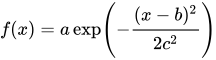
In mathematics, a Gaussian function, often simply referred to as a Gaussian, is a function of the base formand with parametric extensionfor arbitrary real constants a, b and non-zero c. It is named after the mathematician Carl Friedrich Gauss. The graph of a Gaussian is a characteristic symmetric "bell curve" shape. The parameter a is the height of the curve's peak, b is the position of the center of the peak, and c (the standard deviation, sometimes called the Gaussian RMS width) controls the width of the "bell".

Gaussian functions are often used to represent the probability density function of a normally distributed random variable with expected value μ = b and variance σ = c. In this case, the Gaussian is of the form

↑ Return to Menu

Root mean square in the context of Power-factor correction

In electrical engineering, the power factor of an AC power system is defined as the ratio of the real power absorbed by the load to the apparent power flowing in the circuit. Real power is the average of the instantaneous product of voltage and current and represents the capacity of the electricity for performing work. Apparent power is the product of root mean square (RMS) current and voltage. Apparent power is often higher than real power because energy is cyclically accumulated in the load and returned to the source or because a non-linear load distorts the wave shape of the current. Where apparent power exceeds real power, more current is flowing in the circuit than would be required to transfer real power. Where the power factor magnitude is less than one, the voltage and current are not in phase, which reduces the average product of the two. A negative power factor occurs when the device (normally the load) generates real power, which then flows back towards the source.

In an electric power system, a load with a low power factor draws more current than a load with a high power factor for the same amount of useful power transferred. The larger currents increase the energy lost in the distribution system and require larger wires and other equipment. Because of the costs of larger equipment and wasted energy, electrical utilities will usually charge a higher cost to industrial or commercial customers with a low power factor.

↑ Return to Menu

Root mean square in the context of Threshold of hearing

The absolute threshold of hearing (ATH), also known as the absolute hearing threshold or auditory threshold, is the minimum sound level of a pure tone that an average human ear with normal hearing can hear with no other sound present. The absolute threshold relates to the sound that can just be heard by the organism. The absolute threshold is not a discrete point and is therefore classed as the point at which a sound elicits a response a specified percentage of the time.

The threshold of hearing is generally reported in reference to the RMS sound pressure of 20 micropascals, i.e. 0 dB SPL, corresponding to a sound intensity of 0.98 pW/m at 1 atmosphere and 25 °C. It is approximately the quietest sound a young human with undamaged hearing can detect at 1 kHz. The threshold of hearing is frequency-dependent and it has been shown that the ear's sensitivity is best at frequencies between 2 kHz and 5 kHz, where the threshold reaches as low as −9 dB SPL.

↑ Return to Menu