Rolls-Royce Merlin in the context of "Allison V-1710"

Play Trivia Questions online!

or

Skip to study material about Rolls-Royce Merlin in the context of "Allison V-1710"

Ad spacer

⭐ Core Definition: Rolls-Royce Merlin

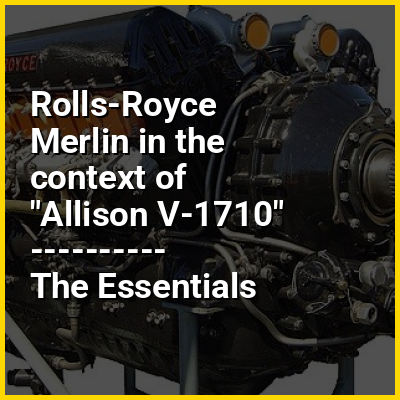
The Rolls-Royce Merlin is a British liquid-cooled V-12 piston aero engine of 27-litre (1,650 cu in) capacity. Developed as a private venture by Rolls-Royce and first run in 1933, the engine became one of the most successful aircraft engines of World War II, most closely associated with the Hawker Hurricane and Supermarine Spitfire, although the majority of the production run was for the four-engined Avro Lancaster heavy bomber.

Initially known as the PV-12, it was dubbed Merlin after the company convention of naming its four-stroke piston aero engines for birds of prey. The engine benefitted from the racing experiences of precursor engines in the 1930s. After several modifications, the first production variants of the PV-12 were completed in 1936. The first operational aircraft to enter service using the Merlin were the Fairey Battle, Hurricane, and Spitfire. Experience in use led to a series of rapidly applied developments that markedly improved the engine's performance and durability. Starting at 1,000 horsepower (750 kW) for the first production models, most late-war versions produced just under 1,800 horsepower (1,300 kW). The final version, used in the de Havilland Hornet, had over 2,000 horsepower (1,500 kW).
↓ Menu

>>>PUT SHARE BUTTONS HERE<<<

👉 Rolls-Royce Merlin in the context of Allison V-1710

The Allison V-1710 aircraft engine designed and produced by the Allison Engine Company was the most common US-developed V-12 liquid-cooled engine in service during World War II. Versions equipped with turbo-superchargers gave excellent performance at high altitude in the twin-engined Lockheed P-38 Lightning, and turbo-superchargers were also fitted to experimental single-engined fighters with similar results.

The United States Army Air Corps (USAAC) preference for turbo-superchargers early in the V-1710's development program meant that less effort was spent on developing suitable mechanically driven centrifugal superchargers for the Allison V-12 design, as other V-12 designs from friendly nations like the British Rolls-Royce Merlin were already using.

↓ Explore More Topics
In this Dossier

Rolls-Royce Merlin in the context of North American P-51 Mustang

The North American Aviation P-51 Mustang is an American long-range, single-seat fighter and fighter-bomber used during World War II and the Korean War, among other conflicts. The Mustang was designed in 1940 by a team headed by James H. Kindelberger of North American Aviation (NAA) in response to a requirement of the British Purchasing Commission. The commission approached NAA to build Curtiss P-40 fighters under license for the Royal Air Force (RAF). Rather than build an old design from another company, NAA proposed the design and production of a more modern fighter. The prototype NA-73X airframe was completed on 9 September 1940, 102 days after contract signing, achieving its first flight on 26 October.

The Mustang was designed to use the Allison V-1710 engine without an export-sensitive turbosupercharger or a multi-stage supercharger, resulting in limited high-altitude performance. The aircraft was first flown operationally by the RAF as a tactical-reconnaissance aircraft and fighter-bomber (Mustang Mk I). In mid 1942, a development project known as the Rolls-Royce Mustang X, replaced the Allison engine with a Rolls-Royce Merlin 65 two-stage inter-cooled supercharged engine. During testing at Rolls-Royce's airfield at Hucknall in England, it was clear the engine dramatically improved the aircraft's performance at altitudes above 15,000 ft (4,600 m) without sacrificing range. Following receipt of the test results and after further flights by USAAF pilots, the results were so positive that North American began work on converting several aircraft developing into the P-51B/C (Mustang Mk III) model, which became the first long-range fighter to be able to compete with the Luftwaffe's fighters. The definitive version, the P-51D, was powered by the Packard V-1650-7, a license-built version of the two-speed, two-stage-supercharged Merlin 66, and was armed with six .50 caliber (12.7 mm) AN/M2 Browning machine guns.

↑ Return to Menu

Rolls-Royce Merlin in the context of Powered aircraft

An aircraft engine, often referred to as an aero engine, is the power component of an aircraft propulsion system. Aircraft using power components are referred to as powered flight. Most aircraft engines are either piston engines or gas turbines, although a few have been rocket powered and in recent years many small UAVs have used electric motors.

↑ Return to Menu

Rolls-Royce Merlin in the context of Hawker Hurricane

The Hawker Hurricane is a British single-seat fighter aircraft of the 1930s–40s which was designed and predominantly built by Hawker Aircraft Ltd. for service with the Royal Air Force (RAF). It was overshadowed in the public consciousness by the Supermarine Spitfire during the Battle of Britain in 1940, but the Hurricane inflicted 60% of the losses sustained by the Luftwaffe in the campaign, and fought in all the major theatres of the Second World War.

The Hurricane originated from discussions between RAF officials and aircraft designer Sir Sydney Camm about a proposed monoplane derivative of the Hawker Fury biplane in the early 1930s. Despite an institutional preference for biplanes and lack of interest by the Air Ministry, Hawker refined its monoplane proposal, incorporating several innovations which became critical to wartime fighter aircraft, including retractable landing gear and the more powerful Rolls-Royce Merlin engine. The Air Ministry ordered Hawker's Interceptor Monoplane in late 1934, and the prototype Hurricane K5083 performed its maiden flight on 6 November 1935.

↑ Return to Menu

Rolls-Royce Merlin in the context of Packard V-1650 Merlin

The Packard V-1650 Merlin is a version of the Rolls-Royce Merlin aircraft engine, produced under license in the United States by the Packard Motor Car Company. The engine was licensed to expand production of the Rolls-Royce Merlin for British use. The engine also filled a gap in the U.S. at a time when similarly powered American-made engines were not available.

The first V-1650s, with a one-stage supercharger, equivalent to the Merlin XX, were used in the P-40F Kittyhawk fighter and in Canadian-built Hawker Hurricanes. Later versions based on the Merlin 60 series included a more advanced two-stage supercharger for improved performance at high altitudes. It found its most notable application in the North American P-51 Mustang fighter, improving the aircraft's performance making them capable of escorting Allied heavy bombers to Germany or Japan and back.

↑ Return to Menu