Rings of Power in the context of "One Ring"

Play Trivia Questions online!

or

Skip to study material about Rings of Power in the context of "One Ring"

Ad spacer

⭐ Core Definition: Rings of Power

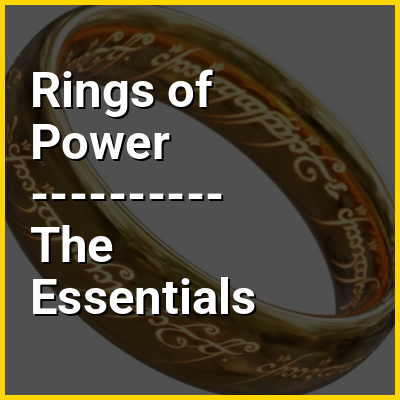
The Rings of Power are magical artefacts in J. R. R. Tolkien's legendarium, most prominently in his high fantasy novel The Lord of the Rings. The One Ring first appeared as a plot device, a magic ring in Tolkien's children's fantasy novel, The Hobbit. Tolkien later gave it a backstory and much greater power: he added nineteen other Great Rings which also conferred powers such as invisibility, and which the One Ring could control. These were the Three Rings of the Elves, the Seven Rings for the Dwarves, and the Nine for Men. He stated that there were in addition many lesser rings with minor powers. A key story element in The Lord of the Rings is the addictive power of the One Ring, made secretly by the Dark Lord Sauron; the Nine Rings enslave their bearers as the Nazgûl (Ringwraiths), Sauron's most deadly servants.

Proposed sources of inspiration for the Rings of Power range from Germanic legend with the ring Andvaranaut and eventually Richard Wagner's Der Ring des Nibelungen, to fairy tales such as Snow White, which features both a magic ring and seven dwarfs. One experience that may have been pivotal was Tolkien's professional work on a Latin inscription at the temple of Nodens; he was a god-hero linked to the Irish hero Nuada Airgetlám, whose epithet is "Silver-Hand", or in Elvish "Celebrimbor", the name of the Elven-smith who made the Rings of Power. The inscription contained a curse upon a ring, and the site was called Dwarf's Hill.
↓ Menu

>>>PUT SHARE BUTTONS HERE<<<

👉 Rings of Power in the context of One Ring

The One Ring, also called the Ruling Ring and Isildur's Bane, is a central plot element in J. R. R. Tolkien's The Lord of the Rings (1954–55). It first appeared in the earlier story The Hobbit (1937) as a magic ring that grants the wearer invisibility. Tolkien changed it into a malevolent Ring of Power and re-wrote parts of The Hobbit to fit in with the expanded narrative. The Lord of the Rings describes the hobbit Frodo Baggins's quest to destroy the Ring and save Middle-earth.

Scholars have compared the story with the ring-based plot of Richard Wagner's opera cycle Der Ring des Nibelungen; Tolkien denied any connection, but scholars state that at the least, both men certainly drew on the same mythology. Another source is Tolkien's analysis of Nodens, an obscure pagan god with a temple at Lydney Park, where he studied the Latin inscriptions, one containing a curse on the thief of a ring.

↓ Explore More Topics
In this Dossier

Rings of Power in the context of The Lord of the Rings

The Lord of the Rings is an epic high fantasy novel written by the English author and scholar J. R. R. Tolkien. Set in Middle-earth, the story began as a sequel to Tolkien's 1937 children's book The Hobbit but eventually developed into a much larger work. Written in stages between 1937 and 1949, The Lord of the Rings is one of the best-selling books ever written, with over 150 million copies sold.

The title refers to the story's main antagonist, the Dark Lord Sauron, who in an earlier age created the One Ring, allowing him to rule the other Rings of Power given to men, dwarves, and elves, in his campaign to conquer all of Middle-earth. From homely beginnings in the Shire, a hobbit land reminiscent of the English countryside, the story ranges across Middle-earth, following the quest to destroy the One Ring, seen mainly through the eyes of the hobbits Frodo, Sam, Merry, and Pippin. Aiding the hobbits are the wizard Gandalf, the men Aragorn and Boromir, the elf Legolas, and the dwarf Gimli, who unite as the Company of the Ring to rally the Free Peoples of Middle-earth against Sauron's armies and give Frodo a chance to destroy the One Ring in the fires of Mount Doom.

↑ Return to Menu