Republican Rome in the context of "Curia of Pompey"

Play Trivia Questions online!

or

Skip to study material about Republican Rome in the context of "Curia of Pompey"

Ad spacer

⭐ Core Definition: Republican Rome

The Roman Republic (Latin: Res publica Romana [ˈreːs ˈpuːblɪka roːˈmaːna]) was the era of classical Roman civilisation beginning with the overthrow of the Roman Kingdom (traditionally dated to 509 BC) and ending in 27 BC with the establishment of the Roman Empire following the War of Actium. During this period, Rome's control expanded from the city's immediate surroundings to hegemony over the entire Mediterranean world.

Roman society at the time was primarily a cultural mix of Latin and Etruscan societies, as well as of Sabine, Oscan, and Greek cultural elements, which is especially visible in the ancient Roman religion and its pantheon. Its political organisation developed at around the same time as direct democracy in ancient Greece, with collective and annual magistracies, overseen by a senate. There were annual elections, but the republican system was an elective oligarchy, not a democracy, with a number of powerful families largely monopolising the senior magistracies. Roman institutions underwent considerable changes throughout the Republic to adapt to difficulties such as the creation of promagistracies to rule its conquered provinces and, after the Social War during the late Republic, the inclusion of peninsular Italians as citizens and senators.
↓ Menu

>>>PUT SHARE BUTTONS HERE<<<

👉 Republican Rome in the context of Curia of Pompey

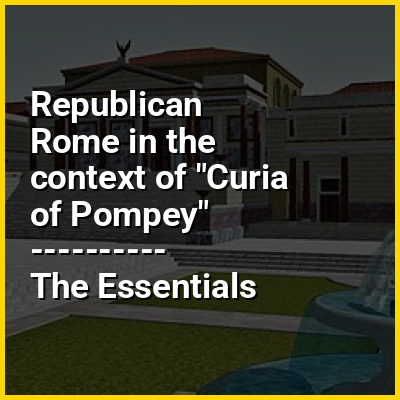
The Curia of Pompey was one of several named meeting halls from Republican Rome of historic significance. A curia was a designated structure for meetings of the senate. The Curia of Pompey was located at the entrance to the Theater of Pompey.

The Curia was attached to the porticus directly behind the theatre section and was a Roman exedra, with a curved back wall and several levels of seating. It was where the Senate met on the Ides of March in 44 BC and where the dictator Julius Caesar was assassinated. After Caesar's death, his heir Augustus removed the large statue of Pompey and had the hall walled up. Eventually it was converted into a latrine.

↓ Explore More Topics
In this Dossier

Republican Rome in the context of Domus

In ancient Rome, the domus (pl.: domūs, genitive: domūs or domī) was the type of town house occupied by the upper classes and some wealthy freedmen during the Republican and Imperial eras. It was found in almost all the major cities throughout the Roman territories. The modern English word domestic comes from Latin domesticus, which is derived from the word domus. Along with a domus in the city, many of the richest families of ancient Rome also owned a separate country house known as a villa. Many chose to live primarily, or even exclusively, in their villas; these homes were generally much grander in scale and on larger acres of land due to more space outside the walled and fortified city.

The elite classes of Roman society constructed their residences with elaborate marble decorations, inlaid marble paneling, door jambs and columns, as well as expensive paintings and frescoes. Many poor and lower-middle-class Romans lived in crowded, dirty and mostly rundown rental apartments, known as insulae. These multi-level apartment blocks were built as high and tightly together as possible and held far less status and convenience than the private homes of the prosperous.

↑ Return to Menu