Relative change in the context of Factor of safety


Relative change in the context of Factor of safety

Relative change Study page number 1 of 1

Play TriviaQuestions Online!

or

Skip to study material about Relative change in the context of "Factor of safety"


⭐ Core Definition: Relative change

In any quantitative science, the terms relative change and relative difference are used to compare two quantities while taking into account the "sizes" of the things being compared, i.e. dividing by a standard or reference or starting value. The comparison is expressed as a ratio and is a unitless number. By multiplying these ratios by 100 they can be expressed as percentages so the terms percentage change, percent(age) difference, or relative percentage difference are also commonly used. The terms "change" and "difference" are used interchangeably.

Relative change is often used as a quantitative indicator of quality assurance and quality control for repeated measurements where the outcomes are expected to be the same. A special case of percent change (relative change expressed as a percentage) called percent error occurs in measuring situations where the reference value is the accepted or actual value (perhaps theoretically determined) and the value being compared to it is experimentally determined (by measurement).

↓ Menu
HINT:

👉 Relative change in the context of Factor of safety

In engineering, a factor of safety (FoS) or safety factor (SF) expresses how much stronger a system is than it needs to be for its specified maximum load. Safety factors are often calculated using detailed analysis because comprehensive testing is impractical on many projects, such as bridges and buildings, but the structure's ability to carry a load must be determined to a reasonable accuracy.Many systems are intentionally built much stronger than needed for normal usage to allow for emergency situations, unexpected loads, misuse, or degradation (reliability).

Margin of safety (MoS or MS) is a related measure, expressed as a relative change.

↓ Explore More Topics
In this Dossier

Relative change in the context of Geodesy

Geodesy or geodetics is the science of measuring and representing the geometry, gravity, and spatial orientation of the Earth in temporally varying 3D. It is called planetary geodesy when studying other astronomical bodies, such as planets or circumplanetary systems.

Geodynamical phenomena, including crustal motion, tides, and polar motion, can be studied by designing global and national control networks, applying space geodesy and terrestrial geodetic techniques, and relying on datums and coordinate systems.

View the full Wikipedia page for Geodesy
↑ Return to Menu

Relative change in the context of Population paradox

Vote-ratio, weight-ratio, or population-ratio monotonicity is a property of some apportionment methods. It says that if the entitlement for grows at a faster rate than (i.e. grows proportionally more than ), should not lose a seat to . More formally, if the ratio of votes or populations increases, then should not lose a seat while gains a seat. An apportionment method violating this rule may encounter population paradoxes.

A particularly severe variant, where voting for a party causes it to lose seats, is called a no-show paradox. The largest remainders method exhibits both population and no-show paradoxes.

View the full Wikipedia page for Population paradox
↑ Return to Menu

Relative change in the context of Logarithmic derivative

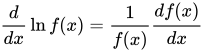
In mathematics, specifically in calculus and complex analysis, the logarithmic derivative of a function f is defined by the formulawhere f′ is the derivative of f. Intuitively, this is the infinitesimal relative change in f; that is, the infinitesimal absolute change in f, namely f′ scaled by the current value of f.

When f is a function f(x) of a real variable x, and takes real, strictly positive values, this is equal to the derivative of ln f(x), or the natural logarithm of f. This follows directly from the chain rule:

View the full Wikipedia page for Logarithmic derivative
↑ Return to Menu

Relative change in the context of Geodetic surveying

Geodesy or geodetics is the science of measuring and representing the geometry, gravity, and spatial orientation of the Earth in temporally varying 3D space. It is called planetary geodesy when studying other astronomical bodies, such as planets or circumplanetary systems. Geodetic job titles include geodesist and geodetic surveyor.

Through highly accurate observations, geodesy provides the scientific basis for mapping, navigation, and positioning, and supports applications such as infrastructure development (including construction), natural resource management, mineral exploration, and geophysics. Its measurements underpin modern geospatial reference frames used in transportation, satellite systems, global trade, and timekeeping.

View the full Wikipedia page for Geodetic surveying
↑ Return to Menu