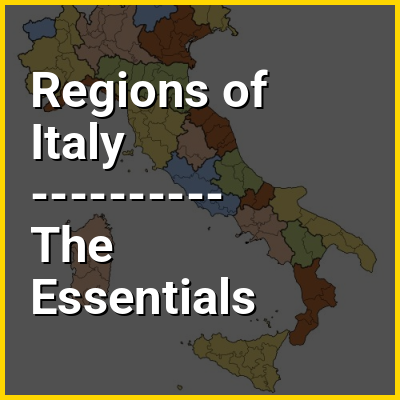
The regions (Italian: regioni; sing. regione) are the first-level administrative divisions of the Italian Republic, constituting its second NUTS administrative level. There are twenty regions, five of which are autonomous regions with special status. Under the Constitution of Italy, each region is an autonomous entity with defined powers. With the exception of the Aosta Valley (since 1945) and Friuli-Venezia Giulia (since 2015), each region is divided into a number of provinces.
HINT:
In this Dossier
- ⭐ Core Definition: Regions of Italy
- Regions of Italy in the context of Rome
- Regions of Italy in the context of Magna Graecia
- Regions of Italy in the context of Southern Italy
- Regions of Italy in the context of Basilicata
- Regions of Italy in the context of Calabria
- Regions of Italy in the context of Sicily
- Regions of Italy in the context of Apulia
- Regions of Italy in the context of Monaco
- Regions of Italy in the context of Genoa
- Regions of Italy in the context of Comune
- Regions of Italy in the context of Northern Italy
- Regions of Italy in the context of Lazio
- Regions of Italy in the context of Rome metropolitan area
- Regions of Italy in the context of Emilia-Romagna
- Regions of Italy in the context of Tuscany
- Regions of Italy in the context of Umbria
- Regions of Italy in the context of Sardinia
- Regions of Italy in the context of Naples
Regions of Italy in the context of Rome
Rome is the capital city and most populated comune (municipality) of Italy. It is also the administrative centre of the Lazio region and of the Metropolitan City of Rome. A special comune named Roma Capitale with 2,746,984 residents in 1,287.36 km (497.1 sq mi), Rome is the third most populous city in the European Union by population within city limits. The Metropolitan City of Rome Capital, with a population of 4,223,885 residents, is the most populous metropolitan city in Italy. Its metropolitan area is the third-most populous within Italy. Rome is located in the central-western portion of the Italian Peninsula, within Lazio (Latium), along the shores of the Tiber Valley. Vatican City (the smallest country in the world and headquarters of the worldwide Catholic Church under the governance of the Holy See) is an independent country inside the city boundaries of Rome, the only existing example of a country within a city. Rome is often referred to as the City of Seven Hills due to its geography, and also as the "Eternal City". Rome is generally considered to be one of the cradles of Western civilization and Western Christian culture, and the centre of the Catholic Church.
Rome's history spans 28 centuries. While Roman mythology dates the founding of Rome at around 753 BC, the site has been inhabited for much longer, making it a major human settlement for over three millennia and one of the oldest continuously occupied cities in Europe. The city's early population originated from a mix of Latins, Etruscans, and Sabines. Eventually, the city successively became the capital of the Roman Kingdom, the Roman Republic and the Roman Empire, and is regarded by many as the first-ever Imperial city and metropolis. It was first called The Eternal City (Latin: Urbs Aeterna; Italian: La Città Eterna) by the Roman poet Tibullus in the 1st century BC, and the expression was also taken up by Ovid, Virgil, and Livy. Rome is also called Caput Mundi (Capital of the World).
View the full Wikipedia page for RomeRegions of Italy in the context of Magna Graecia
Magna Graecia was the historical Greek-speaking area of southern Italy. It encompassed the modern Italian regions of Calabria, Apulia, Basilicata, Campania, and Sicily. These regions were extensively settled by Greeks beginning in the 8th century BC.
Initially founded by their metropoleis (mother cities), the settlements evolved into independent and powerful Greek city-states (poleis). The settlers brought with them Hellenic civilization, which over time developed distinct local forms due to both their distance from Greece and the influence of the indigenous peoples of southern Italy. This interaction left a lasting imprint on Italy, including on Roman culture. The Greek settlers also influenced native groups such as the Sicels and the Oenotrians, many of whom adopted Greek culture and became Hellenized. In areas like architecture and urban planning, the colonies sometimes surpassed the achievements of the motherland. The ancient inhabitants of Magna Graecia are referred to as Italiotes and Siceliotes.
View the full Wikipedia page for Magna GraeciaRegions of Italy in the context of Southern Italy
Southern Italy, also known as Meridione ([meriˈdjoːne]) or Mezzogiorno ([ˌmɛddzoˈdʒorno] ), is a macroregion of Italy consisting of its southern regions.
The term "Mezzogiorno" today mostly refers to the regions that are associated with the people, lands or culture of the historical and cultural region that was once politically under the administration of the former Kingdoms of Naples and Sicily (officially denominated as one entity Regnum Siciliae citra Pharum and ultra Pharum, i.e. "Kingdom of Sicily on the other side of the Strait" and "across the Strait") and which later shared a common organization into Italy's largest pre-unitarian state, the Kingdom of the Two Sicilies.
View the full Wikipedia page for Southern ItalyRegions of Italy in the context of Basilicata
Basilicata (UK: /bəˌsɪlɪˈkɑːtə/ bə-SIL-ih-KAH-tə, US: /-ˌzɪl-/ -ZIL-, Italian: [baziliˈkaːta]), also known by its ancient name Lucania (/luːˈkeɪniə/ loo-KAY-nee-ə, US also /luːˈkɑːnjə/ loo-KAHN-yə, Italian: [luˈkaːnja]), is an administrative region in Southern Italy, bordering on Campania to the west, Apulia to the north and east, and Calabria to the south. It has two coastlines: a 30-kilometre stretch on the Gulf of Policastro (Tyrrhenian Sea) between Campania and Calabria, and a longer coastline along the Gulf of Taranto (Ionian Sea) between Calabria and Apulia. The region can be thought of as "the arch" of "the boot" of Italy, with Calabria functioning as "the toe" and Apulia "the heel".
The region has a population of 529,897 in an area of 10,073.32 km (3,889.33 sq mi). The regional capital is Potenza. The region comprises two provinces: Potenza and Matera. Its inhabitants are generally known as Lucanians (Italian: lucani), and to a lesser extent as basilicatesi or by other very rare terms.
View the full Wikipedia page for BasilicataRegions of Italy in the context of Calabria
Calabria is a region in Southern Italy. It is a peninsula bordered by the region Basilicata to the north, the Ionian Sea to the east, the Strait of Messina to the southwest, which separates it from Sicily, and the Tyrrhenian Sea to the west. It has 1,832,147 residents as of 2025 across a total area of 15,222 km (5,877 sq mi). Catanzaro is the region's capital.
Calabria is the birthplace of the name of Italy, given to it by the Ancient Greeks who settled in this land starting from the 8th century BC. They established the first cities, mainly on the coast, as Greek colonies. During this period Calabria was the heart of Magna Graecia, home of key figures in history such as Pythagoras, Herodotus and Milo.
View the full Wikipedia page for CalabriaRegions of Italy in the context of Sicily
Sicily (Italian and Sicilian: Sicilia), officially the Sicilian Region (Italian: Regione Siciliana; Sicilian: Riggiuni Siciliana), is an island in the central Mediterranean Sea and one of the twenty regions of Italy, situated south of the Italian Peninsula in continental Europe. With 4.7 million inhabitants, including 1.2 million in and around the capital city of Palermo, it is both the largest and most populous island in the Mediterranean Sea.
Sicily is named after the Sicels, who inhabited the eastern part of the island during the Iron Age. Sicily has a rich and unique culture in arts, music, literature, cuisine, and architecture. Its most prominent landmark is Mount Etna, the tallest active volcano in Europe, and one of the most active in the world, currently 3,403 m (11,165 ft) high. The island has a typical Mediterranean climate. It is separated from Calabria by the Strait of Messina. It is one of the five Italian autonomous regions and is considered part of Southern Italy.
View the full Wikipedia page for SicilyRegions of Italy in the context of Apulia
Apulia (/əˈpuːliə/ ə-POO-lee-ə), also known by its Italian name Puglia (Italian: [ˈpuʎʎa]), is a region of Italy, located in the southern peninsular section of the country, bordering the Adriatic Sea to the east, the Strait of Otranto and Ionian Sea to the southeast and the Gulf of Taranto to the south. The region comprises 19,345 square kilometers (7,469 sq mi), and has 3,874,166 inhabitants as of 2025. It is bordered by the other Italian regions of Molise to the north, Campania to the west, and Basilicata to the southwest. The regional capital is Bari.
In ancient times, more precisely at the beginning of the first millennium BC, the region of Apulia was inhabited by the Iapygians, while during the 8th century BC its coastal areas were populated by ancient Greeks. Later, the region was conquered by the ancient Romans. It was then conquered by the Byzantines, followed by the Normans, the Aragonese and the Spanish. Subsequently, it became part of the Kingdom of the Two Sicilies, to then be annexed to the unified Kingdom of Italy after the Expedition of the Thousand.
View the full Wikipedia page for ApuliaRegions of Italy in the context of Monaco
Monaco, officially the Principality of Monaco, is a sovereign city-state and microstate in Western Europe. Situated on the French Riviera, it is a semi-enclave bordered by France to the north, east, and west, with the Mediterranean Sea to the south; the Italian region of Liguria is about 15 km (9.3 mi) east. With a population of 38,423 living in an area of 2.08 km (0.80 sq mi), Monaco is the second smallest sovereign state in the world, after Vatican City, as well as the most densely populated. It also has the world's shortest national coastline of any non-landlocked nation, at 3.83 km (2.38 mi). Fewer than 10,000 of its residents are Monégasque nationals. While the official language of Monaco is French, Italian and Monégasque are also widely spoken and understood.
Monaco is governed under a form of semi-constitutional monarchy, with Prince Albert II as head of state, who holds substantial political powers. The prime minister, who is the head of government, can be either a Monégasque or French citizen; the monarch consults with the Government of France before an appointment. Key members of the judiciary are detached French magistrates. The House of Grimaldi has ruled Monaco, with brief interruptions, since 1297. The state's sovereignty was officially recognised by the Franco-Monégasque Treaty of 1861, with Monaco becoming a full United Nations voting member in 1993. Despite Monaco's independence and separate foreign policy, its defence is the responsibility of France, notwithstanding two small military units.
View the full Wikipedia page for MonacoRegions of Italy in the context of Genoa
Genoa (/ˈdʒɛnoʊə/ JEN-oh-ə; Italian: Genova [ˈdʒɛːnova] ; Ligurian: Zêna [ˈzeːna]) is the sixth-largest city in Italy and the capital of the Italian region of Liguria. As of 2025, 565,301 people live within the city's administrative limits. While its metropolitan city has 818,629 inhabitants, more than 1.5 million people live in the wider metropolitan area stretching along the Italian Riviera.
On the Gulf of Genoa in the Ligurian Sea, Genoa has historically been one of the most important ports on the Mediterranean: it is the busiest port in Italy and in the Mediterranean Sea and twelfth-busiest in the European Union.
View the full Wikipedia page for GenoaRegions of Italy in the context of Comune
A comune (pronounced [koˈmuːne]; pl.: comuni, pronounced [koˈmuːni]) is an administrative division of Italy, roughly equivalent to a township or municipality. It is the third-level administrative division of Italy, after regions (regioni) and provinces (province). The comune can also have the title of città (lit. 'city').
Formed praeter legem according to the principles consolidated in medieval municipalities, the comune is provided for by article 114 of the Constitution of Italy. It can be divided into frazioni, which in turn may have limited power due to special elective assemblies.
View the full Wikipedia page for ComuneRegions of Italy in the context of Northern Italy
Northern Italy (Italian: Italia Settentrionale, Nord Italia, Alta Italia) is a geographical and cultural region in the northern part of Italy. The Italian National Institute of Statistics defines the region as encompassing the four northwestern regions of Piedmont, Aosta Valley, Liguria and Lombardy in addition to the four northeastern regions of Trentino-Alto Adige/Südtirol, Veneto, Friuli-Venezia Giulia and Emilia-Romagna.
With a population of 27.5 million in an area of 120,312.72 km (46,453.00 sq mi) as of 2025, the region covers roughly 40% of Italy and contains 46% of its population. Two of Italy's largest metropolitan areas, Milan and Turin, are located in the region. Northern Italy's GDP was estimated at €1 trillion in 2021, accounting for 56.5% of the Italian economy.
View the full Wikipedia page for Northern ItalyRegions of Italy in the context of Lazio
Lazio (UK: /ˈlætsioʊ/ LAT-see-oh, US: /ˈlɑːt-/ LAHT-; Italian: [ˈlattsjo]) or Latium (/ˈleɪʃiəm/ LAY-shee-əm, US also /-ʃəm/ -shəm; from the original Latin name, pronounced [ˈɫati.ũː]) is one of the 20 administrative regions of Italy. Situated in the central peninsular section of the country, it has 5,714,882 inhabitants and a GDP of more than €212 billion per year, making it the country's second most populated region and second largest regional economy after Lombardy. The capital of Lazio is Rome, which is the capital city of Italy.
Lazio was the home of the Etruscan civilization, then stood at the center of the Roman Republic, of the Roman Empire, of the Papal States, of the Kingdom of Italy and of the Italian Republic. Lazio boasts a rich cultural heritage. Great artists and historical figures lived and worked in Rome, particularly during the Italian Renaissance period.
View the full Wikipedia page for LazioRegions of Italy in the context of Rome metropolitan area
The Rome metropolitan area is a statistical area that is centred on the city of Rome, Italy. It consists of a part of the Metropolitan City of Rome Capital (formerly known as the Province of Rome) and a single comune, Aprilia, in the neighbouring Province of Latina. Both provinces are part of the region of Lazio. The metropolitan area does not have any administrative designation or function unlike the Metropolitan City of Rome Capital.
View the full Wikipedia page for Rome metropolitan areaRegions of Italy in the context of Emilia-Romagna
Emilia-Romagna (UK: /ɪˌmiːliə roʊˈmɑːnjə/, US: /eɪˌ-/, both also /ɛˌ-/, Italian: [eˈmiːlja roˈmaɲɲa]) is an administrative region of northern Italy, comprising the historical regions of Emilia and Romagna. Its capital is Bologna. It has a population of over 4.4 million in an area of 22,509.67 km (8,691 sq mi).
Emilia-Romagna is one of the wealthiest and most developed regions in Europe, with the third highest gross domestic product per capita in Italy. It is also a cultural center, being the home of the University of Bologna, the oldest university in the world. Some of its cities, such as Modena, Parma, Ferrara, and Ravenna, are UNESCO heritage sites. It is a center for food and automobile production (such as Ferrari, Lamborghini, and Maserati). It has coastal resorts such as Cervia, Cesenatico, and Rimini. In 2018, the Lonely Planet guide named Emilia-Romagna as the best place to see in Europe.
View the full Wikipedia page for Emilia-RomagnaRegions of Italy in the context of Tuscany
Tuscany (/ˈtʌskəni/ TUSK-ə-nee; Italian: Toscana [tosˈkaːna]) is a region in central Italy with an area of about 23,000 square kilometres (8,900 square miles) and a population of 3,660,834 as of 2025. The capital city is Florence.
Tuscany is known for its landscapes, history, artistic legacy, and influence on high culture. It is regarded as the birthplace of the Italian Renaissance and of the foundations of the Italian language. The prestige established by Tuscan's use in literature by Dante Alighieri, Petrarch, Giovanni Boccaccio, Niccolò Machiavelli, and Francesco Guicciardini led to its adoption as the basis for elaboration of the language of culture throughout Italy. It has been home to many figures influential in the history of art and science, and contains well-known museums such as the Uffizi and the Palazzo Pitti. Tuscany is also known for its wines, including Chianti, Vino Nobile di Montepulciano, Morellino di Scansano, Brunello di Montalcino, and white Vernaccia di San Gimignano. Having a strong linguistic and cultural identity, it is sometimes considered "a nation within a nation".
View the full Wikipedia page for TuscanyRegions of Italy in the context of Umbria
Umbria (/ˈʌmbriə/ UM-bree-ə; Italian: [ˈumbrja]) is a region of central Italy. It includes Lake Trasimeno and Marmore Falls, and is crossed by the Tiber. It is the only landlocked region on the Apennine Peninsula. The capital is Perugia. The region has 851,954 inhabitants as of 2025.
The region is characterized by hills, mountains, thick forests, valleys and historical towns such as the university centre of Perugia, Assisi (a World Heritage Site associated with St. Francis of Assisi), Terni, Norcia, Città di Castello, Gubbio, Spoleto, Orvieto, Todi, Castiglione del Lago, Narni, Amelia, Spello and other small cities.
View the full Wikipedia page for UmbriaRegions of Italy in the context of Sardinia
Sardinia (/sɑːrˈdɪniə/ sar-DIN-ee-ə; Sardinian: Sardigna [saɾˈdiɲːa]; Italian: Sardegna [sarˈdeɲɲa] ), officially the Autonomous Region of Sardinia, is the second largest island in the Mediterranean Sea after Sicily, and one of the twenty regions of Italy. It is located 200 km west of the Italian Peninsula, 200 km north of Tunisia, and 16.45 km south of the French island of Corsica. Sardinia is one five Italian regions with statutory domestic autonomy. It is divided into six provinces and two metropolitan cities. Cagliari is the capital and largest city, followed by Sassari. It has over 1.5 million inhabitants as of 2025.
Sardinia's indigenous language and the Algherese dialect of Catalan are recognized by both regional and national law as two of Italy's twelve official linguistic minorities, albeit gravely endangered; regional law provides some degree of protection and recognition of the island's other minority languages: the Corsican-influenced Sassarese and Gallurese, and Tabarchino Ligurian.
View the full Wikipedia page for SardiniaRegions of Italy in the context of Naples
Naples (/ˈneɪpəlz/ NAY-pəlz; Italian: Napoli [ˈnaːpoli] ; Neapolitan: Napule [ˈnɑːpələ]) is the regional capital of Campania and the third-largest city of Italy, after Rome and Milan, with a population of 908,082 within the city's administrative limits as of 2025, while its province-level municipality is the third most populous metropolitan city in Italy with a population of 2,958,410 residents, and the eighth most populous in the European Union. Its metropolitan area stretches beyond the boundaries of the city wall for approximately 30 kilometres (20 miles). Naples also plays a key role in international diplomacy, since it is home to NATO's Allied Joint Force Command Naples and the Parliamentary Assembly of the Mediterranean.
Founded by Greeks in the first millennium BC, Naples is one of the oldest continuously inhabited urban areas in the world. In the eighth century BC, a colony known as Parthenope (Ancient Greek: Παρθενόπη) was established on the Pizzofalcone hill. In the sixth century BC, it was refounded as Neápolis. The city was an important part of Magna Graecia, played a major role in the merging of Greek and Roman society, and has been a significant international cultural centre ever since with particular reference to the development of the arts.
View the full Wikipedia page for Naples