Reform of local government in Northern Ireland in the context of "Lisburn City Council"

Play Trivia Questions online!

or

Skip to study material about Reform of local government in Northern Ireland in the context of "Lisburn City Council"


⭐ Core Definition: Reform of local government in Northern Ireland

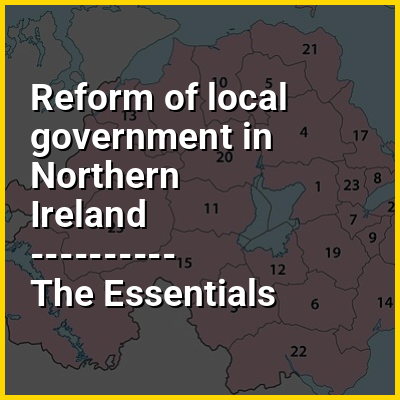
Reform of local government in Northern Ireland saw the replacement of the twenty-six districts created in 1973 with a smaller number of "super districts". The review process began in 2002, with proposals for either seven or eleven districts made before it was suspended in 2010. On 12 March 2012, the Northern Ireland Executive published its programme for government, which included a commitment to reduce the number of councils in Northern Ireland to 11. The first elections to these new councils were on 22 May 2014.

↓ Menu

👉 Reform of local government in Northern Ireland in the context of Lisburn City Council

Lisburn City Council was the local authority for an area partly in County Antrim and partly in County Down in Northern Ireland. As of May 2015 it was merged with Castlereagh Borough Council as part of the reform of local government in Northern Ireland to become Lisburn and Castlereagh City Council.

Created in 1974, the council was the second largest in the Belfast Metropolitan Area. Council headquarters were in the city of Lisburn. It was the second-largest council area in Northern Ireland with over 120,000 people and an area of 174 square miles (450 km) of southwest Antrim and northwest Down. The council area included Glenavy and Dundrod in the north, Dromara and Hillsborough in the south, Moira and Aghalee in the west, and Drumbo in the east.

↓ Explore More Topics
In this Dossier

Reform of local government in Northern Ireland in the context of Counties of Northern Ireland

Northern Ireland is divided into six counties, namely Antrim, Armagh, Down, Fermanagh, Londonderry and Tyrone. Six largely rural administrative counties based on these were among the eight primary local government areas of Northern Ireland from its 1921 creation until 1973. The other two local government areas were the urban county boroughs of Derry (geographically part of the County of Londonderry) and Belfast (geographically split between the counties of Antrim and Down).

The six counties date from the Kingdom of Ireland; five were created between 1570 and 1591 in the Tudor conquest of Ireland, while county Londonderry dates from 1613 and the Plantation of Ulster. The total number of counties in the island of Ireland is 32, with Northern Ireland and the Republic of Ireland often respectively called "the Six Counties" and "the Twenty-Six Counties", especially by Irish nationalists opposed to the partition of Ireland. The 1898–1973 administrative counties were subdivided into county districts. The two-tier county/district system was replaced with a single-tier of "districts", numbering 26 in 1973 and rationalised into 11 in 2015. The areas corresponding to the six counties and two county boroughs remain in use for some administrative purposes, and the six historic counties retain a popular identity.

↑ Return to Menu

Reform of local government in Northern Ireland in the context of Lisburn

Lisburn (/ˈlɪzbɜːrn, ˈlɪsbɜːrn/ LIZ-burn, LISS-burn; Irish: Lios na gCearrbhach [ˌl̠ʲɪsˠ n̪ˠə ˈɟaːɾˠ(ə)wəx] ) is a city in Northern Ireland. It is 8 mi (13 km) southwest of Belfast city centre, on the River Lagan, which forms the boundary between County Antrim and County Down. First laid out in the 17th century by English and Welsh settlers, with the arrival of French Huguenots in the 18th century, the town developed as a global centre of the linen industry.

In 2002, as part of Queen Elizabeth's Golden Jubilee celebrations, the predominantly unionist borough was granted city status alongside the largely nationalist town of Newry. With a population of 45,370 in the 2011 Census, Lisburn was the third-largest city in Northern Ireland. In the 2016 reform of local government in Northern Ireland Lisburn was joined with the greater part of Castlereagh to form the Lisburn City and Castlereagh District.

↑ Return to Menu