Red-figure vase painting in the context of "Gnathia vases"

Play Trivia Questions online!

or

Skip to study material about Red-figure vase painting in the context of "Gnathia vases"

Ad spacer

⭐ Core Definition: Red-figure vase painting

Red-figure pottery (Ancient Greek: ἐρυθρόμορφα, romanizederythrómorpha) is a style of ancient Greek pottery in which the background of the pottery is painted black while the figures and details are left in the natural red or orange color of the clay.

It developed in Athens around 520 BC and remained in use until the late 3rd century AD. It replaced the previously dominant style of black-figure pottery within a few decades. Its modern name is based on the figural depictions in red color on a black background, in contrast to the preceding black-figure style with black figures on a red background. The most important areas of production, apart from Attica, were in Southern Italy. The style was also adopted in other parts of Greece. Etruria became an important center of production outside the Greek World.
↓ Menu

>>>PUT SHARE BUTTONS HERE<<<

👉 Red-figure vase painting in the context of Gnathia vases

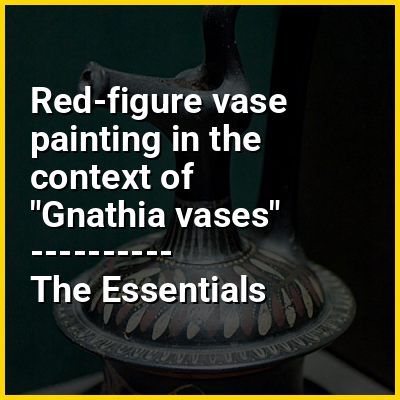
Gnathia vases are a type of pottery belonging to ancient Apulian vase painting of the 4th century BC.

They are named after the ancient city of Gnathia (now Egnazia) in Eastern Apulia. There, the first examples of the style were discovered in the mid-19th century. Their production began in Apulia around 370/360 BC, in parallel to the local version of the red-figure style which developed tendencies towards polychromy around that time. Typical of Gnathia vases is the application of different paints directly onto the glazed vase body. Additionally, internal details could be added by incision. The themes depicted include erotes, images from the life of women, theatre scenes and dionysiac motifs. Figural, painting is often limited to the upper half of the vessel body, while the bottom half often bears only ornamental decoration. The most common shapes were bell kraters, pelikes, oinochoai and skyphoi. The most important artists are the Konnakis Painter and the Rose Painter.

↓ Explore More Topics
In this Dossier

Red-figure vase painting in the context of Gela Painter

The Gela Painter was an Attic black-figure vase painter. His real name is unknown. His long career started around the turn of the 6th and 5th centuries BC. A majority of his works, consisting mainly of lekythoi were exported to West Greece. His work was strongly influenced by the newly developed red-figure style. His style is often careless, but his images are original. Especially his mythological and genre scenes are notable. Often, his compositions on smaller vases mirror those normally used on larger, more expensive, ones. On his shoulder ornaments, he replaced the conventional buds with leaves.

↑ Return to Menu

Red-figure vase painting in the context of Pamphaios

Pamphaios was an Attic potter active around the end of the 6th century BC.Pamphaios was the successor of Nikosthenes in that artist's workshop, and thus took over from one of the most influential and creative potters of antiquity. He probably took over the workshop before 510 BC and continued the tradition of his predecessor by producing typical shapes the latter had developed, such as the Nikosthenic amphora, the Nikosthenic pyxis or the Chalkidian style cup. At times, he developed these shapes further. Unlike Nikostehenes, Pamphaios favoured painters of the red-figure style, which was at the time replacing the previously dominant technique of black-figure vase painting. He also continued to employ many of the painters that had worked for Nikosthenes, such as Oltos, Epiktetos and the Nikosthenes Painter.

Pamphaios signature survives on more than fifty vases – spelled different ways by various artists, it probably functioned as a trademark on his workshop's products.

↑ Return to Menu

Red-figure vase painting in the context of Euphiletos Painter

The Euphiletos Painter was an Attic black-figure vase painter active in the second half of the sixth century BC.

One of the better-quality vase painters of the black-figure style in Athens, he is known especially for his Panathenaic prize amphorae. In them, his work evinces a chronological development influenced extensively by red-figure vase painting, a style developing during his lifetime. While his early works show athletes in unrealistic stances, the quality of the depictions improved considerably over time, especially with regard to his increasing control of internal detail. This improvement is especially visible in human depictions and in shield devices. His work on vases other than prize amphorae is of lesser quality and often depicts the then-popular motif of chariot races. Most of his non-prize amphora work dates to about 520 BC, but some pieces are estimated to be up to 20 years earlier or later. He collaborated with the potter Pamphaios.

↑ Return to Menu

Red-figure vase painting in the context of Bilingual vase

Bilingual vase painting is a special form of ancient Greek vase painting. The term, derived from linguistics, is essentially a metaphorical one; it describes vases that are painted both in the black-figure and in the red-figure techniques. It also describes the transitional period when black-figure was being gradually replaced in dominance by red-figure, basically the last quarter of the 6th and the very beginning of the 5th century BC. Their appearance may be due to the initial uncertainty of the market for the new red-figure style, although that style subsequently became dominant rather fast.

↑ Return to Menu

Red-figure vase painting in the context of Epiktetos

Epiktetos was an Attic vase painter in the early red-figure style. Besides Oltos, he was the most important painter of the Pioneer Group. He was active between 520 BCE and 490 BCE. His name translates as "newly acquired", which is most probably a reference to his slave status.

↑ Return to Menu