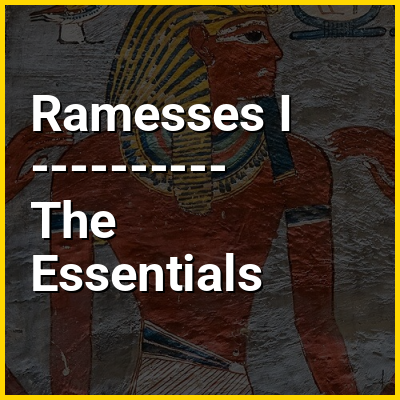
Menpehtyre Ramesses I (or Ramses) was the founding pharaoh of ancient Egypt's 19th Dynasty. The dates for his short reign are not completely known but the timeline of late 1292–1290 BC is frequently cited as well as 1295–1294 BC. While Ramesses I was the founder of the 19th Dynasty, his brief reign mainly serves to mark the transition between the reign of Horemheb, who had stabilized Egypt in the late 18th Dynasty, and the rule of the powerful pharaohs of his own dynasty, in particular his son Seti I, and grandson Ramesses II.
HINT:
In this Dossier
- ⭐ Core Definition: Ramesses I
- Ramesses I in the context of New Kingdom of Egypt
- Ramesses I in the context of Nineteenth Dynasty of Egypt
- Ramesses I in the context of Mummification
- Ramesses I in the context of Seti I
- Ramesses I in the context of Sitre
Ramesses I in the context of New Kingdom of Egypt
The New Kingdom, also called the Egyptian Empire, refers to ancient Egypt between the 16th century BC and the 11th century BC. This period of ancient Egyptian history covers the Eighteenth, Nineteenth, and Twentieth dynasties. Through radiocarbon dating, the establishment of the New Kingdom has been placed between 1570 and 1544 BC. The New Kingdom followed the Second Intermediate Period and was succeeded by the Third Intermediate Period. It was the most prosperous time for ancient Egypt and marked the peak of its power.
In 1845, the concept of a "New Kingdom" as one of three "golden ages" was coined by German scholar Christian Charles Josias von Bunsen; the original definition would evolve significantly throughout the 19th and 20th centuries. The later part of this period, under the Nineteenth Dynasty (1295–1189 BC) and the Twentieth Dynasty (1189–1069 BC), is also known as the Ramesside period. It is named after the eleven pharaohs who took the name Ramesses, after Ramesses I, who founded the Nineteenth Dynasty, and his grandson Ramesses II, who was its longest-reigning monarch.
View the full Wikipedia page for New Kingdom of EgyptRamesses I in the context of Nineteenth Dynasty of Egypt
The Nineteenth Dynasty of Egypt (notated Dynasty XIX), also known as the Ramessid dynasty, is classified as the second Dynasty of the Ancient Egyptian New Kingdom period, lasting from 1292 BC to 1189 BC. The 19th Dynasty and the 20th Dynasty furthermore together constitute an era known as the Ramesside period. This Dynasty was founded by Vizier Ramesses I, whom Pharaoh Horemheb chose as his successor to the throne.
View the full Wikipedia page for Nineteenth Dynasty of EgyptRamesses I in the context of Mummification
A mummy is a dead human or an animal whose soft tissues and organs have been preserved by either intentional or accidental exposure to chemicals, extreme cold, very low humidity, or lack of air, so that the recovered body does not decay further if kept in cool and dry conditions. Some authorities restrict the use of the term to bodies deliberately embalmed with chemicals, but the use of the word to cover accidentally desiccated bodies goes back to at least the early 17th century.
Mummies of humans and animals have been found on every continent, both as a result of natural preservation through unusual conditions, and as cultural artifacts. Over one million animal mummies have been found in Egypt, many of which are cats. Many of the Egyptian animal mummies are sacred ibis, and radiocarbon dating suggests the Egyptian ibis mummies that have been analyzed were from a time frame that falls between approximately 450 and 250 BC.
View the full Wikipedia page for MummificationRamesses I in the context of Seti I
Menmaatre Seti I (or Sethos I in Greek) was the second pharaoh of the Nineteenth Dynasty of Egypt during the New Kingdom period, ruling c. 1294 or 1290 BC to 1279 BC. He was the son of Ramesses I and Sitre, and the father of Ramesses II (commonly known as Ramesses the Great).
The name 'Seti' means "of Set", which indicates that he was consecrated to the god Set (also termed "Sutekh" or "Seth"). As with most pharaohs, Seti had several names. Upon his ascension, he took the prenomen "mn-m3't-r' ", usually vocalized in Egyptian as Menmaatre (Established is the Justice of Re). His better known nomen, or birth name, is transliterated as "sty mry-n-ptḥ" or Sety Merenptah, meaning "Man of Set, beloved of Ptah". Manetho incorrectly considered him to be the founder of the 19th Dynasty, and gave him a reign length of 55 years, though no evidence has ever been found for so long a reign.
View the full Wikipedia page for Seti IRamesses I in the context of Sitre
Sitre ("Daughter of Re") or Tia-Sitre, was the Great Royal Wife of Pharaoh Ramesses I of Egypt and mother of Seti I.
View the full Wikipedia page for Sitre