Rajasthani languages in the context of "Marwar"

Play Trivia Questions online!

or

Skip to study material about Rajasthani languages in the context of "Marwar"


⭐ Core Definition: Rajasthani languages

The Rajasthani languages are a group of Western Indo-Aryan languages, primarily spoken in Rajasthan and Malwa, and adjacent areas of Haryana, Gujarat and Madhya Pradesh in India and Bahawalpur division of Pakistani Punjab and the adjacent areas of Sindh. They have also reached different corners of India, especially eastern and southern parts, due to the migrations of people of the Marwari community who use them for internal communication. Rajasthani languages are also spoken to a lesser extent in Nepal, where they are spoken by 25,394 people according to the 2011 Census of Nepal.

The term Rajasthani is also used to refer to a literary language mostly based on Marwari.
↓ Menu

👉 Rajasthani languages in the context of Marwar

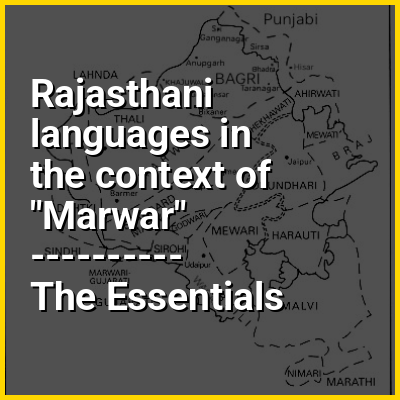
Marwar (Marwari: [maːɾwaːɽ], also called Jodhpur region, Marwari: [d͡ʒoːd̪ʱpʊɾ]) is a cultural and historical region in the western part of the Indian state of Rajasthan. The Thar Desert is located in this region of Rajasthan and stretches westward into Pakistan's Sindh province. The language of this region is known as Marwari, which is the most widely spoken dialect of the Rajasthani language.

In its most contracted definition, Marwar refers to the area governed by the erstwhile princely state of Jodhpur, comprising present-day districts of Jodhpur, Barmer, Jalore, Nagaur, and Pali. Although the former kingdoms of Bikaner and Jaisalmer were independent of the Marwar state, they are often included in the broader Marwar region due to geographical and cultural affinities.

↓ Explore More Topics
In this Dossier

Rajasthani languages in the context of Hindustani classical music

Hindustani classical music (also known as North Indian classical music or Shastriya Sangeet) is the classical music of the Indian subcontinent's northern regions. It is played on instruments like the veena, sitar and sarod. It diverged in the 12th-century from Carnatic music, the classical tradition of southern India. While Carnatic music largely uses compositions written in Sanskrit, Telugu, Kannada, Tamil, Malayalam, Hindustani music largely uses compositions written in Sanskrit, Hindustani (Hindi-Urdu), Braj, Awadhi, Bhojpuri, Bengali, Rajasthani and Punjabi.

Knowledge of Hindustani classical music is taught through a network of classical music schools, called gharana. Hindustani classical music is an integral part of the culture of North India and is performed across the country and internationally. Exponents of Hindustani classical music, including Ustad Bismillah Khan, Pandit Bhimsen Joshi and Ravi Shankar have been awarded the Bharat Ratna, the highest civilian award of India, for their contributions to the arts.

↑ Return to Menu

Rajasthani languages in the context of Alwar

Alwar (Rajasthani Pronunciation: [əlʋəɾ]) is a city located in India's National Capital Region (NCR) and the administrative headquarters of Alwar District in the state of Rajasthan. It is located 150 km south of Delhi and 150 km north of Jaipur.

↑ Return to Menu

Rajasthani languages in the context of Old Western Rājasthāni

Old Western Rājasthāni (also known as Maru-Gurjari, Old Gujarātī) is the common ancestor of the modern Gujarati and Western Rajasthani languages which developed from Sanskrit and the Prakrit Apabhraṃśas, and was spoken around 8-14th centuries in Western India. The literary form of Old Western Rājasthāni, the Dingala language was in use as early as the 12th century. While the spoken Old Western Rajasthani gave way to medieval forms of Western Rajasthani and Gujarati, it flourished in its literary form as Dingala till the 19th century.

Early texts of the language display characteristic features such as direct/oblique noun forms, postpositions, and auxiliary verbs. It had three genders, as Gujarati does today, and by around the time of 1300 CE, a fairly standardized form of this language emerged. The belief that modern Rajasthani sporadically expressed a neuter gender was based on the incorrect conclusion that the [ũ] that came to be pronounced in some areas for masculine [o] after a nasal consonant was analogous to Gujarati's neuter [ũ]. A formal grammar, Prakrita Vyakarana, of the precursor to this language, Gurjar Apabhraṃśa, was written by Jain monk and eminent scholar Acharya Hemachandra Suri in the reign of Chaulukya king Jayasimha Siddharaja of Anhilwara (Patan).

↑ Return to Menu

Rajasthani languages in the context of Mewar

Mewar, also spelled as Mewad, is a historical region located in the south-eastern part of the Indian state of Rajasthan. It includes the present-day districts of Udaipur, Rajsamand, Bhilwara, Chittorgarh and Pratapgarh in Rajasthan. The language of this region is known as Mewari, one of the dialects of the Rajasthani language.

↑ Return to Menu

Rajasthani languages in the context of Mewari language

Mewari is an Indo-Aryan language of the Rajasthani languages group. It is spoken by about five million speakers in Rajsamand, Bhilwara, Udaipur, Chittorgarh and Pratapgarh districts of Rajasthan state and Mandsaur, Neemuch districts of Madhya Pradesh state of India.

There are 31 consonants, 10 vowels and 2 diphthongs in Mewari. Intonation is prominent. Dental fricative is replaced by glottal stop at initial and medial positions. Inflection and derivation are the forms of word formation. There are two numbers—singular and plural, two genders—masculine and feminine, and three cases—simple, oblique, and vocative. Case marking is partly inflectional and partly postpositional. Concord is of nominative type in the imperfective aspect but ergative in the perfective aspect. Nouns are declined according to their endings. Pronouns are inflected for number, person, and gender. Third person is distinguished not only in gender but also in remote-proximal level. There are three tenses—present, past, and future; and four moods. Adjective are of two types—marked or unmarked. Three participles are there—present, past, and perfect. It has SOV word order.

↑ Return to Menu