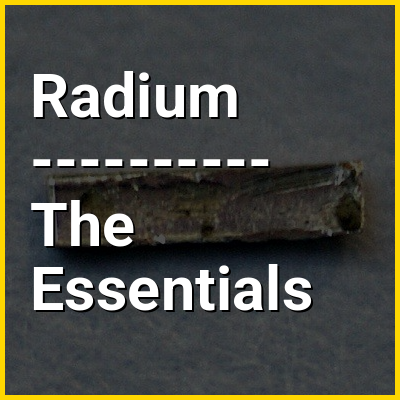
Radium is a chemical element; it has symbol Ra and atomic number 88. It is the sixth element in group 2 of the periodic table, also known as the alkaline earth metals. Pure radium is silvery-white, but it readily reacts with nitrogen (rather than oxygen) upon exposure to air, forming a black surface layer of radium nitride (Ra3N2). All isotopes of radium are radioactive, the most stable isotope being radium-226 with a half-life of 1,600 years. When radium decays, it emits ionizing radiation as a by-product, which can excite fluorescent chemicals and cause radioluminescence. For this property, it was widely used in self-luminous paints following its discovery. Of the radioactive elements that occur in quantity, radium is considered particularly toxic, and it is carcinogenic due to the radioactivity of both it and its immediate decay product radon as well as its tendency to accumulate in the bones.
Radium, in the form of radium chloride, was discovered by Marie and Pierre Curie in 1898 from ore mined at Jáchymov. They extracted the radium compound from uraninite and published the discovery at the French Academy of Sciences five days later. Radium was isolated in its metallic state by Marie Curie and André-Louis Debierne through the electrolysis of radium chloride in 1910, and soon afterwards the metal started being produced on larger scales in Austria, the United States, and Belgium. However, the amount of radium produced globally has always been small in comparison to other elements, and by the 2010s, annual production of radium, mainly via extraction from spent nuclear fuel, was less than 100 grams.