In biology, a rachis /ˈreɪkɪs/ (from the Ancient Greek: ῥάχις [rhákhis], "backbone, spine") is a main axis or "shaft".

In biology, a rachis /ˈreɪkɪs/ (from the Ancient Greek: ῥάχις [rhákhis], "backbone, spine") is a main axis or "shaft".
_q.jpg)
In botany, a stipe is a stalk that supports some other structure. The precise meaning is different depending on which taxonomic group is being described.
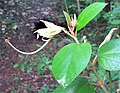

In the case of ferns, the stipe is only the petiole from the rootstock to the beginning of the leaf tissue, or lamina. The continuation of the structure within the lamina is then termed a rachis.
In agriculture, shattering is the dispersal of a crop's seeds upon their becoming ripe. From an agricultural perspective this is generally an undesirable process, and in the history of crop domestication several important advances have involved a mutation in a crop plant that reduced shattering—instead of the seeds being dispersed as soon as they were ripe, the mutant plants retained the seeds for longer, which made harvesting much more effective. Non-shattering phenotype is one of the prerequisites for plant breeding especially when introgressing valuable traits from wild varieties of domesticated crops.
A particularly important mutation that was selected very early in the history of agriculture removed the "brittle rachis" problem from wheat. A ripe head ("ear") of wild-type wheat is easily shattered into dispersal units when touched, or blown by the wind, because during ripening a series of abscission layers forms that divides the rachis into short segments, each attached to a single spikelet (which contains 2–3 grains along with chaff).
A frond is a large, divided leaf. In both common usage and botanical nomenclature, the leaves of ferns are referred to as fronds and some botanists restrict the term to this group. Other botanists allow the term frond to also apply to the large leaves of cycads, as well as palms (Arecaceae) and various other flowering plants, such as mimosa or sumac. "Frond" is commonly used to identify a large, compound leaf, but if the term is used botanically to refer to the leaves of ferns and algae it may be applied to smaller and undivided leaves.
Fronds have particular terms describing their components. Like all leaves, fronds usually have a stalk connecting them to the main stem. In botany, this leaf stalk is generally called a petiole, but in regard to fronds specifically it is called a stipe, and it supports a flattened blade (which may be called a lamina), and the continuation of the stipe into this portion is called the rachis. The blades may be simple (undivided), pinnatifid (deeply incised, but not truly compound), pinnate (compound with the leaflets arranged along a rachis to resemble a feather), or further compound (subdivided). If compound, a frond may be compound once, twice, or more.
A pulvinus (pl. pulvini) may refer to a joint-like thickening at the base of a plant leaf or leaflet that facilitates growth-independent movement. Pulvinus is also a botanical term for the persistent peg-like bases of the leaves in the coniferous genera Picea and Tsuga. Pulvinar movement is common, for example, in members of the bean family Fabaceae (Leguminosae) and the prayer plant family Marantaceae.
Pulvini may be present at the base of the leaf stalk or on its other end (apex), where the leaf is attached, or in a compound leaf at the place where the leaflets are joined to its middle stem. They consist of a core of vascular tissue within a flexible, bulky cylinder of thin-walled parenchyma cells. A pulvinus is also sometimes called a geniculum (meaning a knee-like structure in Latin).
A spikelet, in botany, describes the typical arrangement of the inflorescences of grasses, sedges and some other monocots.
Each spikelet has one or more florets. The spikelets are further grouped into panicles or spikes. The part of the spikelet that bears the florets is called the rachilla.
In botany, a peduncle is a stalk supporting an inflorescence or a solitary flower, or, after fertilisation, an infructescence or a solitary fruit. The peduncle sometimes has bracts (a type of cataphyll) at nodes. The main axis of an inflorescence above the peduncle is the rachis, which hosts flowers (as opposed to directly on the peduncle).
When a peduncle arises from the ground level, either from a compressed aerial stem or from a subterranean stem (rhizome, tuber, bulb, corm), with few or no bracts except the part near the rachis or receptacle, it is referred to as a scape.
The crest is a prominent feature exhibited by several bird species on their heads. It is distinct from features such as casques and cockscombs - sometimes erroneously referred to as "crests", which are bony and fleshy structures respectively.
The crest is made up of semiplume feathers: a long rachis with barbs on either side. These are plumulaceous feathers, meaning that they are soft and bendable. In birds, these semiplumes are common along the head, neck, and upper back, and may be used for buoyancy and sensing vibrations.
Thyrsopteris is a genus of tree fern. It contains a single living species, Thyrsopteris elegans, endemic to the Juan Fernandez Archipelago off the coast of Chile.
The oldest records of the genus are the species Thyrsopteris cretacea and Thyrsopteris cyathindusia which were described from the Burmese amber of Myanmar, dating to the Cenomanian of the Cretaceous period, around 99 million years ago. Other fossil species include Thyrsopteris antiqua from the Upper Cretaceous of Chile and Thyrsopteris shenii from the Paleogene of King George Island, Antarctica A thyrsopterid rachis is also known from the Upper Cretaceous of Japan.