Qumran Caves in the context of "Qumran"

Play Trivia Questions online!

or

Skip to study material about Qumran Caves in the context of "Qumran"

Ad spacer

⭐ Core Definition: Qumran Caves

The Qumran Caves (Arabic: كهوف قمران Kuhūf Qumrān; Hebrew: מערות קומראן HaMeara Kumran) are a series of caves, both natural and artificial, found around the archaeological site of Qumran in the Judaean Desert. It is in these caves that the Dead Sea Scrolls were discovered.

Israel Nature and Parks Authority took over the site following the end of the 1967 war, when Israel occupied the West Bank and seized Qumran. Israel has since invested heavily in the area to establish the Qumran caves as a site of "uniquely Israeli Jewish heritage". The caves are recognized in Israel as a National Heritage Site, despite the caves being in occupied Palestinian territories; as such, the designation has drawn criticism.

↓ Menu

>>>PUT SHARE BUTTONS HERE<<<

👉 Qumran Caves in the context of Qumran

Qumran (/ˈkʊmrɑːn/; Hebrew: קומראן; Arabic: خربة قمران Khirbet Qumran) is an archaeological site in the West Bank managed by Israel's Qumran National Park. It is located on a dry marl plateau about 1.5 km (1 mi) from the northwestern shore of the Dead Sea, about 10 km (6 mi) south of the historic city of Jericho, and adjacent to the modern Israeli settlement and kibbutz of Kalya.

The Hellenistic period settlement was constructed during the reign of Hasmonean leader John Hyrcanus (134–104 BCE) or somewhat later. Qumran was inhabited by a Jewish sect of the late Second Temple period, which most scholars identify with the Essenes; however, other Jewish groups were also suggested. It was occupied most of the time until 68 CE and was destroyed by the Romans during the First Jewish–Roman War, possibly as late as 73 CE. It was later used by Jewish rebels during the Bar Kokhba revolt. Today, the Qumran site is best known as the settlement nearest to the Qumran Caves where the Dead Sea Scrolls were hidden, caves in the sheer desert cliffs and beneath, in the marl terrace. The principal excavations at Qumran were conducted by Roland de Vaux in the 1950s, and several later digs have been carried out.

↓ Explore More Topics
In this Dossier

Qumran Caves in the context of Dead Sea Scrolls

The Dead Sea Scrolls, in the narrow sense identical with the Qumran Caves Scrolls, are a set of ancient Jewish manuscripts from the Second Temple period. They were discovered over a period of ten years, between 1946 and 1956, at the Qumran Caves near Ein Feshkha in the West Bank, on the northern shore of the Dead Sea. Dating from the 3rd century BCE to the 1st century CE, the Dead Sea Scrolls include the oldest surviving manuscripts of entire books later included in the biblical canons, including deuterocanonical manuscripts from late Second Temple Judaism and extrabiblical books. At the same time, they cast new light on the emergence of Christianity and of Rabbinic Judaism. In the wider sense, the Dead Sea Scrolls also include similar findings from elsewhere in the Judaean Desert, of which some are from later centuries. Almost all of the 15,000 scrolls and scroll fragments are held in the Shrine of the Book at the Israel Museum located in Jerusalem.

The Israeli government's custody of the Dead Sea Scrolls is disputed by Jordan and the Palestinian Authority on territorial, legal, and humanitarian grounds—they were mostly discovered following the Jordanian annexation of the West Bank and were acquired by Israel after Jordan lost the 1967 Arab–Israeli War—whilst Israel's claims are primarily based on historical and religious grounds, given their significance in Jewish history and in the heritage of Judaism.

↑ Return to Menu

Qumran Caves in the context of Ein Gedi

Ein Gedi (Hebrew: עֵין גֶּדִי, romanizedʿĒn Geḏi, Arabic: عين جدي, romanizedʿAyn Gidī), also spelled En Gedi, meaning "spring of the kid", is an oasis and a nature reserve in Israel, located west of the Dead Sea, near Masada and the Qumran Caves. Ein Gedi is a popular tourist attraction and was listed in 2016 as one of the most popular nature sites in Israel. The site attracts about one million visitors a year.

Next to the reserve is the Ein Gedi Archaeological Park, which hosts the remains of the Roman and Byzantine-era Jewish settlement located nearby. Immediately to the south is modern Ein Gedi, a kibbutz (collective community) established in 1954.

↑ Return to Menu

Qumran Caves in the context of Cave monastery

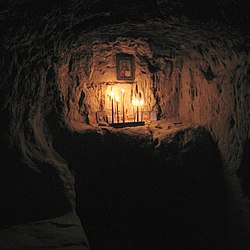
A cave monastery is a monastery built in caves, with possible outside facilities. The 3rd-century monk St. Anthony the Great, known as the founder of Christian monasticism, lived in a cave.

↑ Return to Menu