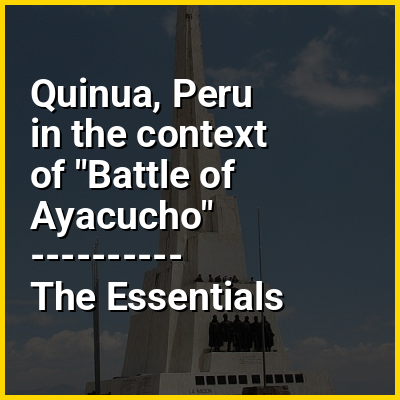
The Battle of Ayacucho (Spanish: Batalla de Ayacucho, IPA: [baˈtaʎa ðe aʝaˈkutʃo]) was a decisive military encounter during the Peruvian War of Independence. This battle secured the independence of Peru and ensured independence for the rest of belligerent South American states. In Peru it is considered the end of the Spanish American wars of independence in this country, although the campaign of Antonio José de Sucre continued through 1825 in Upper Peru and the siege of the fortresses Chiloé and Callao eventually ended in 1826.
At the end of 1824, Royalists still had control of most of the south of Peru as well as of the Real Felipe fortress in the port of Callao. On 9 December 1824, the Battle of Ayacucho (Battle of La Quinua) took place between Royalist and Independentist forces at Pampa de Ayacucho (or Quinua), a few kilometers from Ayacucho, near the town of Quinua. Independentist forces were led by Simón Bolívar's lieutenant Antonio José de Sucre. Viceroy José de la Serna was wounded, and after the battle second commander-in-chief José de Canterac signed the final capitulation of the Royalist army.