Quintus Lucretius Vespillo in the context of "Laudatio Turiae"

Play Trivia Questions online!

or

Skip to study material about Quintus Lucretius Vespillo in the context of "Laudatio Turiae"

Ad spacer

⭐ Core Definition: Quintus Lucretius Vespillo

Quintus Lucretius Vespillo was a Roman senator and consul, whose career commenced during the late Roman Republic and concluded in the reign of emperor Augustus.

He was in the past believed to be the author of the Laudatio Turiae, a tombstone engraved with an epitaph in the form of a husband's eulogy for his wife, but this is rejected by modern scholars.

↓ Menu

>>>PUT SHARE BUTTONS HERE<<<

👉 Quintus Lucretius Vespillo in the context of Laudatio Turiae

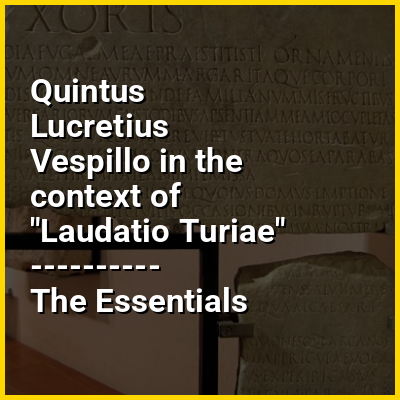
The laudatio Turiae (CIL VI, 41062; ILS 8393) the modern name for an inscription recording a speech given in the late last century BC – modern dates range between 9 and 6 BC – by an upper class husband in eulogy of his wife. The speech details the matronal qualities of the wife, her perseverance in the aftermath of her family's death, how she saved the husband during the triumviral proscriptions, and their marriage. The speech was not necessarily given in public but was inscribed and put up around Rome.

Traditionally, following Theodor Mommsen, the deceased wife has been identified as Turia, the wife of the Quintus Lucretius Vespillo who was consul in 19 BC. This identification, however, is no longer widely accepted for lack of corroborating evidence.

↓ Explore More Topics
In this Dossier

Quintus Lucretius Vespillo in the context of Epitaph

An epitaph (from Ancient Greek ἐπιτάφιος (epitáphios) 'a funeral oration'; from ἐπι- (epi-) 'at, over' and τάφος (táphos) 'tomb') is a short text honoring a deceased person. Strictly speaking, it refers to text that is inscribed on a tombstone or plaque, but it may also be used in a figurative sense. Some epitaphs are specified by the person themselves before their death, while others are chosen by those responsible for the burial. An epitaph may be written in prose or in verse.

Most epitaphs are brief records of the family, and perhaps the career, of the deceased, often with a common expression of love or respect—for example, "beloved father of ..."—but others are more ambitious. From the Renaissance to the 19th century in Western culture, epitaphs for notable people became increasingly lengthy and pompous descriptions of their family origins, career, virtues and immediate family, often in Latin. Notably, the Laudatio Turiae, the longest known Ancient Roman epitaph, exceeds almost all of these at 180 lines; it celebrates the virtues of an honored wife (sometimes identified, but not generally accepted, as the Wife of consul Quintus Lucretius Vespillo).
↑ Return to Menu

Quintus Lucretius Vespillo in the context of Marcus Vinicius (consul 19 BC)

Marcus Vinicius (also spelled Vinucius) was a Roman senator and general, who held a number of posts in the service of the first Roman emperor, Augustus. Vinicius was suffect consul in the latter part of 19 BC with Quintus Lucretius Vespillo as his colleague.

↑ Return to Menu