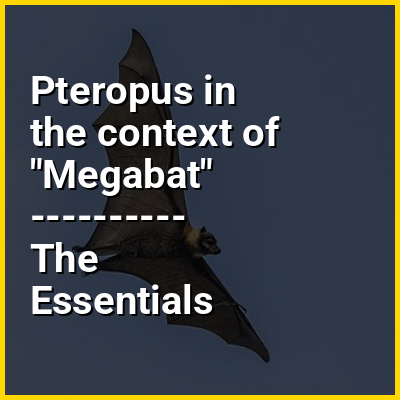
Pteropus in the context of "Megabat"

Play Trivia Questions online!

or

Skip to study material about Pteropus in the context of "Megabat"

Ad spacer

>>>PUT SHARE BUTTONS HERE<<<

👉 Pteropus in the context of Megabat

Megabats constitute the family Pteropodidae of the order Chiroptera. They are also called fruit bats, Old World fruit bats, or—especially the genera Acerodon and Pteropus—flying foxes. They are the only member of the superfamily Pteropodoidea, which is one of two superfamilies in the suborder Yinpterochiroptera. Internal divisions of Pteropodidae have varied since subfamilies were first proposed in 1917. From three subfamilies in the 1917 classification, six are now recognized, along with various tribes. As of 2018, 197 species of megabat had been described.

The leading theory of the evolution of megabats has been determined primarily by genetic data, as the fossil record for this family is the most fragmented of all bats. They likely evolved in Australasia, with the common ancestor of all living pteropodids existing approximately 31 million years ago. Many of their lineages probably originated in Melanesia, then dispersed over time to mainland Asia, the Mediterranean, and Africa. Today, they are found in tropical and subtropical areas of Eurasia, Africa, and Oceania.

↓ Explore More Topics
In this Dossier

Pteropus in the context of Giant golden-crowned flying fox

The giant golden-crowned flying fox (Acerodon jubatus), also known as the golden-capped fruit bat, is a species of megabat endemic to the Philippines. Since its description in 1831, three subspecies of the giant golden-crowned flying fox have been recognized, one of which is extinct. The extinct subspecies (A. jubatus lucifer) was formerly recognized as a full species, the Panay golden-crowned flying fox. Formerly, this species was placed in the genus Pteropus; while it is no longer within the genus, it has many physical similarities to Pteropus megabats. It is one of the largest bat species in the world, weighing up to 1.4 kg (3.1 lb)—only the Indian and great flying fox can weigh more. It has the longest documented forearm length of any bat species at 21 cm (8.3 in).

It is primarily frugivorous, consuming several kinds of fig and some leaves. It forages at night and sleeps during the day in tree roosts. These roosts can consist of thousands of individuals, often including another species, the large flying fox. Not much is known about its reproduction; it gives birth annually from April through June, with females having one pup at a time. Predators of the giant golden-crowned flying fox include raptors such as eagles, the reticulated python, and humans.

↑ Return to Menu