Propeller in the context of "Impeller"

Play Trivia Questions online!

or

Skip to study material about Propeller in the context of "Impeller"

Ad spacer

⭐ Core Definition: Propeller

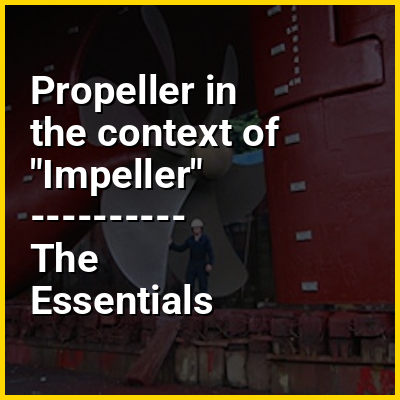
A propeller (often called a screw if on a ship or an airscrew if on an aircraft) is a device with a rotating hub and radiating blades that are set at a pitch to form a helical spiral which, when rotated, exerts linear thrust upon a working fluid such as water or air. Propellers are used to pump fluid through a pipe or duct, or to create thrust to propel a boat through water or an aircraft through air.

The blades are shaped so that their rotational motion through the fluid causes a pressure difference between the two surfaces of the blade by Bernoulli's principle which exerts force on the fluid. Most marine propellers are screw propellers with helical blades rotating on a propeller shaft with an approximately horizontal axis.

↓ Menu

>>>PUT SHARE BUTTONS HERE<<<

👉 Propeller in the context of Impeller

An impeller, or impellor, is a driven rotor used to increase the pressure and flow of a fluid. It is the opposite of a turbine, which extracts energy from, and reduces the pressure of, a flowing fluid.

Strictly speaking, propellers are a sub-class of impellers where the flow both enters and leaves axially, but in many contexts the term "impeller" is reserved for non-propeller rotors where the flow enters axially and leaves radially, especially when creating suction in a pump or compressor.

↓ Explore More Topics
In this Dossier

Propeller in the context of Archaellum

The archaellum (pl.: archaella; formerly archaeal flagellum) is a unique structure on the cell surface of many archaea that allows for swimming motility. The archaellum consists of a rigid helical filament that is attached to the cell membrane by a molecular motor. This molecular motor – composed of cytosolic, membrane, and pseudo-periplasmic proteins – is responsible for the assembly of the filament and, once assembled, for its rotation. The rotation of the filament propels archaeal cells in liquid medium, in a manner similar to the propeller of a boat. The bacterial analog of the archaellum is the flagellum, which is also responsible for their swimming motility and can also be compared to a rotating corkscrew. Although the movement of archaella and flagella is sometimes described as "whip-like", this is incorrect, as only cilia from Eukaryotes move in this manner. Indeed, even "flagellum" (word derived from Latin meaning "whip") is a misnomer, as bacterial flagella also work as propeller-like structures.

Early studies on "archaeal flagella" identified several differences between archaella and flagella, although those differences were dismissed as a possible adaptation of archaella to the extreme ecological environments where archaea were at the time known to inhabit. When the first genomes of archaeal organisms were sequenced, it became obvious that archaea do not code for any of the proteins that are part of the flagellum, thus establishing that the motility system of archaea is fundamentally different from that of bacteria. In order to highlight the difference between these two organelles, the name archaellum was proposed in 2012 following studies that showed it to be evolutionarily and structurally different from the bacterial flagella and eukaryotic cilia.
↑ Return to Menu

Propeller in the context of Marine propulsion

Marine propulsion is the mechanism or system used to generate thrust to move a watercraft through water. While paddles and sails are still used on some smaller boats, most modern ships are propelled by mechanical systems consisting of an electric motor or internal combustion engine driving a propeller, or less frequently, in pump-jets, an impeller. Marine engineering is the discipline concerned with the engineering design process of marine propulsion systems.

Human-powered paddles and oars, and later, sails were the first forms of marine propulsion. Rowed galleys, some equipped with sail, played an important early role in early human seafaring and warfare. The first advanced mechanical means of marine propulsion was the marine steam engine, introduced in the early 19th century. During the 20th century it was replaced by two-stroke or four-stroke diesel engines, outboard motors, and gas turbine engines on faster ships. Marine nuclear reactors, which appeared in the 1950s, produce steam to propel warships and icebreakers; commercial application, attempted late that decade, failed to catch on. Electric motors using battery packs have been used for propulsion on submarines and electric boats and have been proposed for energy-efficient propulsion.

↑ Return to Menu

Propeller in the context of Cupronickel

Cupronickel or copper–nickel (CuNi) is an alloy of copper with nickel, usually along with small quantities of other metals added for strength, such as iron and manganese. The copper content typically varies from 60 to 90 percent. (Monel is a nickel–copper alloy that contains a minimum of 52 percent nickel.)

Despite its high copper content, cupronickel is silver in colour. Cupronickel is highly resistant to corrosion by salt water, and is therefore used for piping, heat exchangers and condensers in seawater systems, as well as for marine hardware. It is sometimes used for the propellers, propeller shafts, and hulls of high-quality boats. Other uses include military equipment and chemical industry, petrochemical industry, and electrical industries.

↑ Return to Menu

Propeller in the context of Paddle steamer

A paddle steamer is a steamship or steamboat powered by a steam engine driving paddle wheels to propel the craft through the water. In antiquity, paddle wheelers followed the development of poles, oars and sails, whereby the first uses were wheelers driven by animals or humans.

In the early 19th century, paddle wheels were the predominant way of propulsion for steam-powered boats. In the late 19th century, paddle propulsion was largely superseded by the screw propeller and other marine propulsion systems that have a higher efficiency, especially in rough or open water.

↑ Return to Menu

Propeller in the context of Draft (hull)

The draft or draught of a ship is a determined depth of the vessel below the waterline, measured vertically to its hull's lowest—its propellers, or keel, or other reference point. Draft varies according to the loaded condition of the ship. A deeper draft means the ship will have greater vertical depth below the waterline. Draft is used in under keel clearance calculations, where the draft is calculated with the available depth of water (from Electronic navigational charts) to ensure the ship can navigate safely, without grounding. Navigators can determine their draught by calculation or by visual observation (of the ship's painted load lines).

↑ Return to Menu

Propeller in the context of Drivetrain

A drivetrain (also frequently spelled as drive train or sometimes drive-train) or transmission system, is the group of components that deliver mechanical power from the prime mover to the driven components. In automotive engineering, the drivetrain is the components of a motor vehicle that deliver power to the drive wheels. This excludes the engine or motor that generates the power. In marine applications, the drive shaft will drive a propeller, thruster, or waterjet rather than a drive axle, while the actual engine might be similar to an automotive engine. Other machinery, equipment and vehicles may also use a drivetrain to deliver power from the engine(s) to the driven components.

In contrast, the powertrain is considered to include both the engine and/or motor(s) as well as the drivetrain.

↑ Return to Menu

Propeller in the context of Ships of the line

A ship of the line was a type of naval warship constructed during the Age of Sail from the 17th century to the mid-19th century. The ship of the line was designed for the naval tactic known as the line of battle, which involved the two columns of opposing warships manoeuvering to volley fire with the cannons along their broadsides. In conflicts where opposing ships were both able to fire from their broadsides, the faction with more cannons firing – and therefore more firepower – typically had an advantage.

From the end of the 1840s, the introduction of steam power brought less dependence on the wind in battle and led to the construction of screw-driven wooden-hulled ships of the line; a number of purely sail-powered ships were converted to this propulsion mechanism. However, the rise of the ironclad frigate, starting in 1859, made steam-assisted ships of the line obsolete. The ironclad warship was predecessor to the 20th-century battleship, whose very designation is itself a contraction of the phrase "ship of the line of battle" or, more colloquially, "battleship of the line".

↑ Return to Menu

Propeller in the context of Outboard motor

An outboard motor is a propulsion system for boats, consisting of a self-contained unit that includes engine, gearbox and propeller or jet drive, designed to be affixed to the outside of the transom. They are the most common motorised method of propelling small watercraft. As well as providing propulsion, outboards provide steering control, as they are designed to pivot over their mountings and thus control the direction of thrust. The skeg also acts as a rudder when the engine is not running. Unlike inboard motors, outboard motors can be easily removed for storage or repairs.

In order to eliminate the chances of hitting bottom with an outboard motor, the motor can be tilted up to an elevated position either electronically or manually. This helps when traveling through shallow waters where there may be debris that could potentially damage the motor as well as the propeller. If the electric motor required to move the pistons which raise or lower the engine is malfunctioning, every outboard motor is equipped with a manual piston release which will allow the operator to drop the motor down to its lowest setting.

↑ Return to Menu