Pronghorn in the context of "Prairie dogs"

Play Trivia Questions online!

or

Skip to study material about Pronghorn in the context of "Prairie dogs"

Ad spacer

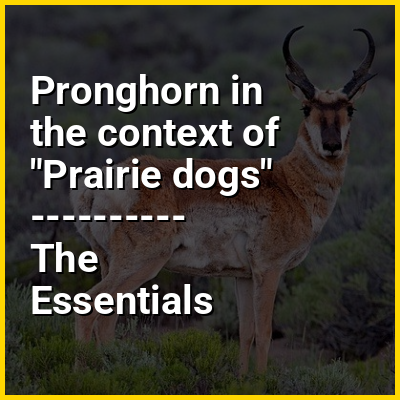
⭐ Core Definition: Pronghorn

The pronghorn (UK: /ˈprɒŋhɔːrn/, US: /ˈprɔːŋ-/) (Antilocapra americana) is a species of artiodactyl (even-toed, hoofed) mammal indigenous to interior western and central North America. Though not an antelope, it is known colloquially in North America as the American antelope, prong buck, pronghorn antelope, and prairie antelope, because it closely resembles the antelopes of the Old World and fills a similar ecological niche due to parallel evolution. It is the only surviving member of the family Antilocapridae.

During the Pleistocene epoch, about 11 other antilocaprid species existed in North America, many with long or spectacularly twisted horns. Three other genera (Capromeryx, Stockoceros and Tetrameryx) existed when humans entered North America but are now extinct.

↓ Menu

>>>PUT SHARE BUTTONS HERE<<<

👉 Pronghorn in the context of Prairie dogs

Prairie dogs (genus Cynomys) are herbivorous burrowing ground squirrels native to the grasslands of North America. There are five recognized species of prairie dog: black-tailed, white-tailed, Gunnison's, Utah, and Mexican prairie dogs. In Mexico, prairie dogs are found primarily in the northern states, which lie at the southern end of the Great Plains: northeastern Sonora, north and northeastern Chihuahua, northern Coahuila, northern Nuevo León, and northern Tamaulipas. In the United States, they range primarily to the west of the Mississippi River, though they have also been introduced in a few eastern locales. They are also found in the Canadian Prairies. Despite the name, they are not actually canines; prairie dogs, along with the marmots, chipmunks, and several other basal genera belong to the ground squirrels (tribe Marmotini), part of the larger squirrel family (Sciuridae).

Prairie dogs are considered a keystone species, with their mounds often being used by other species. Their mound-building encourages grass development and renewal of topsoil, with rich mineral and nutrient renewal in the soil, which can be crucial for soil quality and agriculture. They are extremely important in the food chain, being important to diets of many animals such as the black-footed ferret, swift fox, golden eagle, red tailed hawk, American badger, and coyote. Other species, such as the golden-mantled ground squirrel, mountain plover, and the burrowing owl, also rely on prairie dog burrows for nesting areas. Grazing species, such as plains bison, pronghorn, and mule deer, have shown a proclivity for grazing on the same land used by prairie dogs, with their regeneration of topsoil being important for maintaining healthy humus. Prairie dogs have some of the most complex systems of communication and social structures in the animal kingdom.
↓ Explore More Topics
In this Dossier

Pronghorn in the context of Horn (anatomy)

A horn is a permanent pointed projection on the head of various animals that consists of a covering of keratin and other proteins surrounding a core of live bone. Horns are distinct from antlers, which are not permanent. In mammals, true horns are found mainly among the ruminant artiodactyls, in the families Antilocapridae (pronghorn) and Bovidae (cattle, goats, antelope etc.). Cattle horns arise from subcutaneous connective tissue (under the scalp) and later fuse to the underlying frontal bone.

One pair of horns is usual; however, two or more pairs occur in a few wild species and in some domesticated breeds of sheep. Polycerate (multi-horned) sheep breeds include the Hebridean, Icelandic, Jacob, Manx Loaghtan, and the Navajo-Churro.

↑ Return to Menu

Pronghorn in the context of Rut (mammalian reproduction)

The rut (from the Latin rugire, meaning "to roar") is the mating season of certain mammals, which includes ruminants such as deer, sheep, camels, goats, pronghorns, bison, giraffes and antelopes, and extends to others such as skunks and elephants. The rut is characterized in males by an increase in testosterone, exaggerated sexual dimorphisms, increased aggression, and increased interest in females. The males of the species may mark themselves with mud, undergo physiological changes or perform characteristic displays in order to make themselves more visually appealing to the females. Males also use olfaction to entice females to mate using secretions from glands and soaking in their own urine.

During the rut (known as the rutting period and in domestic sheep management as tupping), males often rub their antlers or horns on trees or shrubs, fight with each other, wallow in mud or dust, self-anoint, and herd estrus females together. These displays make the male conspicuous and aid in mate selection.

↑ Return to Menu

Pronghorn in the context of Petrified Forest National Park

Petrified Forest National Park is a national park of the United States in Navajo and Apache counties in northeastern Arizona. Named for its large deposits of petrified wood, the park covers about 346 square miles (900 square kilometers), encompassing semi-desert shrub steppe as well as highly eroded and colorful badlands. The park's headquarters is about 26 miles (42 km) east of Holbrook along Interstate 40 (I-40), which parallels the BNSF Railway's Southern Transcon, the Puerco River, and historic U.S. Route 66, all crossing the park roughly east–west. The site, the northern part of which extends into the Painted Desert, was declared a national monument in 1906 and a national park in 1962. The park received 644,922 recreational visitors in 2018.

Averaging about 5,400 feet (1,600 m) in elevation, the park has a dry windy climate with temperatures that vary from summer highs of about 100 °F (38 °C) to winter lows well below freezing. More than 400 species of plants, dominated by grasses such as bunchgrass, blue grama, and sacaton, are found in the park. Fauna include larger animals such as pronghorns, coyotes, and bobcats; many smaller animals, such as deer mice, snakes, lizards, and seven kinds of amphibians; and more than 200 species of birds, some of which are permanent residents and many of which are migratory. About one third of the park is designated wilderness—50,260 acres (79 sq mi; 203 km).

↑ Return to Menu

Pronghorn in the context of Elk

The elk (pl.: elk or elks; Cervus canadensis) or wapiti is the second largest species within the deer family, Cervidae, and one of the largest terrestrial mammals in its native range of North America and Central and East Asia. The word "elk" originally referred to the European variety of the moose, Alces alces, but was transferred to Cervus canadensis by North American colonists.

The name "wapiti" is derived from a Shawnee and Cree word meaning "white rump", after the distinctive light fur around the tail region which the animals may fluff-up or raise to signal their agitation or distress to one another, when fleeing perceived threats, or among males courting females and sparring for dominance. A similar trait is seen in other artiodactyl species, like the bighorn sheep, pronghorn and the white-tailed deer, to varying degrees.

↑ Return to Menu

Pronghorn in the context of Antelope

The term antelope refers to numerous extant or recently extinct species of the ruminant artiodactyl family Bovidae that are indigenous to most of Africa, India, the Middle East, Central Asia, and a small area of Russia. Antelopes do not form a monophyletic group, as some antelopes are more closely related to other bovid groups, such as bovines, goats, and sheep, than to other antelopes.

A stricter grouping, known as the true antelopes, includes only the genera Gazella, Nanger, Eudorcas, and Antilope. One North American mammal, the pronghorn or "pronghorn antelope", is colloquially referred to as the "American antelope", despite the fact that it belongs to a completely different family (Antilocapridae) than the true Old-World antelopes; pronghorn are the sole extant member of a lineage that once included many species which went extinct in the prehistoric period.

↑ Return to Menu

Pronghorn in the context of Antilocapridae

The Antilocapridae are a family of ruminant artiodactyls endemic to North America. Their closest extant relatives are the giraffids. Only one species, the pronghorn (Antilocapra americana), is living today; all other members of the family are extinct. The living pronghorn is a small ruminant mammal resembling an antelope.

↑ Return to Menu