Projected coordinate system in the context of "Universal Transverse Mercator"

Play Trivia Questions online!

or

Skip to study material about Projected coordinate system in the context of "Universal Transverse Mercator"

Ad spacer

⭐ Core Definition: Projected coordinate system

A projected coordinate system – also called a projected coordinate reference system, planar coordinate system, or grid reference system – is a type of spatial reference system that represents locations on Earth using Cartesian coordinates (x, y) on a planar surface created by a particular map projection. Each projected coordinate system, such as "Universal Transverse Mercator WGS 84 Zone 26N," is defined by a choice of map projection (with specific parameters), a choice of geodetic datum to bind the coordinate system to real locations on the earth, an origin point, and a choice of unit of measure. Hundreds of projected coordinate systems have been specified for various purposes in various regions.

When the first standardized coordinate systems were created during the 20th century, such as the Universal Transverse Mercator, State Plane Coordinate System, and British National Grid, they were commonly called grid systems; the term is still common in some domains such as the military that encode coordinates as alphanumeric grid references. However, the term projected coordinate system has recently become predominant to clearly differentiate it from other types of spatial reference system. The term is used in international standards such as the EPSG and ISO 19111 (also published by the Open Geospatial Consortium as Abstract Specification 2), and in most geographic information system software.
↓ Menu

>>>PUT SHARE BUTTONS HERE<<<

👉 Projected coordinate system in the context of Universal Transverse Mercator

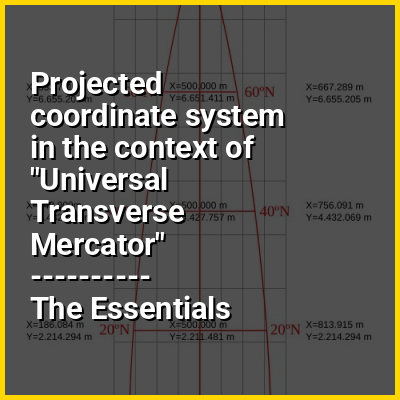
The Universal Transverse Mercator (UTM) is a projected coordinate system based on the transverse Mercator map projection of the Earth spheroid. As a map projection, it transforms geographic coordinates of locations on Earth's surface to assign plane coordinates to them. It is a horizontal position representation, which means it ignores altitude and treats the earth surface as an oblate ellipsoid. The system divides Earth into 60 zones and projects each to the plane as a basis for its coordinates. Specifying a location means specifying the zone and the x, y coordinate in that plane.

UTM parameter specifications vary by nation or region or mapping system. However, most zones in UTM span 6 degrees of longitude, and each has a designated central meridian. In each zone, the scale factor at the central meridian is specified to be 0.9996 of true scale (for most UTM systems in use). Therefore maps, atlases, and topographic grid systems built from an appropriate collection of UTM zones cover a region with planar maps with well-controlled, minimal distortion. For this reason, UTM coordinates are used in many nations and regions for topographic mapping, as well as more generally for pinpointing locations.

↓ Explore More Topics
In this Dossier

Projected coordinate system in the context of Graticule (cartography)

A graticule or grid (from Latin crāticula 'grill/grating'), on a map, is a graphical depiction of a coordinate system as a grid of coordinate curves or "lines", each curve/line representing a constant coordinate value. It is thus a form of isoline, and is commonly found on maps of many kinds, at scales from local to global.

The term graticule is almost always used to specifically refer to the parallels and meridians of latitude and longitude, respectively. In modern usage, graticules are contrasted with grids, which display the eastings and northings of a projected coordinate reference system, such as Universal Transverse Mercator – usually the coordinate system in which the map is drawn.

↑ Return to Menu