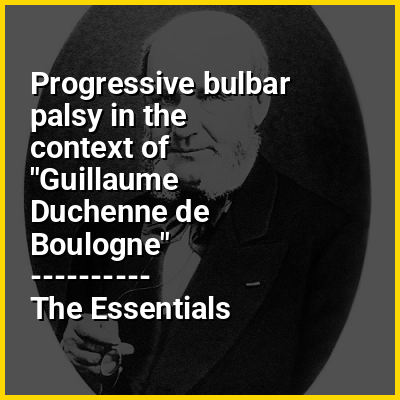
Guillaume-Benjamin-Amand Duchenne (de Boulogne) (September 17, 1806, in Boulogne-sur-Mer – September 15, 1875, in Paris) was a French neurologist who revived Luigi Galvani's research and greatly advanced the science of electrophysiology. The era of modern neurology developed from Duchenne's understanding of neural pathways and his diagnostic innovations including deep tissue biopsy, nerve conduction tests (NCS), and clinical photography. This extraordinary range of activities (mostly in the Salpêtrière) was achieved against the background of a troubled personal life and a generally indifferent medical and scientific establishment.
Neurology did not exist in France before Duchenne and although many medical historians regard Jean-Martin Charcot as the father of the discipline, Charcot owed much to Duchenne, often acknowledging him as "mon maître en neurologie" (my master in neurology). The American neurologist Joseph Collins (1866–1950) wrote that Duchenne found neurology "a sprawling infant of unknown parentage which he succored to a lusty youth."His greatest contributions were made in the myopathies that came to immortalize his name, Duchenne muscular dystrophy, Duchenne-Aran spinal muscular atrophy, Duchenne-Erb paralysis, Duchenne's disease (Tabes dorsalis), and Duchenne's paralysis (progressive bulbar palsy). He was the first clinician to practise muscle biopsy, with an invention he called "l'emporte-pièce" (Duchenne's trocar). In 1855, he formalized the diagnostic principles of electrophysiology and introduced electrotherapy in a textbook titled De l'electrisation localisée et de son application à la physiologie, à la pathologie et à la thérapeutique. A companion atlas to this work, the Album de photographies pathologiques, was the first neurology text illustrated by photographs. Duchenne's monograph, the Mécanisme de la physionomie humaine – also illustrated prominently by his photographs – was the first study on the physiology of emotion and was highly influential on Darwin's work on human evolution and emotional expression.