Product (mathematics) in the context of Integer multiple


Product (mathematics) in the context of Integer multiple

Product (mathematics) Study page number 1 of 3

Play TriviaQuestions Online!

or

Skip to study material about Product (mathematics) in the context of "Integer multiple"


⭐ Core Definition: Product (mathematics)

In mathematics, a product is the result of multiplication, or an expression that identifies objects (numbers or variables) to be multiplied, called factors. For example, 21 is the product of 3 and 7 (the result of multiplication), and is the product of and (indicating that the two factors should be multiplied together).When one factor is an integer, the product is called a multiple.

The order in which real or complex numbers are multiplied has no bearing on the product; this is known as the commutative law of multiplication. When matrices or members of various other associative algebras are multiplied, the product usually depends on the order of the factors. Matrix multiplication, for example, is non-commutative, and so is multiplication in other algebras in general as well.

↓ Menu
HINT:

In this Dossier

Product (mathematics) in the context of Exponentiation

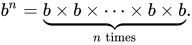
In mathematics, exponentiation, denoted b, is an operation involving two numbers: the base, b, and the exponent or power, n. When n is a positive integer, exponentiation corresponds to repeated multiplication of the base: that is, b is the product of multiplying n bases:In particular, .

The exponent is usually shown as a superscript to the right of the base as b or in computer code as b^n. This binary operation is often read as "b to the power n"; it may also be referred to as "b raised to the nth power", "the nth power of b", or, most briefly, "b to the n".

View the full Wikipedia page for Exponentiation
↑ Return to Menu

Product (mathematics) in the context of Prime number

A prime number (or a prime) is a natural number greater than 1 that is not a product of two smaller natural numbers. A natural number greater than 1 that is not prime is called a composite number. For example, 5 is prime because the only ways of writing it as a product, 1 × 5 or 5 × 1, involve 5 itself. However, 4 is composite because it is a product (2 × 2) in which both numbers are smaller than 4. Primes are central in number theory because of the fundamental theorem of arithmetic: every natural number greater than 1 is either a prime itself or can be factorized as a product of primes that is unique up to their order.

The property of being prime is called primality. A simple but slow method of checking the primality of a given number , called trial division, tests whether is a multiple of any integer between 2 and . Faster algorithms include the Miller–Rabin primality test, which is fast but has a small chance of error, and the AKS primality test, which always produces the correct answer in polynomial time but is too slow to be practical. Particularly fast methods are available for numbers of special forms, such as Mersenne numbers. As of October 2024 the largest known prime number is a Mersenne prime with 41,024,320 decimal digits.

View the full Wikipedia page for Prime number
↑ Return to Menu

Product (mathematics) in the context of Proportionality (mathematics)

In mathematics, two sequences of numbers, often experimental data, are proportional or directly proportional if their corresponding elements have a constant ratio. The ratio is called coefficient of proportionality (or proportionality constant) and its reciprocal is known as constant of normalization (or normalizing constant). Two sequences are inversely proportional if corresponding elements have a constant product.

Two functions and are proportional if their ratio is a constant function.

View the full Wikipedia page for Proportionality (mathematics)
↑ Return to Menu

Product (mathematics) in the context of Multiplication

Multiplication is one of the four elementary mathematical operations of arithmetic, with the other ones being addition, subtraction, and division. The result of a multiplication operation is called a product. Multiplication is often denoted by the cross symbol, ×, by the mid-line dot operator, , by juxtaposition, or, in programming languages, by an asterisk, *.

The multiplication of whole numbers may be thought of as repeated addition; that is, the multiplication of two numbers is equivalent to adding as many copies of one of them, the multiplicand, as the quantity of the other one, the multiplier; both numbers can be referred to as factors. This is to be distinguished from terms, which are added.

View the full Wikipedia page for Multiplication
↑ Return to Menu

Product (mathematics) in the context of Work (physics)

In science, work is the energy transferred to or from an object via the application of force along a displacement. In its simplest form, for a constant force aligned with the direction of motion, the work equals the product of the force strength and the distance traveled. A force is said to do positive work if it has a component in the direction of the displacement of the point of application. A force does negative work if it has a component opposite to the direction of the displacement at the point of application of the force.

For example, when a ball is held above the ground and then dropped, the work done by the gravitational force on the ball as it falls is positive, and is equal to the weight of the ball (a force) multiplied by the distance to the ground (a displacement). If the ball is thrown upwards, the work done by the gravitational force is negative, and is equal to the weight multiplied by the displacement in the upwards direction.

View the full Wikipedia page for Work (physics)
↑ Return to Menu

Product (mathematics) in the context of Leading coefficient

In mathematics, a coefficient is a multiplicative factor involved in some term of a polynomial, a series, or any other type of expression. It may be a number without units, in which case it is known as a numerical factor. It may also be a constant with units of measurement, in which it is known as a constant multiplier. In general, coefficients may be any expression (including variables such as a, b and c). When the combination of variables and constants is not necessarily involved in a product, it may be called a parameter. For example, the polynomial has coefficients 2, −1, and 3, and the powers of the variable in the polynomial have coefficient parameters , , and .

A constant coefficient, also known as constant term or simply constant, is a quantity either implicitly attached to the zeroth power of a variable or not attached to other variables in an expression; for example, the constant coefficients of the expressions above are the number 3 and the parameter c, involved in 3=cx. The coefficient attached to the highest degree of the variable in a polynomial of one variable is referred to as the leading coefficient; for example, in the example expressions above, the leading coefficients are 2 and a, respectively.

View the full Wikipedia page for Leading coefficient
↑ Return to Menu

Product (mathematics) in the context of Dot product

In mathematics, the dot product is an algebraic operation that takes two equal-length sequences of numbers (usually coordinate vectors), and returns a single number. In Euclidean geometry, the scalar product of two vectors is the dot product of their Cartesian coordinates, and is independent from the choice of a particular Cartesian coordinate system. The terms "dot product" and "scalar product" are often used interchangeably when a Cartesian coordinate system has been fixed once for all. The scalar product being a particular inner product, the term "inner product" is also often used.

Algebraically, the dot product is the sum of the products of the corresponding entries of the two sequences of numbers. Geometrically, the scalar product of two vectors is the product of their lengths and the cosine of the angle between them. These definitions are equivalent when using Cartesian coordinates. In modern geometry, Euclidean spaces are often defined by using vector spaces. In this case, the scalar product is used for defining lengths (the length of a vector is the square root of the scalar product of the vector by itself) and angles (the cosine of the angle between two vectors is the quotient of their scalar product by the product of their lengths).

View the full Wikipedia page for Dot product
↑ Return to Menu

Product (mathematics) in the context of Combat effectiveness

Combat effectiveness is the capacity or performance of a military force to succeed in undertaking an operation, mission or objective. Determining optimal combat effectiveness is crucial in the armed forces, whether they are deployed on land, air or sea. Combat effectiveness is an aspect of military effectiveness and can be attributed to the strength of combat support including the quality and quantity of logistics, weapons and equipment as well as military tactics, the psychological states of soldiers, level of influence of leaders, skill and motivation that can arise from nationalism to survival are all capable of contributing to success on the battlefield. Combat effectiveness is a function of these factors. Overall combat effectiveness or combat power is the product of a forces strength and the combat effectiveness of that force. Combat effectiveness explains how a numerically weak force can prevail over another that is much stronger. It also explains how relatively small units can have a significant impact on the outcome of a conflict.

View the full Wikipedia page for Combat effectiveness
↑ Return to Menu

Product (mathematics) in the context of Multiple (mathematics)

In mathematics, a multiple is the product of any quantity and an integer. In other words, for the quantities a and b, it can be said that b is a multiple of a if b = na for some integer n, which is called the multiplier. If a is not zero, this is equivalent to saying that is an integer.

When a and b are both integers, and b is a multiple of a, then a is called a divisor of b. One says also that a divides b. If a and b are not integers, mathematicians prefer generally to use integer multiple instead of multiple, for clarification. In fact, multiple is used for other kinds of product; for example, a polynomial p is a multiple of another polynomial q if there exists third polynomial r such that p = qr.

View the full Wikipedia page for Multiple (mathematics)
↑ Return to Menu

Product (mathematics) in the context of Integer factorization

In mathematics, integer factorization is the decomposition of a positive integer into a product of integers. Every positive integer greater than 1 is either the product of two or more integer factors greater than 1, in which case it is a composite number, or it is not, in which case it is a prime number. For example, 15 is a composite number because 15 = 3 · 5, but 7 is a prime number because it cannot be decomposed in this way. If one of the factors is composite, it can in turn be written as a product of smaller factors, for example 60 = 3 · 20 = 3 · (5 · 4). Continuing this process until every factor is prime is called prime factorization; the result is always unique up to the order of the factors by the prime factorization theorem.

To factorize a small integer n using mental or pen-and-paper arithmetic, the simplest method is trial division: checking if the number is divisible by prime numbers 2, 3, 5, and so on, up to the square root of n. For larger numbers, especially when using a computer, various more sophisticated factorization algorithms are more efficient. A prime factorization algorithm typically involves testing whether each factor is prime each time a factor is found.

View the full Wikipedia page for Integer factorization
↑ Return to Menu

Product (mathematics) in the context of Factorial

In mathematics, the factorial of a non-negative integer , denoted by , is the product of all positive integers less than or equal to . The factorial of also equals the product of with the next smaller factorial:For example,The value of 0! is 1, according to the convention for an empty product.

Factorials have been discovered in several ancient cultures, notably in Indian mathematics in the canonical works of Jain literature, and by Jewish mystics in the Talmudic book Sefer Yetzirah. The factorial operation is encountered in many areas of mathematics, notably in combinatorics, where its most basic use counts the possible distinct sequences – the permutations – of distinct objects: there are . In mathematical analysis, factorials are used in power series for the exponential function and other functions, and they also have applications in algebra, number theory, probability theory, and computer science.

View the full Wikipedia page for Factorial
↑ Return to Menu