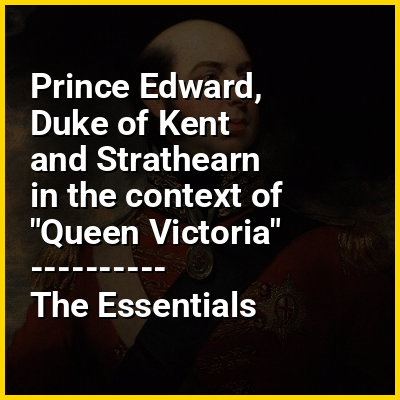
Prince Edward, Duke of Kent and Strathearn in the context of "Queen Victoria"

Play Trivia Questions online!

or

Skip to study material about Prince Edward, Duke of Kent and Strathearn in the context of "Queen Victoria"

Ad spacer

⭐ Core Definition: Prince Edward, Duke of Kent and Strathearn

Prince Edward, Duke of Kent and Strathearn (Edward Augustus; 2 November 1767 – 23 January 1820), was the fourth son and fifth child of King George III and Queen Charlotte. His only child, Victoria, became Queen of the United Kingdom 17 years after his death.

Edward lived in Lower Canada and Nova Scotia from 1791 to 1800, where he served as commander-in-chief of British forces in the Maritime Provinces of North America. He was the first British prince to enter the United States following its recognition of independence in 1783, travelling on foot to Boston from Lower Canada in 1794.

↓ Menu

>>>PUT SHARE BUTTONS HERE<<<

👉 Prince Edward, Duke of Kent and Strathearn in the context of Queen Victoria

Victoria (Alexandrina Victoria; 24 May 1819 – 22 January 1901) was Queen of the United Kingdom of Great Britain and Ireland from 20 June 1837 until her death. Her reign of 63 years and 216 days, which was longer than those of any of her predecessors, constituted the Victorian era, a period of industrial, political, scientific, and military change within the United Kingdom marked by a great expansion of the British Empire. In 1876, the British parliament voted to grant her the additional title of Empress of India.

Victoria was the daughter of Prince Edward, Duke of Kent and Strathearn (the fourth son of King George III), and Princess Victoria of Saxe-Coburg-Saalfeld. After the deaths of her father and grandfather in 1820, she was raised under close supervision by her mother and her comptroller, John Conroy. She inherited the throne aged 18 after her father's three elder brothers died without surviving legitimate issue. Victoria attempted privately to influence government policy and ministerial appointments; publicly, she became a national icon who was identified with strict standards of personal morality.

↓ Explore More Topics
In this Dossier

Prince Edward, Duke of Kent and Strathearn in the context of Princess Victoria of Saxe-Coburg-Saalfeld

Princess Victoria of Saxe-Coburg-Saalfeld (Marie Louise Victoire; 17 August 1786 – 16 March 1861), later Princess of Leiningen and subsequently Duchess of Kent and Strathearn, was a German princess and the mother of Queen Victoria of the United Kingdom. As the widow of Emich Karl, Prince of Leiningen, from 1814, she served as regent of the principality during the minority of her son from her first marriage, Karl, until her second wedding in 1818 to Prince Edward, fourth son of George III.

↑ Return to Menu

Prince Edward, Duke of Kent and Strathearn in the context of John Conroy

Sir John Ponsonby Conroy, 1st Baronet, KCH (21 October 1786 – 2 March 1854) was a British military officer best known for serving as comptroller to the Duchess of Kent and her young daughter, the future Queen Victoria. Born in Wales to Irish parents, he was educated in Dublin before being commissioned into the British Army's Royal Artillery in 1803, but did not take part in active service during the Napoleonic Wars.

In 1817, he became the equerry of Prince Edward, Duke of Kent and Strathearn. The Duke died two years later, leaving a widow and infant daughter. Holding the position of comptroller of the Duchess of Kent's household for the next nineteen years, Conroy also acted as her confidant and political agent, among other roles. Together, they designed the Kensington System, an elaborate and strict system of rules for Victoria's upbringing designed to render her weak-willed and utterly dependent upon them in the hope of allowing them one day to wield power through her.

↑ Return to Menu

Prince Edward, Duke of Kent and Strathearn in the context of Victoria of the United Kingdom

Victoria (Alexandrina Victoria; 24 May 1819 – 22 January 1901) was Queen of the United Kingdom of Great Britain and Ireland from 20 June 1837 until her death in 1901. Her reign of 63 years and 216 days, which was longer than those of any of her predecessors, constituted the Victorian era, a period of industrial, political, scientific, and military change within the United Kingdom marked by a great expansion of the British Empire. In 1876, the British parliament voted to grant her the additional title of Empress of India.

Victoria was the daughter of Prince Edward, Duke of Kent and Strathearn (the fourth son of King George III), and Princess Victoria of Saxe-Coburg-Saalfeld. After the deaths of her father and grandfather in 1820, she was raised under close supervision by her mother and her comptroller, John Conroy. She inherited the throne aged 18 after her father's three elder brothers died without surviving legitimate issue. Victoria attempted privately to influence government policy and ministerial appointments; publicly, she became a national icon who was identified with strict standards of personal morality.

↑ Return to Menu

Prince Edward, Duke of Kent and Strathearn in the context of Ernest Augustus, King of Hanover

Ernest Augustus (German: Ernst August; 5 June 1771 – 18 November 1851) was King of Hanover from 20 June 1837 until his death in 1851. As the fifth son of George III of the United Kingdom and Hanover, he initially seemed unlikely to become a monarch, but none of his older brothers had a legitimate son. When his brother William IV, who ruled both kingdoms, died in 1837, his niece Victoria inherited the British throne under British succession law, while Ernest succeeded in Hanover under Salic law, which barred women from the succession. This ended the personal union between Britain and Hanover that had begun in 1714. He remained heir presumptive to the British throne until the birth of Victoria, Princess Royal in 1840.

Ernest was born in London but was sent to Hanover in his adolescence for his education and military training. While serving with Hanoverian forces near Tournai against Revolutionary France, he received a disfiguring facial wound. He was created Duke of Cumberland and Teviotdale in 1799. Although his mother, Queen Charlotte, disapproved of his marriage in 1815 to her twice-widowed niece, Frederica of Mecklenburg-Strelitz, it proved happy. The eldest son of George III, the Prince of Wales (later George IV), had one child, Charlotte, who was expected to become the British queen, but she died in 1817, giving Ernest some prospect of succeeding to the British and Hanoverian thrones. However, his elder brother Prince Edward, Duke of Kent and Strathearn, fathered the eventual British heir, Victoria, in 1819 shortly before the birth of Ernest's only child, George.
↑ Return to Menu