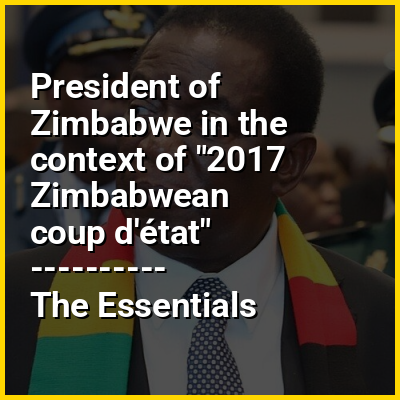
The president of Zimbabwe is the head of state and head of government of Zimbabwe. The president chairs the national cabinet and is the chief commanding authority of the Zimbabwe Defence Forces. The incumbent president is Emmerson Mnangagwa, who was installed on 24 November 2017 after his predecessor, Robert Mugabe, resigned in the aftermath of the 2017 coup d'état.
HINT:
In this Dossier
- ⭐ Core Definition: President of Zimbabwe
- President of Zimbabwe in the context of Cabinet of Zimbabwe
- President of Zimbabwe in the context of Robert Mugabe
- President of Zimbabwe in the context of Emmerson Mnangagwa
- President of Zimbabwe in the context of Politics of Zimbabwe
- President of Zimbabwe in the context of Vice-President of Zimbabwe
- President of Zimbabwe in the context of Prime Minister of Zimbabwe
- President of Zimbabwe in the context of 2018 Zimbabwean general election
- President of Zimbabwe in the context of 2023 Zimbabwean general election
- President of Zimbabwe in the context of Zimbabwe National Army
President of Zimbabwe in the context of Cabinet of Zimbabwe
The Cabinet of Zimbabwe is the executive branch of the government of Zimbabwe, responsible for advising the President and implementing national policies. It consists of the President, who serves as its head, the two Vice-Presidents, and Ministers appointed by the President. The Cabinet plays a central role in the administration of the country, overseeing various ministries and ensuring the execution of laws passed by Parliament. Established under the independence constitution in 1980, the Cabinet has undergone significant transformations, particularly with the shift to an executive presidency in 1987 and the adoption of a new constitution in 2013. It has also been shaped by political agreements, such as the Government of National Unity formed in 2009.
View the full Wikipedia page for Cabinet of ZimbabwePresident of Zimbabwe in the context of Robert Mugabe
Robert Gabriel Mugabe (/mʊˈɡɑːbi/; Shona: [muɡaɓe]; 21 February 1924 – 6 September 2019) was a Zimbabwean revolutionary and politician who served as the leader of Zimbabwe from 1980 until he was deposed in a coup in 2017. He served as the first Prime Minister of Zimbabwe from internationally recognised independence in 1980 to 1987, then as the second president of Zimbabwe from 1987 to 2017. He was also the Leader of the Zimbabwe African National Union (ZANU) from 1975 to 1980 and led its successor political party, the ZANU – Patriotic Front (ZANU–PF) as its First Secretary, from 1980 to 2017. Ideologically an African nationalist, during the 1970s and 1980s he identified as a Marxist–Leninist, and from the 1990s as a socialist.
Mugabe was born to a poor Shona family in Kutama, then in Southern Rhodesia. Educated at Kutama College and the University of Fort Hare, he worked as a schoolteacher. Angered by white minority rule of his homeland within the British Empire, Mugabe embraced Marxism and joined African nationalists calling for an independent state controlled by the black majority. After making antigovernmental comments, he was convicted of sedition and imprisoned between 1964 and 1974. On release, he fled to Mozambique, established his leadership of ZANU, and oversaw its role in the Rhodesian Bush War, fighting Ian Smith's predominantly white government. He reluctantly participated in peace talks in the United Kingdom that resulted in the Lancaster House Agreement, putting an end to the war. In the 1980 general election, Mugabe led ZANU-PF to victory, becoming prime minister when the country, now renamed Zimbabwe, gained internationally recognised independence later that year. Mugabe's administration expanded healthcare and education and—despite his professed desire for a socialist society—adhered largely to mainstream economic policies.
View the full Wikipedia page for Robert MugabePresident of Zimbabwe in the context of Emmerson Mnangagwa
Emmerson Dambudzo Mnangagwa (US: /mənəŋˈɡɑːɡwə/ mə-nəng-GAH-gwə, Shona: [m̩naˈᵑɡaɡwa]; born 15 September 1942) is a Zimbabwean politician who has served as the president of Zimbabwe since 2017. A member of ZANU–PF and a longtime ally of former president Robert Mugabe, he held a series of cabinet portfolios and he was Mugabe's first-vice president from 2014 until 2017, when he was dismissed before coming to power in a coup d'état. He secured his first full term as president in the disputed 2018 general election. Mnangagwa was re-elected in the 2023 Zimbabwean general election with 52.6% of the vote.
Mnangagwa was born in 1942 in Shabani, Southern Rhodesia, to a large Shona family. His parents were farmers, and in the 1950s he and his family were forced to move to Northern Rhodesia because of his father's political activism. There he became active in anti-colonial politics, and in 1963 he joined the newly formed Zimbabwe African National Liberation Army, the militant wing of the Zimbabwe African National Union (ZANU). He returned to Rhodesia in 1964 as leader of the "Crocodile Gang", a group that attacked white-owned farms in the Eastern Highlands. In 1965, he bombed a train near Fort Victoria (now Masvingo) and was imprisoned for ten years, after which he was released and deported to the recently independent Zambia. He later studied law at the University of Zambia and practiced as an attorney for two years before going to Mozambique to rejoin ZANU. In Mozambique, he was assigned to be Robert Mugabe's assistant and bodyguard and accompanied him to the Lancaster House Agreement which resulted in Zimbabwe's recognised independence in 1980.
View the full Wikipedia page for Emmerson MnangagwaPresident of Zimbabwe in the context of Politics of Zimbabwe
The politics of Zimbabwe occurs in a society deeply divided along lines of race, ethnicity, gender and geography. The ZANU–PF party has historically been dominant in Zimbabwe politics. The party, which was led by Robert Mugabe from 1980 to 2017, has used the powers of the state to intimidate, imprison and otherwise hobble political opposition in Zimbabwe, as well as use state funds and state media to advance the interests of the party.
Per the 2013 Constitution, Zimbabwe is a full presidential republic, whereby the President is the head of state and government. Executive power is exercised by the government. Legislative power is vested in both the government and parliament. The status of Zimbabwean politics has been thrown into question by a 2017 coup.
View the full Wikipedia page for Politics of ZimbabwePresident of Zimbabwe in the context of Vice-President of Zimbabwe
The vice-president of Zimbabwe is the second highest political position obtainable in Zimbabwe. Between 1987 and 1990, there was a provision for only one vice-president; since 1990 there is a provision for two. The vice-presidents are appointed by the president of Zimbabwe, and are designated as "First" and "Second" in the Constitution of Zimbabwe; the designation reflects their position in the presidential order of succession.
Under the ruling ZANU–PF party, the vice-presidential post ranked first in the order of succession has traditionally been reserved for a representative of the party's historical ZANU wing (mainly ethnic Shona), while the other vice-presidential post has gone to a representative of the party's historical ZAPU wing (mainly ethnic Northern Ndebele).
View the full Wikipedia page for Vice-President of ZimbabwePresident of Zimbabwe in the context of Prime Minister of Zimbabwe
The prime minister of Zimbabwe was a political office in the government of Zimbabwe that existed on two occasions. The first person to hold the position was Robert Mugabe from 1980 to 1987 following independence from the United Kingdom. He took office when Southern Rhodesia became the Republic of Zimbabwe on 18 April 1980. This position was abolished when the constitution was amended in 1987 and Mugabe became president of Zimbabwe, replacing Canaan Banana as the head of state while also remaining the head of government. The office of prime minister was restored in 2009 and held by Morgan Tsvangirai until the position was again abolished by the 2013 Constitution of Zimbabwe.
View the full Wikipedia page for Prime Minister of ZimbabwePresident of Zimbabwe in the context of 2018 Zimbabwean general election
General elections were held in Zimbabwe on 30 July 2018 to elect the President and members of both houses of Parliament. Held eight months after the 2017 coup d'état, the election was the first since independence in which former President Robert Mugabe was not a candidate.
ZANU–PF, the country's ruling party, went into the election with majorities in both the National Assembly and the Senate. The main opposition, the Movement for Democratic Change – Tsvangirai, contested the election as part of the MDC Alliance, a coalition that included the MDC–T and six smaller parties. The election gave ZANU–PF control of both houses in the 9th Parliament of Zimbabwe, though with reduced majorities in each. The MDC Alliance gained seats in both houses, closely corresponding to ZANU–PF's losses.
View the full Wikipedia page for 2018 Zimbabwean general electionPresident of Zimbabwe in the context of 2023 Zimbabwean general election
General elections were held throughout Zimbabwe on 23 and 24 August 2023 to elect the president, legislators and councillors. The main race for presidential office was between two candidates of Karanga origin: ZANU–PF's Emmerson Mnangagwa and Citizens Coalition for Change's Nelson Chamisa.
The presidential election was won by the incumbent president Mnangagwa, while the governing ZANU–PF party won a majority of seats in parliament, with observer bodies describing the elections as not being free and fair.
View the full Wikipedia page for 2023 Zimbabwean general electionPresident of Zimbabwe in the context of Zimbabwe National Army
The Zimbabwe National Army (ZNA) is the primary branch of the Zimbabwe Defence Forces responsible for land-oriented military operations. It is the largest service branch under the Zimbabwean Joint Operations Command (JOC). The modern army has its roots in the Rhodesian Army, which was raised between 1963 and 1964 after the breakup of the Federation of Rhodesia and Nyasaland. A Joint High Command created in March 1980 to oversee integration of the formerly belligerent Rhodesian Security Forces, Zimbabwe African National Liberation Army (ZANLA), and the Zimbabwe People's Revolutionary Army (ZIPRA) officially established the Zimbabwe National Army in late 1980, nearly a year after the end of the Rhodesian Bush War.
The mission statement of the army is "to defend the sovereignty, territorial integrity and national interests of Zimbabwe and to contribute to international peace and security" a mandate the force has been able live up to in the region. It is considered an integral component of the JOC, and falls under the ultimate authority of the President of Zimbabwe. The ZNA is directed by a Chief of the Army, the senior official being an Army Chief of Staff. Zimbabwe's highest ranking army officer as of 29 March 2025 is Lt. Gen. Emmanuel Matatu. In 2011, Harare continued to maintain a statutory strength of 40,000 active personnel; actual numbers hover closer to 30,000.
View the full Wikipedia page for Zimbabwe National Army