Power of Women in the context of The tale of Phyllis and Aristotle


Power of Women in the context of The tale of Phyllis and Aristotle

⭐ Core Definition: Power of Women

The "Power of Women" (German: Weibermacht) is a medieval and Renaissance artistic and literary topos, showing "heroic or wise men dominated by women", presenting "an admonitory and often humorous inversion of the male-dominated sexual hierarchy". It was defined by Susan L. Smith as "the representational practice of bringing together at least two, but usually more, well-known figures from the Bible, ancient history, or romance to exemplify a cluster of interrelated themes that include the wiles of women, the power of love, and the trials of marriage". Smith argues that the topos is not simply a "straightforward manifestation of medieval antifeminism"; rather, it is "a site of contest through which conflicting ideas about gender roles could be expressed".

Smith argues the topos originates in classical literature and finds it in medieval texts such as Aucassin et Nicolette, The Consolation of Philosophy, the Roman de la Rose, and the Canterbury Tales. The topos was attacked by Christine de Pizan around 1400, who argued that if women wrote these accounts their interpretations would be different from those of men.
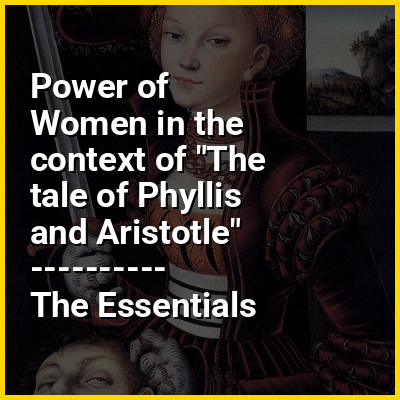
↓ Menu
HINT:

In this Dossier

Power of Women in the context of Tomyris

Tomyris (/ˈtɒmɪrɪs/; Saka: *Taumuriyah; Ancient Greek: Τόμυρις, romanizedTómuris; Latin: Tomyris) also called Thomyris, Tomris, or Tomiride, was a queen of the Massagetae who ruled in the 6th century BCE. Tomyris is known only from the writings of the Greek historian Herodotus, according to whom she led her armies to defend against an attack by Cyrus the Great of the Achaemenid Empire, and defeated and killed him in 530 BC. She is not mentioned in the few other early sources covering the period, especially Ctesias.

Tomyris became a popular subject in European art and literature during the Renaissance. In visual art, she was typically depicted either receiving the head of Cyrus or placing it into a vessel filled with blood, a motif derived from one version of the accounts. This theme belonged to the 'Power of Women' tradition in Renaissance art, which celebrated women who triumphed over men in various ways.

View the full Wikipedia page for Tomyris
↑ Return to Menu