Political status of Kosovo in the context of "Constitution of Kosovo"

Play Trivia Questions online!

or

Skip to study material about Political status of Kosovo in the context of "Constitution of Kosovo"

Ad spacer

⭐ Core Definition: Political status of Kosovo

The political status of Kosovo, also known as the Kosovo question, is the subject of a long-running political and territorial dispute between the Serbian (and previously, Yugoslav) government and the Government of Kosovo, stemming from the breakup of Yugoslavia (1991–92) and the ensuing Kosovo War (1998–99). In 1999, the administration of the Autonomous Province of Kosovo and Metohija was handed on an interim basis to the United Nations under the terms of UNSCR 1244, which ended the Kosovo conflict of that year. That resolution reaffirmed Serbia's territorial integrity over Kosovo but required the UN administration to promote the establishment of 'substantial autonomy and self-government' for Kosovo, pending a 'final settlement' for negotiation between the parties.

The UN-sponsored talks began in February 2006, and though no agreement was reached between the parties, a proposal from UN Special Envoy Martti Ahtisaari was presented in May 2007, which recommended 'supervised independence' for the province. After several weeks of discussions at the United Nations General Assembly in New York, the representatives of the United States, the United Kingdom, and other European members of the United Nations Security Council formally 'discarded' a draft resolution backing the Ahtisaari Plan on 20 July 2007, as they had failed to secure Russian backing.
↓ Menu

>>>PUT SHARE BUTTONS HERE<<<

👉 Political status of Kosovo in the context of Constitution of Kosovo

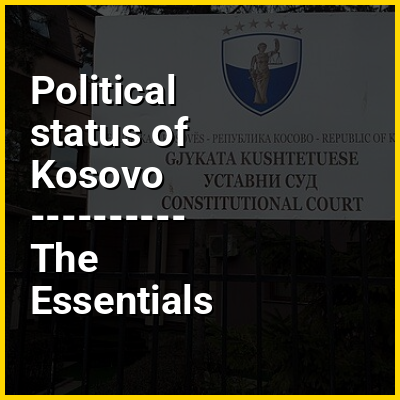
The Constitution of Kosovo (Albanian: Kushtetuta e Kosovës, Serbian: Устав Косовa / Ustav Kosova) is the supreme law (article 16) of the Republic of Kosovo, a territory of unresolved political status. Article four of the constitution establishes the rules and separate powers of the three branches of the government. The unicameral Assembly of the Republic exercises the legislative power, the executive branch led by the president and the prime minister which are responsible for implementing laws and the judicial system headed by the Supreme Court.

The constitution was signed on 7 April 2008 at 13:00 local time at the national library in Pristina. The constitution was ratified on 9 April and came to effect on 15 June 2008.

↓ Explore More Topics
In this Dossier

Political status of Kosovo in the context of Serbia

Serbia, officially the Republic of Serbia, is a landlocked country in Southeast and Central Europe. Located in the Balkans, it borders Hungary to the north, Romania to the northeast, Bulgaria to the southeast, North Macedonia to the south, Croatia to the northwest, Bosnia and Herzegovina to the west, and Montenegro to the southwest. Serbia also claims to share a border with Albania through the disputed territory of Kosovo. Serbia has about 6.6 million inhabitants, excluding Kosovo. Serbia's capital, Belgrade, is also the largest city in the country.

Continuously inhabited since the Paleolithic age, the territory of modern-day Serbia faced Slavic migrations in the 6th century. Several regional states were founded in the Early Middle Ages and were at times recognised as tributaries to the Byzantine, Frankish and Hungarian kingdoms. The Serbian Kingdom obtained recognition by the Holy See and Constantinople in 1217, reaching its territorial apex in 1346 as the Serbian Empire. By the mid-16th century, the Ottoman Empire annexed the entirety of modern-day Serbia; their rule was at times interrupted by the Habsburg Empire, which began expanding towards Central Serbia from the end of the 17th century while maintaining a foothold in Vojvodina. In the early 19th century, the Serbian Revolution established the nation-state as the region's first constitutional monarchy, which subsequently expanded its territory.

↑ Return to Menu

Political status of Kosovo in the context of Autonomous Province of Kosovo and Metohija

The Autonomous Province of Kosovo and Metohija (Serbian: Косово и Метохиja, romanizedKosovo i Metohija; Albanian: Kosova dhe Metohia), commonly known as Kosovo (Serbian: Косово; Albanian: Kosova) and abbreviated to Kosmet (from Kosovo and Metohija; Serbian: Космет) or KiM (Serbian: КиМ), is an autonomous province that occupies the southernmost corner of Serbia. However, the territory is the subject of an ongoing political and territorial dispute between the Republic of Serbia and the partially recognised Government of Kosovo, with the APKM being viewed as the de jure interpretation of the territory under Serbian law; however, the Serbian government currently does not control the territories because they are administered by the Republic of Kosovo. Its claimed administrative capital and largest city is Pristina.

The territory of the province, as defined by Serbian laws, lies in the southern part of Serbia and covers the regions of Kosovo and Metohija. The territory was previously an autonomous province of Serbia during Socialist Yugoslavia (1946–1990), and acquired its current status in 1990. The province was governed as part of Serbia until the Kosovo War (1998–99), when it came under United Nations (UN) administration in accordance with United Nations Security Council Resolution 1244, but still remained internationally recognized as part of the then Federal Republic of Yugoslavia. On 17 February 2008, representatives of the people of Kosovo (Albanian: Udhëheqësit e popullit tonë, të zgjedhur në mënyrë demokratike) unilaterally and extra-institutionally declared Kosovo's independence, which is internationally recognized by 108 UN members. While it is de facto independent from Serbia, Serbia still regards it as its province.

↑ Return to Menu

Political status of Kosovo in the context of Republic of Serbia

Serbia, officially the Republic of Serbia, is a landlocked country in Southeast and Central Europe. Located in the Balkans, it borders Hungary to the north, Romania to the northeast, Bulgaria to the southeast, North Macedonia to the south, Croatia to the northwest, Bosnia and Herzegovina to the west, and Montenegro to the southwest. Serbia also claims to share a border with Albania through the disputed territory of Kosovo. Serbia has about 6.6 million inhabitants, excluding Kosovo. Serbia's capital, Belgrade, is also the largest city in the country.

Continuously inhabited since the Paleolithic age, the territory of modern-day Serbia, then part of Roman Empire Illyria, Dacia, Moesia, Praevalitana, Dardania, and Pannonia, faced Slavic migrations in the 6th century. Several regional states were founded in the Early Middle Ages and were at times recognised as tributaries to the Byzantine, Frankish and Hungarian kingdoms. The Serbian Kingdom obtained recognition by the Holy See and Constantinople in 1217, reaching its territorial apex in 1346 as the Serbian Empire. By the mid-16th century, the Ottoman Empire annexed the entirety of modern-day Serbia; their rule was at times interrupted by the Habsburg Empire, which began expanding towards Central Serbia from the end of the 17th century while maintaining a foothold in Vojvodina. In the early 19th century, the Serbian Revolution established the nation-state as the region's first constitutional monarchy, which subsequently expanded its territory.

↑ Return to Menu

Political status of Kosovo in the context of Islam in Serbia

Serbia is a Christian majority country, with Islam being a minority faith representing around 4.2% of the total population (excluding the disputed region of Kosovo, in which Islam is the predominant faith) as per the 2022 census. Islam spread to Serbia during the three centuries of Ottoman rule. The Muslims in Serbia are mostly ethnic Bosniaks, Albanians and significant part of Muslim Roma as well as members of the smaller groups, like ethnic Muslims, Gorani and Serbs (Čitaci).

↑ Return to Menu

Political status of Kosovo in the context of List of top-division football clubs in UEFA countries

The Union of European Football Associations (UEFA) is the administrative and controlling body for European football. It consists of 55 member associations, each of which is responsible for governing football in their respective countries.

All widely recognised sovereign states located entirely within Europe are members, with the exceptions of the United Kingdom, Monaco and Vatican City. Eight states partially or entirely outside Europe are also members: Armenia, Azerbaijan, Cyprus, Georgia, Israel, Kazakhstan, Russia and Turkey. The United Kingdom is divided into the four separate football associations of England, Northern Ireland, Scotland, and Wales; each association has a separate UEFA membership. The Faroe Islands, an autonomous country of the Kingdom of Denmark, also has its own football association which is a member of UEFA. The football association of Gibraltar, a British Overseas Territory, was approved as a member by UEFA in 2013. Kosovo was approved as a member in 2016, even though it is claimed by Serbia and is not recognised by several other UEFA member states.

↑ Return to Menu