Placentia Bay in the context of Cape Shore


Placentia Bay in the context of Cape Shore

⭐ Core Definition: Placentia Bay

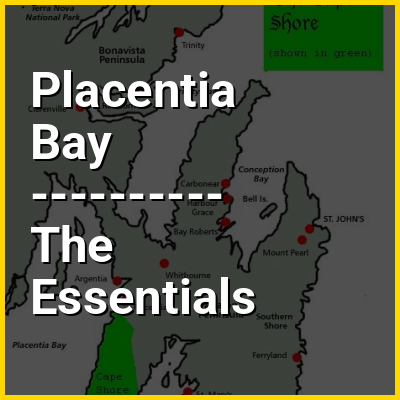
Placentia Bay (French: Baie de Plaisance) is a body of water on the southeast coast of Newfoundland, Canada. It is formed by Burin Peninsula on the west and Avalon Peninsula on the east. Fishing grounds in the bay were used by native people long before the first European fishermen arrived in the 16th century. For a time, the French controlled the bay. They built their capital at Placentia on the east coast. The British gained Placentia during the Treaty of Utrecht in 1713. The town and nearby Castle Hill are national historic sites. English settlement followed in the bay and today the main communities are Burin, Marystown, and Placentia.

On 14 August 1941 US Naval Station Argentia located in Little Placentia Sound was the site of the Atlantic Conference for the Atlantic Charter, where Winston Churchill and Franklin D. Roosevelt met face to face for the first time since both took office and the start of World War II.
↓ Menu
HINT:

👉 Placentia Bay in the context of Cape Shore

The Cape Shore is a region on the southwestern portion of the Avalon Peninsula on the island of Newfoundland, Canada.

Often confused or conflated with the Southern Shore (a rural district with strong Irish-Newfoundland heritage stretching south from St. John's to Trepassey), the Cape Shore is similarly rural and populated by Irish Newfoundlanders, but is geographically distinct. It is named for Cape St. Mary's, the southeastern tip of Placentia Bay, celebrated in the famous Newfoundland ballad Let Me Fish Off Cape St. Mary's.

↓ Explore More Topics
In this Dossier

Placentia Bay in the context of Avalon Peninsula

The Avalon Peninsula (French: Péninsule d'Avalon) is a large peninsula that makes up the southeast portion of the island of Newfoundland in Canada. It is 9,220.61 square kilometres (3,560.10 sq mi) in size.

The peninsula is home to 270,348 people, about 52% of the province's population, according to the 2016 Canadian census. The peninsula is the location of St. John's, the provincial capital and largest city. It is connected to the main section of the island by the 5 km (3 mi) wide Isthmus of Avalon. The peninsula protrudes into the rich fishing zones near the Grand Banks. Its four major bays (Trinity Bay, Conception Bay, St. Mary's Bay and Placentia Bay) have long been the centre of Newfoundland's fishing industry.

View the full Wikipedia page for Avalon Peninsula
↑ Return to Menu

Placentia Bay in the context of Burin Peninsula

The Burin Peninsula (/ˈbjʊərɪn/ BURE-in) is a peninsula located on the south coast of the island of Newfoundland in the province of Newfoundland and Labrador. Marystown is the largest population centre on the peninsula.

The Burin Peninsula extends to the southwest from the main island of Newfoundland, separating Fortune Bay to the west from Placentia Bay to the east. It measures approximately 130 km (81 mi) in length and between 15 and 30 kilometres (9.3–18.6 mi) in width. It is connected by a 30 km (19 mi) wide isthmus between Terrenceville and Monkstown.

View the full Wikipedia page for Burin Peninsula
↑ Return to Menu

Placentia Bay in the context of Trinity Bay (Newfoundland and Labrador)

Trinity Bay is a large bay on the northeastern coast of Newfoundland in the Canadian province of Newfoundland and Labrador. The Bay along with Placentia Bay to the southwest define the isthmus of Avalon from which the Avalon Peninsula lies to the east of the main landmass of Newfoundland Island. The maximum depth of the bay is about 580 metres (1,900 ft).

Major fishing communities include Trinity and Heart's Content. The smaller communities in Newfoundland may often be referenced by the Bay in which they are located, e.g.: 'Brownsdale, TB'.

View the full Wikipedia page for Trinity Bay (Newfoundland and Labrador)
↑ Return to Menu

Placentia Bay in the context of Burin, Newfoundland and Labrador

Burin (/ˈbjʊərɪn/ BURE-in) is a town on the Burin Peninsula in Placentia Bay, Newfoundland and Labrador, Canada. The Burin Peninsula is often affectionately nicknamed "The Boot" due to its resemblance to the footwear when seen on a map, with the town of Burin located near the "heel". Burin is approximately 318 km from the capital of St. John's. Settlement in Burin dates to the early 18th century, although documentary evidence indicates that French fishermen had been fishing and exploring the area even earlier.

View the full Wikipedia page for Burin, Newfoundland and Labrador
↑ Return to Menu